


January 2, 2020
It’s hard to remember life before social media platforms popped on the scene and revolutionized how we communicate with others and how we express ourselves.
Social media was once a place where friend networks were in the thousands. And let’s be honest, it’s not like many people would actually know that number of people in real life. Photos, status updates, and videos became public knowledge, instead of an intimate moment shared between friends. Fast forward to 2019, and we’re seeing a shift in how and why people use social media.
Social media is evolving
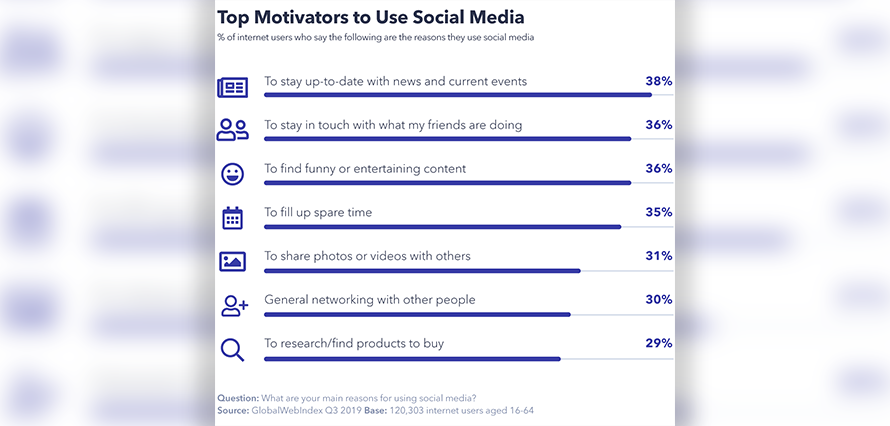
Social media has transitioned from a place where people mainly kept in touch with friends to one of content consumption. GlobalWebIndex’s global research reinforces this, revealing that the primary reason to use social media is to stay up-to-date with news and current affairs (38%), just overtaking staying in touch with family and friends (36%).
Entertaining content is also a huge draw – 36% of global internet users turn to social media to find funny or entertaining content, making it the third biggest reason to use social media and one which has gradually increased in importance over the years. A further 29% of consumers use social media to research/find products to buy.
Essentially, social media has become a one-stop-shop for our daily needs – from entertainment to shopping – and everything in between. This has given rise to a new form of private sharing – dark social.
In the dark
The term “dark social” refers to sharing on private, often untracked spaces like messaging apps, SMS, or email. In a recent bespoke survey in the U.S. and UK, we found consumers primarily share information/content with friends and family via private messaging apps (58%). This came ahead of all other forms of sharing including posting on social media accounts, SMS, in person, and by email.
One of the primary reasons behind this is because consumers feel more comfortable “being themselves” when sharing privately, rather than sharing publicly to a mass of followers. In an age of oversharing and information overload, it makes sense why consumers turn to private, more comfortable spaces to share with those they have genuine relationships with and trust.
As a result, many brands may be overlooking a significant portion of social sharing about their products, and it means they need to shake up their social media strategies to reach consumers effectively. Using “dark social” channels presents some challenges for brands, especially when it comes to accurately tracking ROI, but it also opens up an exciting opportunity to potentially engage consumers in a more meaningful way.
When approaching consumers in this more private, intimate space, it’s vital that brands do so with a genuine purpose. In the case of Starbucks, the company engaged loyal fans to get their opinion on product development, engaging consumers in a sincere way and creating meaningful conversations.
Even though the term “dark social” might seem intimidating at first, it offers brands and marketers the opportunity to build deeper connections with its consumers, providing that it’s done in the right way with consumer privacy front-of-mind.
Katie Gilsenan, Senior Trends Analyst, GWI