


September 4, 2025
The latest data from Buffer has indicated that less isn’t more on LinkedIn after all – and posting more frequently on is key to cutting through the noise.
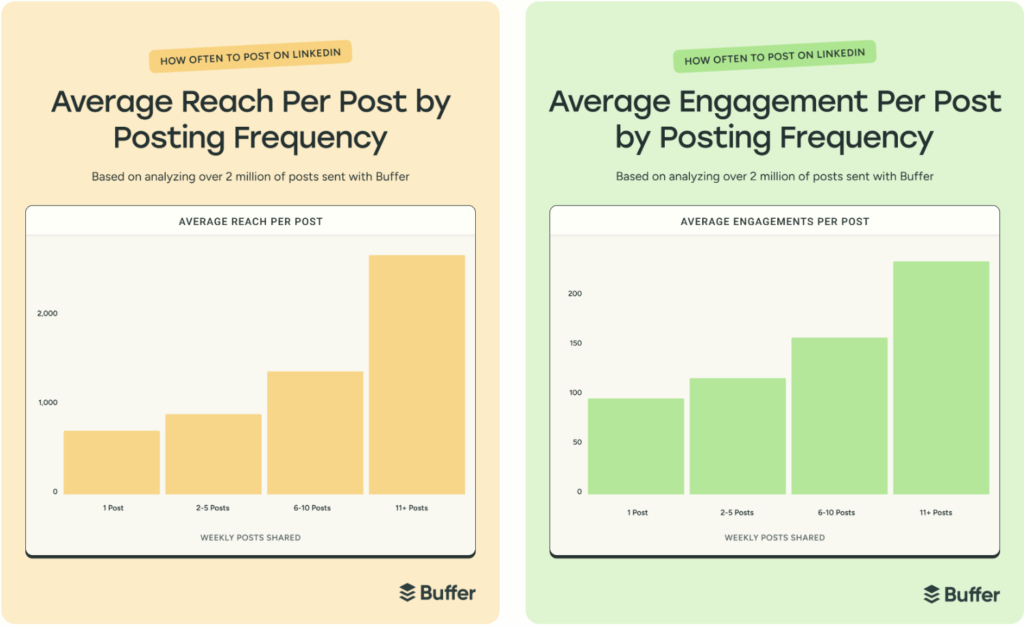
Tamilore Oladipo shared the LinkedIn insights at the end of August – taking data from over 2 million posts scheduled through Buffer to find out the sweet spot for maximal reach and growth.
Now the ‘sweet spot’ we always say is around 2-3 a week max. But Buffer believes that posting up to 5 times can be rewarding too – whether you’re a business page or a personal profile. In fact, 11 times or more could lead to substantial performance uplifts, apparently.
“But doesn’t posting too much put a cap on my reach?”
Well, according to Buffer:
LinkedIn doesn’t “cap” your reach or punish you for posting often. Instead, it compounds your visibility, surfacing more of your content to more people.
So there is an argument here – data driven – that says you should be posting more often than you think. We’ve included their images below for context:
(Source: Buffer)
Anything else worth noting for LinkedIn?
The best performing formats are always going to be mentioned in analysis on posting, and Buffer reiterates the point of carousels being most effective for engagement on LinkedIn. It’s vanity as far as metrics are concerned; making people click through compounds the engagement and leads to very high numbers compared a single text, image or video post – so if you have a CMO who is not clued in to the engagement rate farming that is carousels…use more!
Videos are still renowned for performing strongly too, but there is some subjectivity regarding what length and what classes as an actual video. Anything MP4 will be classed as a video, even if it’s a 10-second animation or 8-second infographic – right the way through to a 45-second talking-head clip. So what the ‘video’ features will impact massively on clicks.
The cynical take
While the data is indeed interesting, it is produced with the intention of making you use Buffer a lot more than you are. This is good for their platform usage figures when trying to get new clients…
While Buffer’s data is not to be questioned – it doesn’t really solve the problem of impactful content that really cuts through the noise. Ultimately, strong engagement levels will lead to an uplift in impressions – not just posting any old crap for the sake of it on a more regular basis.
We always stand by quality over quantity. It’s better to do x2 high quality posts a week than 5 meh ones.
There’s more to think about now too.
Social search is a significant player in the user journey now – keywords, image description and alt text have never been more important.
If you’re looking for info on how to get started, check out our useful guide here.