


March 25, 2026
When your social is too polished to trust
AI is helping marketers move faster. Fair enough. The bigger issue is that it can make weak strategy look polished enough to slip through unchallenged.
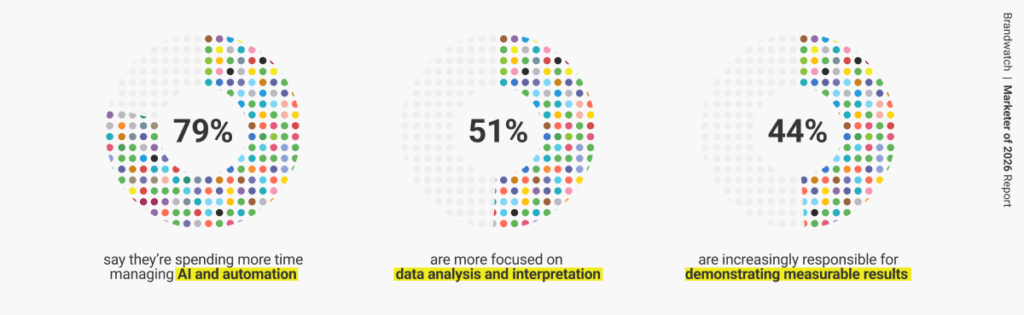
AI is now embedded in the day job. GWI says 84% of advertisers and marketers in the US are already using AI professionally. Brandwatch says 79% of marketers are spending more time managing AI and automation, and 81% say AI tools are now the most essential tool in the marketer’s toolkit. So this is no longer a novelty story. The question is not whether teams are using AI. It is whether AI is helping them understand people better, make sharper decisions, and create better.
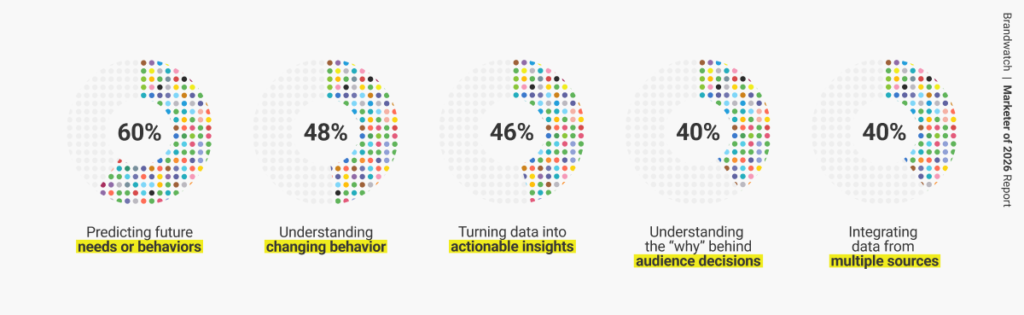
Sorry to throw numbers at you, but this is distressing. Brandwatch says only 25% of marketers say they understand their audience very well. The biggest challenges are still predicting future needs or behaviours at 60%, understanding changing behaviour at 48%, and turning data into actionable insight at 46%. In other words, the machine is arriving faster than the understanding.
That is why I think the real AI problem in social is false confidence. It helps teams get to something polished very quickly, and in busy organisations polished can easily pass for finished. Except it often is not done at all.
The polished trap
You can see the gap in the numbers. GWI says 79% of marketers place value on consumer insights for audience targeting, but only 53% use them often.
For campaign or media planning, 76% say insights matter, yet just 47% use them often. Even more telling, 1 in 2 business decisions are still being made without any consumer insight at all. So yes, AI is accelerating work. It is also turning up in teams where the evidence base is still patchy.
The output sounds sensible because it is built from what the open web already tends to agree on. Buyers want trust. Gen Z care about TikTok. Video matters. Fine. None of that is wrong. It is just not enough to build a point of view that anyone remembers.
Why social matters more now, not less
The odd thing about all this is that AI makes social more important, not less.
Once content is public, it gets summarised, searched, recombined, and quoted out of context. Your posts, comments, interviews, newsletters, captions, and explainers are no longer just outputs. They are source material for discovery.
Brandwatch says 67% of marketers agree consumers are discovering brands through AI and social platforms, not traditional search. 10Fold backs that up from a different angle. In its 2025 research, social media was the top place qualified prospects first hear about a company at 46%, ahead of AI search platforms at 34% and organic search at 30%. At the same time, 65% still distribute content through Google and other browsers, while 56% are also using AI-native platforms like ChatGPT and Perplexity. Discovery is no longer a single lane, which means public content has to work harder across more surfaces.
That is why I think social has become the debugging layer. It is where you see whether the work has impact. The comments show where the message lost clarity. Saves show where it became useful. Shares show what people felt confident passing on. Community chatter and social listening show where your polished answer still sounds like category wallpaper.
The proof problem is getting worse, not easier
Listen up, social is influencing commercial outcomes, but the proof trail is often a bit of a bodge job.
Sprout says 67% of marketing leaders believe social drives brand awareness, 60% say it drives customer acquisition, 58% say customer loyalty, and 56% say revenue.
Yet less than half, 44%, rate their social team as expert at measuring the business impact of social. NIQ adds the wider media context. It says 84% of CMOs cite marketing ROI as a key metric for budget allocation, but 58% are already using up to five measurement tools and another 34% are using between six and 15. That is a lot of dashboards for one supposedly joined-up story.
So when people talk about AI fixing reporting, I get the appeal. But AI cannot magic coherence out of fragmented data. NIQ makes that point very plainly. Digital channels may offer the best performance according to 62% of CMOs, but they are also the most fragmented sources of data. AI can help synthesise and interpret, certainly. What it cannot do is turn messy inputs into trustworthy proof just by making the chart look nicer.
The real edge is better inputs
Others often claim the difference will come from better prompting. Our standard is better source material, clearer thinking, and stronger editorial judgement. Oh and at the latest Fintech roundtable, this point was clearly made my senior marketers.
You need proof: GWI found that when AI is plugged into structured, reliable data, marketers using AI for market research are 71% more likely to report better team alignment, 58% more likely to surface unexpected insights, and 55% more likely to gain deeper customer understanding.
That is a far more useful story than AI saves time. Of course it saves time. The more valuable point is that AI becomes commercially useful when it is connected to evidence the business can trust. Customer language. Search questions. CRM patterns. Sales objections. Listening outputs. Service friction. Performance data with context around it.
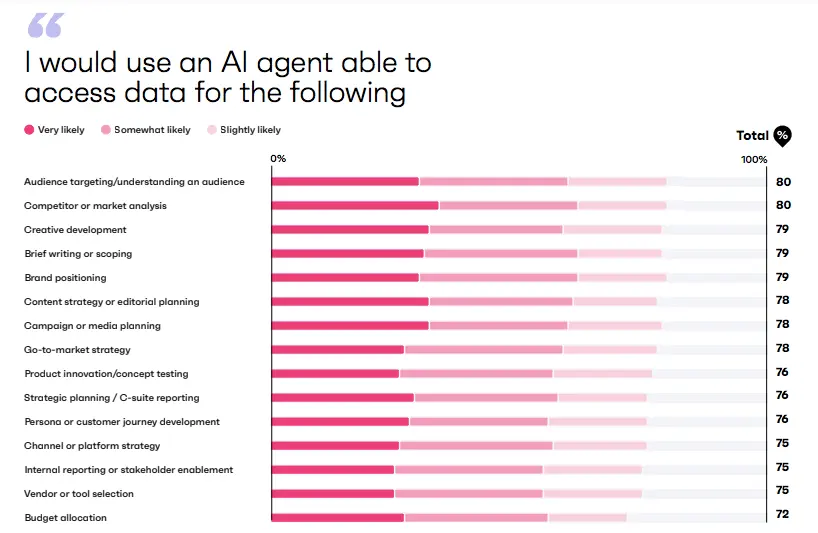
Brandwatch lands a similar point. It says high-performing teams are moving from raw data collection to signal detection across search, social, and traditional media. I like that because it gets us out of the trap of collecting more bits ’n bobs and into the discipline of interpreting what matters.
What to do with all this insight
The answer is not to use less AI out of principle. The answer is to use it with better friction around it and a higher standard for what counts as insight.
You might like to have a read of our 27 things AI can do to help social marketing.
Use AI to surface patterns, contradictions, anomalies, and first cuts. Then pressure-test those against live audience evidence. Check the neat answer against what customers actually ask, what prospects actually search, what sales teams actually hear, and what social conversations actually reveal. If the output still sounds like everyone else in the category, it probably is.
Treat social as part of the operating system. It’s not the dumping ground at the end. If discovery now runs across search, social, and answer engines at the same time, then social content needs clarity, specificity, proof, and repetition with intent. It also needs measurement that connects useful social signals to commercial ones. A smaller, cleaner proof model is worth more than a massive dashboard full of hopeful interpretation.
That is the opportunity in all this. AI is raising the bar on content production, which means the advantage moves elsewhere. It moves to sharper audience understanding, better source material, stronger systems, and the confidence to publish work with an actual point of view.
I find that quite encouraging, actually. It gives social marketers a bigger job, not a smaller one. We are no longer there just to make content and post it. We are there to help the business understand what its audience is doing, what public content is teaching the market, and how credibility gets built before the click.
That is where the best work will come from this year. Not from asking AI for more. From giving it better.
BTW: if you still have questions (and remember integrating AI into marketing is all quite new), then have a read of our AI in marketing FAQs
Sources
https://www.brandwatch.com/reports/marketer/view/?utm_medium=web&utm_campaign=marketer-2026&utm_source=growl https://www.gwi.com/reports/connecting-the-dots https://sproutsocial.com/insights/business-value-of-social-media/ https://nielseniq.com/global/en/insights/report/2025/cmo-outlook-for-2026/ https://10fold.com/wp-content/uploads/2025/09/2025-Content-Survey-Part-II.pdf