


February 25, 2026
Make it weird, make it work
Chaos culture is the internet’s new default language for attention. It sort of is an all-encompassing terms for absurd humour, fast cuts, deliberate mess, meme logic, and a kind of playful nonsense that’s very online. It’s significant because it matches how people behave now, overstimulated, sceptical, scrolling for entertainment, then switching into verification mode when they’re about to spend.
The bit you need to make notes on, is that chaos earns the share, and the share is the modern reach multiplier.

Oh yeah! The feed has changed
Too many consumer brands are still churning social like a broadcast channel. Smooth, polished, benefits-led, a bit samey. The problem is the feed has changed, it’s less a shop window and more a street market. Loud, competitive, full of characters, and heavily influenced by creator pacing.
Hootsuite puts a name on one corner of this shift, Gen Alpha “chaos culture” shaping new content norms. I’d go further. Chaos is spilling into mainstream creative because it’s a coping style, a humour style, and a distribution style all at once.
What chaos culture actually is
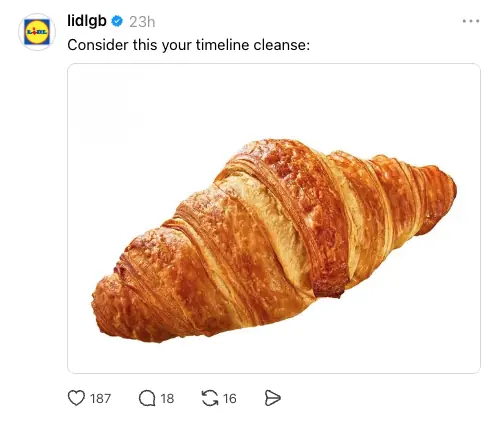
Chaos culture isn’t “random weird” stuff. It’s a recognisable creative pattern.
It’s content that feels like it was made inside the internet rather than translated into it. It borrows from meme behaviour, creator editing styles, and the comment section as a second screen.
Here’s the simplest definition (well that makes sense to us at IF).
Chaos culture is high-salience, low-polish, socially shareable entertainment that signals taste and belonging.
What it tends to look like in the wild
- Absurdist humour and surreal edits, the point is “what did I just watch”, but in a way you want to show someone.
- Imperfection as a trust cue, scuffed captions, lo-fi filming, visible reactions, less brand blah.
- Characters and worlds, mascots, recurring bits, running jokes, lore.
- Comment-led storytelling, posts designed to trigger replies, stitches, duets, quote posts.
This is why it’s different from standard “funny brand” content. It’s not jokes on a brand page. It’s a format that behaves like social.
And, consumer brands need to treat it as a distribution lever, ‘cos that’s where the value is.
The behavioural shift behind it all
So why is this taking off now?
People are managing overstimulation
Chaos is a mirror of how it feels to be online. Too much information, too many tabs, too many decisions. So content that leans into that energy can feel oddly comforting, it says “same”.
There’s a behavioural reason this lands. Distinctiveness is remembered. In a wall of polished sameness, the slightly odd, slightly chaotic piece becomes the thing your brain tags as worth keeping.
Basically, chaos makes memory cheaper, because it creates contrast.
Social has become the reality check
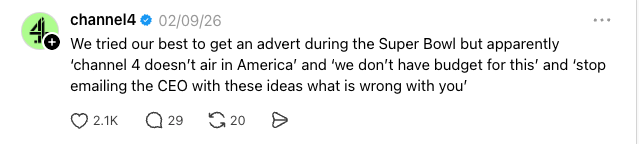
Sprout’s research has repeatedly pointed to social becoming a first stop for information discovery for younger audiences, and Deloitte’s 2025 Digital Media Trends found Gen Z (63%) and millennials (49%) are most likely to say ads or product reviews on social are the most influential to their purchasing decisions.
That’s the behavioural loop brands need to design for.
Entertainment first, then plausibility checks.
Does it work. Is it safe. Is it worth it. Are real people backing it up. Will it arrive. Can I return it.
The thing is, chaos opens the door, and then the decision to buy is in comments, with creators, and in the search for proof.
People are escaping the public feed when it’s time to decide
Public feeds are for discovery and social currency. Private spaces are for decision-making and reassurance.
Simple.
Ofcom’s Online Nation reporting shows how dominant messaging is in the UK, WhatsApp in particular is effectively infrastructure, not a trend.
Chaos is public, conversion is often private, and most brands still treat private as an afterthought.
Here’s why that matters for chaos specifically. Chaos creative gets shared in ways you can’t easily track, screenshot into WhatsApp, copied into iMessage, forwarded in Instagram DMs, posted into small group chats with a “look at this”, then quietly saved for later. That’s dark social in action, the distribution happens off-platform or inside private surfaces where attribution is patchy, but influence is real.
So chaos can create invisible reach. If you only judge it by public likes and comments, you’ll under-rate what it’s doing.
Why this is cutting edge for consumer brands
Chaos is becoming a brand strategy lever because it solves three modern problems at once.
It increases the chance you get shared
The feed is crowded and paid attention is expensive. Sharing is the closest thing to free distribution left, and chaos is built to be share-worthy.
You know, when FDs squeeze paid budgets, the brands that can earn shares keep a growth at least going.
It signals humanity in an era of AI sameness
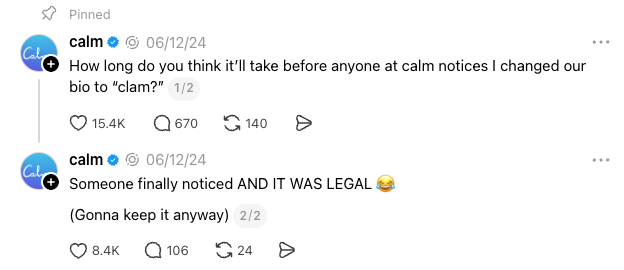
Sprout reports 55% of consumers say they’re more likely to trust brands that commit to publishing content created by humans compared with AI.
Chaos content often reads as human because it’s specific, messy, reactive, and culturally fluent.
Hehehe, in fact the weirder, more human bits can become a trust cue, as long as you don’t fake it.
It creates a stronger “brand world” than single posts ever will
Chaos culture rewards continuity. Running jokes, recurring characters, and serial formats build familiarity. Familiarity reduces perceived risk and increases confidence, which is a buying behaviour.
Who’s already doing it, and why it works
This is not hypothetical. A small group of brands have been testing the edges for years, and they’ve taught the market what “acceptable chaos” looks like.
Duolingo
Duolingo didn’t just make a mascot funny. It built a character with consistency, a universe, and an audience that expects the bit. Adweek and Contagious have covered how this “absurd mascot” approach has become a broader brand playbook.
They turned attention into cultural relevance, and cultural relevance into repeated exposure.
Scrub Daddy and the ‘unhinged mascot’ era
Adweek has reported on brands leaning into absurd mascot behaviour, including Scrub Daddy. The point isn’t that mascots are back. It’s that character-led content gives you repeatable energy and a recognisable visual anchor.
We all know a character is a shortcut to memory, which is why this scales.
Greggs and Aldi, chaos that actually travels
If you want UK examples, look at Greggs and Aldi.
Greggs has built a very British flavour of chaos on TikTok, self-deprecating, deliberately scruffy, and culturally fluent. It’s rarely selling in a straight line; it’s earning affection and repeat exposure by behaving like a creator brand, then letting the comments and stitches carry the distribution.
Aldi is the other obvious reference point. The #FreeCuthbert saga showed how a supermarket can turn a product moment into a running narrative the public wants to follow, then share. More recently, the “Aldeh” store sign in Prestwich became a shareable cultural object in its own right, the kind of offline joke that spreads online because it feels like a wink to the internet.
UK chaos works when it feels locally native, and when there’s a repeatable bit people can pass around in group chats.
Can’t leave out Ryanair, the masters at weaponised self-awareness
Ryanair has spent years proving that lo-fi, self-deprecating, internet-native content can outperform glossy category norms, especially on TikTok.
Honesty, even when it’s comedic, can be more persuasive than polish.
Why micro-drama is the grown-up version of chaos
Micro-drama is where chaos culture meets structured storytelling.
It’s vertical, episodic, cliffhanger-led content built for bingeing in short bursts. It uses big emotion and simple stakes, because that’s what survives the scroll.
This is a commercial format with creative consequences.
Digiday reported micro-dramas are expected to hit $11bn in global revenue, and that Q3 2025 revenue outside China hit $800m, doubling year on year. WARC has also covered the format as a marketer opportunity.
Micro-drama is a proof point that serialised vertical storytelling is becoming its own media channel, with budgets following.
Why it has rewards for brands
- It holds attention longer than single posts, because people want the next beat.
- It creates familiarity fast, recurring characters and repeated exposure.
- It generates conversation, theories, reactions, and re-shares.
- It can carry product or category truth inside a story, which makes persuasion feel less like persuasion.
Micro-drama turns attention into habit, and habit is where preference gets built.
Oh there are risks, though
Chaos is not “free fun”. It carries brand risk, and the risk is the point, it’s why it cuts through.
Brand dilution risk
If the chaos has no relationship to what you sell, you win attention and lose meaning. People remember the bit, not the brand.
Remember, fame without the brand connection is an expensive hobby.
Audience mismatch risk
Chaos culture is strongly tied to Gen Alpha norms. If your buyers skew older, or your category relies on calm authority, chaos can feel like you’ve lost your mind.
Note the creative has to match the moment of choice in your category.
Cringe risk
Sprout research found a third of consumers think brands jumping on viral trends is embarrassing. And it can be.
Trust and safety risk
Some categories have low tolerance for being “cute” with serious topics, health, finance, kids, safety. In those spaces, chaos needs to be carefully aimed at the friction, not the consumer.
If you use chaos, keep your integrity.
Operational risk
Chaos increases comment volume, reply expectations, and scrutiny. If your customer care is slow, your proof is thin, or your supply chain is shaky, chaos simply accelerates disappointment.
Sooooo
Chaos culture is the creative expression of a bigger behavioural shift, entertainment-first feeds, private decision-making, and rising scepticism of polished brand content.
The upside is real, distinctive content can earn distribution, build memory, and create preference faster than beige ever will.
The downside is also real, get it wrong and you look try-hard, confuse your meaning, or expose operational cracks.
As usual, risk and reward come as a pair. The brands that win are the ones who treat chaos as a strategic choice.
If you want to pressure-test whether chaos fits your category and audience, come talk to us. We’ll show you how to make it work
Sources
- https://www.hootsuite.com/research/social-trends
- https://blog.hootsuite.com/social-media-trends/
- https://www.deloitte.com/us/en/insights/industry/technology/digital-media-trends-consumption-habits-survey/2025.html
- https://sproutsocial.com/insights/the-state-of-social-media/
- https://www.ofcom.org.uk/siteassets/resources/documents/research-and-data/online-research/online-nation/2025/online-nations-report-2025.pdf
- https://www.adweek.com/brand-marketing/brands-unhinged-mascot-social-media-mcdonalds-scrub-daddy-duolingo/
- https://www.adweek.com/brand-marketing/duolingo-duo-owl-marketing-strategy/
- https://www.contagious.com/en/article/news-and-views/duolingo-social-media-marketing
- https://www.marketingbrew.com/stories/2026/01/12/liquid-death-social-marketing-strategy
- https://www.theguardian.com/business/article/2024/may/28/liquid-death-the-viral-canned-water-brand-killing-it-with-gen-z
- https://digiday.com/marketing/in-graphic-detail-the-rise-of-micro-dramas-that-are-attracting-big-ad-dollars/
- https://www.warc.com/content/feed/micro-dramas-are-becoming-the-soap-operas-of-the-modern-age/en-GB/11089
- https://www.warc.com/newsandopinion/opinion/inside-the-rise-of-micro-dramas–and-the-opportunities-for-marketers/en-gb/6981
- https://www.theguardian.com/tv-and-radio/2026/feb/18/vertical-drama-phone-films-to-watch
- https://www.businessinsider.com/tiktok-launches-a-new-micro-drama-app-called-pinedrama-2026-1
- https://www.businessinsider.com/fox-partnering-with-dhar-mann-to-win-micro-drama-fans-2026-1