


January 21, 2026
Ten years from Vine loops and Pokémon GO chaos to AI summaries, and why social is where people decide if they trust you now.
Everyone’s suddenly obsessed with 2016 again. The year Snapchat still felt like the future, the Mannequin Challenge, your mate nearly walking into a fountain while catching a Pikachu, and those six-second Vine loops that somehow felt like peak culture.
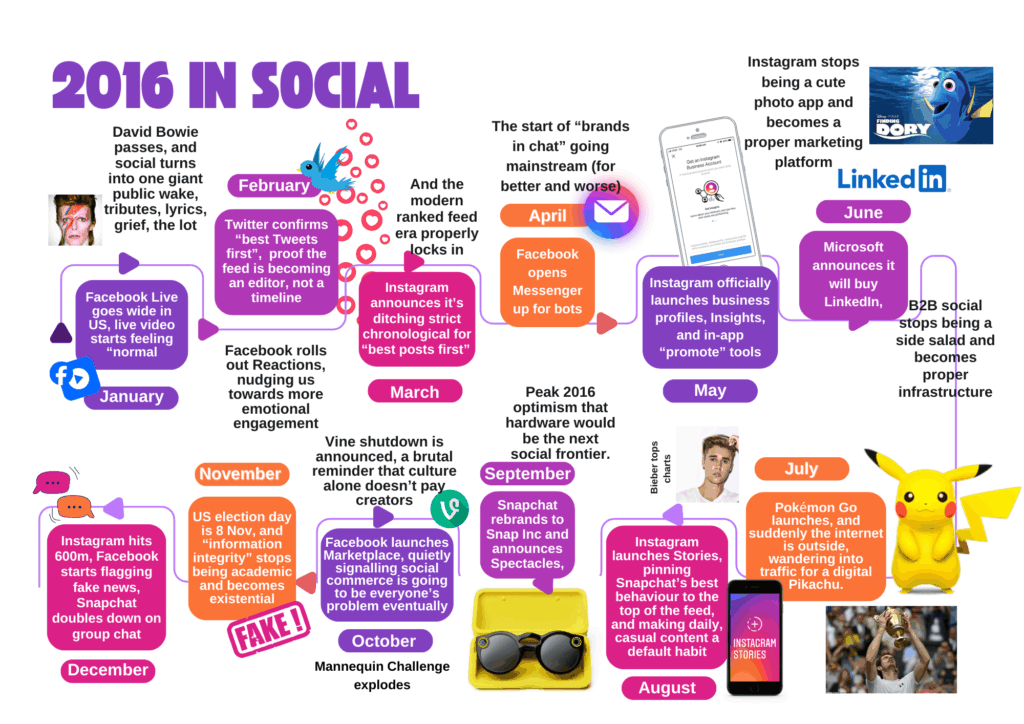
Nostalgia is fine. The more useful truth is that 2016 is when social stopped being a bunch of apps and started behaving like infrastructure. We’ve been doing social at Immediate Future since 2004, which means we watched that switch happen in real time, and we’ve been dealing with the knock-on effects ever since.
2016 made the feed a machine. 2026 has the internet explaining you back to your buyers, whether you like it or not.
Discovery became a system
In 2016 the big debate was chronological versus ranked feeds, and Instagram’s move to algorithmic ranking basically told everyone where this was going. If a platform can decide what you see, it can decide what you believe matters.
Fast forward to 2026 and discovery is no longer one place. It’s feed recommendations, in-platform search, Google snippets, and AI summaries sitting on top of it all. Ofcom’s latest Online Nation work is blunt on this, around 30% of keyword searches now show AI overviews, and 53% of UK adults say they often see AI summaries. That’s passive adoption, people didn’t ask for it, they’re just getting it.
So to be clear (‘cos we love being brutally honest), your brand is being interpreted by machines, then sanity-checked by humans, usually in private. If your story is woolly, the system will happily make something up on your behalf. Cheers.
Scale beat novelty, and we should stop being surprised
2016 was the year “copying wins” became obvious in broad daylight. Instagram Stories landed, and it didn’t need to be more magical than Snapchat. It just needed to be good enough, and sat right there at the top of an app everyone already used.
That pattern never went away. Most features don’t “launch” now, they get bundled into ecosystems, shoved into the UI, and distributed by default. The platform that reduces friction wins. The platform that can pay creators wins. The platform that can sell ads at scale wins.
Threads is basically Meta proving this point with a smirk. It didn’t invent text posting, it just attached it to Instagram’s graph, made it feel familiar, and let distribution do the heavy lifting. It hit 100 million sign-ups in five days, then kept climbing, Meta reported 350m+ monthly actives in April 2025 and 400m+ by August 2025. As of January 2026, Similarweb data cited by The Verge had Threads ahead of X on daily mobile users. Now it’s running ads too, because of course it is.
The good news for brands is you can stop trying to predict the next format and start designing for behaviour. People still want quick meaning, proof, and something worth sharing. They just want it delivered in the least effortful way possible.
Creators became the media
Vine shutting down in 2016 wasn’t just a sad internet funeral. It was a business lesson. Culture without creator economics dies.

Ten years on, creators aren’t just providing the sprinkles. They are the channel. People follow them to filter reality, pick a side, validate a purchase, and feel less alone in the chaos. That’s why creator partnerships work when they’re built on taste and trust, and fall flat when they’re basically a branded caption with a smiling face.
This is also why employee voice matters more than ever in B2B. Buyers don’t want the brand voice to “announce”. They want a human to explain, with enough confidence that it feels safe to forward to a colleague.
Trust got fragile, and measurement had to grow up
2016 was a trust crack year. Fake news didn’t invent misinformation, but it showed how quickly engagement-led distribution can make nonsense feel mainstream. One widely cited academic paper estimated pro-Trump fake stories were shared 30 million times on Facebook in the run-up to the election, versus about 8 million for pro-Clinton stories.
That wasn’t a US-only problem. It changed how everyone thinks about information integrity, privacy, and the ethics of attention. Then the next decade piled on, regulation, tighter privacy controls, platform brand safety theatre, and a general sense from the public that the internet is doing their head in.
So here’s my view, and it’s very 2026. Marketing doesn’t fail because people don’t click. Marketing fails because people can’t validate you. They can’t find your proof, they don’t trust your claims, or they don’t know what applies to them.
This is why we bang on about trust as the KPI. It’s also why we obsess over saves, sends, branded search lift, and time-to-opportunity. Those are confidence signals, and confidence is customers want.
Culture still does the distribution
Pokémon GO was a silly summer headline, and also a preview of participation-led attention. It proved people will move their bodies, change their plans, and drag their friends into something if it feels like a shared moment.
That behaviour never left. We just swapped AR parks for short-form video loops, co-watching, comment sections, and whatever meme format is currently eating your content calendar. And this month’s TikTok move into shared feeds and shared collections basically makes “watching together” an actual product feature, not just something your audience does anyway in DMs.
The positive bit is you don’t need to be a comedian or a trend-hunter to earn attention. You need to create something people want to share because it helps them look smart, feel seen, or make a decision faster.
The real decisions moved into private
In 2016, public virality got the headlines. Quietly, the serious stuff was already shifting into group chats, DMs, Slack threads, and WhatsApp. The places where people say what they really think, with less performance.
In 2026, that’s where buying groups do the work. They forward screenshots, add commentary, ask a colleague, then decide when you’re not in the room. Social is the credibility layer those private conversations draw from.
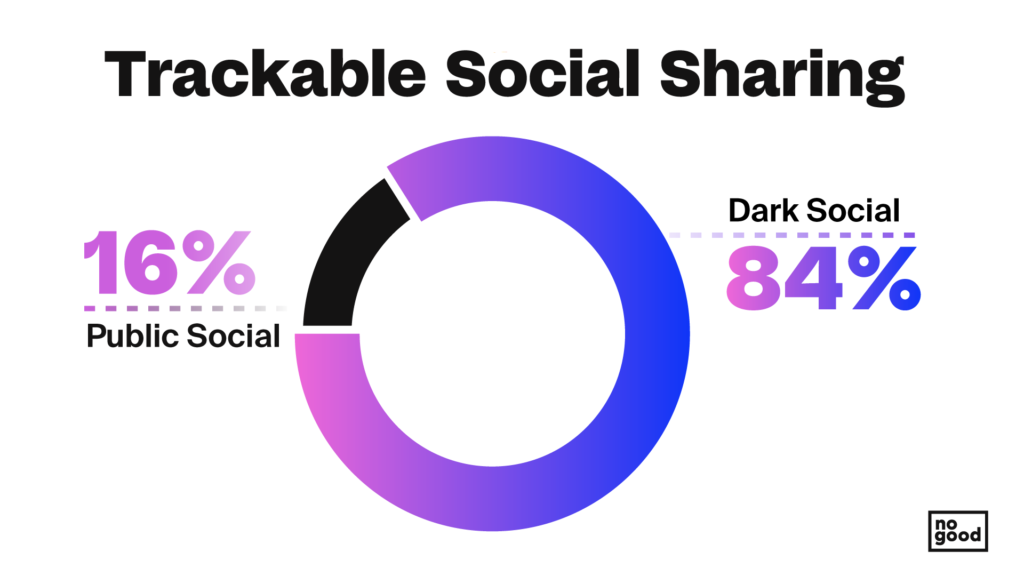
So when someone tells you “social isn’t converting”, half the time they mean “we can’t see what it’s doing”. That’s not the same thing. The job is to make the proof easy to find, consistent across surfaces, and human enough that people feel comfortable sharing it privately.
B2B grew up in public
Microsoft buying LinkedIn in 2016 was a signal that professional social data was strategic infrastructure, not just networking fluff. Ten years later, it’s obvious what that created. B2B discovery happens in public, credibility gets built in comments, and expertise compounds when it shows up consistently from real people.
That’s why we keep saying social is the backbone of marketing. It influences search. It shapes reputation. It feeds demand gen. It turns into sales enablement. It’s where buyers go to reduce risk.
It’s also why bloomin’ beige content is such a waste. If you sound like everyone, the algorithm treats you like everyone, and the humans in the buying group don’t bother forwarding you.
So what do we do with this
The decade from 2016 to 2026 didn’t make social “harder”. It made it more consequential. The systems got smarter, the journeys got messier, and trust became the only real currency.
Our advice stays consistent, and yes it’s annoyingly un-sexy. Build a credibility system, not a content factory. Get your claims straight, your proof visible, your humans active, and your creative distinctive enough that people remember you.
If you want a second pair of eyes on how your brand shows up across feeds, search, and AI summaries, give us a shout. We’ve been doing this long enough to know what changes every month, and what never changes at all.
Sources
- Instagram is switching its feed from chronological to best posts first, TechCrunch, 15 March 2016
https://techcrunch.com/2016/03/15/filteredgram/ - Crunch Report, Instagram launches Stories, TechCrunch, 2 August 2016
https://techcrunch.com/2016/08/02/crunch-report-instagram-launches-stories/ - Pokémon GO passed 100 million installs over the weekend, TechCrunch, 1 August 2016
https://techcrunch.com/2016/08/01/pokemon-go-passed-100-million-installs-over-the-weekend/ - Microsoft to acquire LinkedIn, Microsoft News, 13 June 2016
https://news.microsoft.com/source/2016/06/13/microsoft-to-acquire-linkedin/ - Social media and fake news in the 2016 election, Allcott and Gentzkow, NBER Working Paper 23089
https://www.nber.org/papers/w23089 - From apps to AI search, how the UK goes online in 2025, Ofcom
https://www.ofcom.org.uk/media-use-and-attitudes/online-habits/from-apps-to-ai-search-how-the-uk-goes-online-in-2025 - Online Nations Report 2025, Ofcom PDF
https://www.ofcom.org.uk/siteassets/resources/documents/research-and-data/online-research/online-nation/2025/online-nations-report-2025.pdf