



April 22, 2026
Episodic social is your secret to growth
Most social content is built for one spike. One moment. One shot at the algorithm. Then silence.
Leadership has moved on. They want pipeline, revenue, retention. The mandate is growth. The strategy is still “make it go viral.” (Oh the horror of it!)
Series content outperforms one-off posts by almost 8x. Brands posting less, with more consistency, are seeing higher engagement per post and stronger save behaviour. People come back. They bookmark. They build a habit around you.
Creator programmes run as series tell the same story. 94% of organisations report higher ROI when content runs consistently over time
A series gives you three things a single post never can: continuity, compounding proof, and content that holds its value past the first 48 hours.
Think of it like a thriller. Nobody watches one episode and calls it done. They come back because they need to know what happens next.
The viral fantasy vs the weekly reality
Everyone has chased the viral hit. It lifts reach for a day, flatters the dashboard, and feels brilliant for about 48 hours (oooh and we all love the dopamine hit of big numbers).
But. It rarely helps when you need to show how activity connects to pipeline.
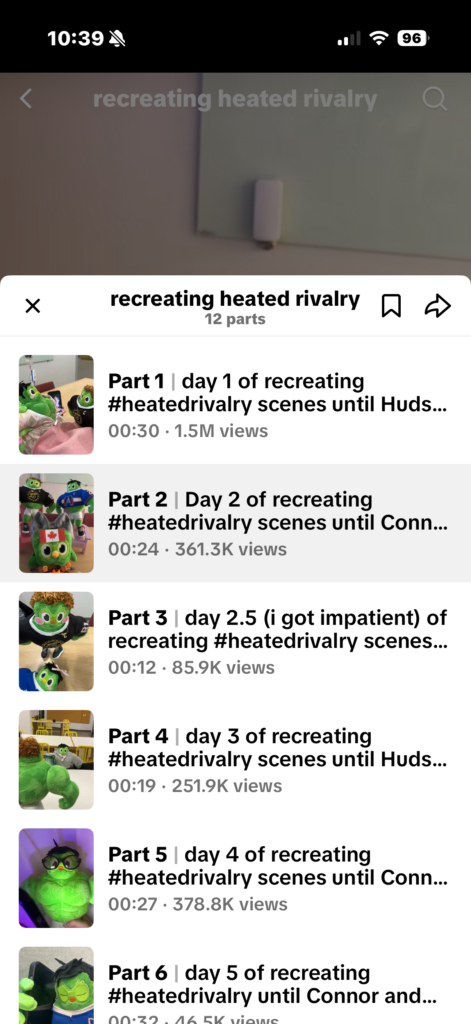
Look at what broadcasters figured out decades ago. They set the bar for episodic craft. Clear arcs, character development, and well-timed cliffhangers are designed to increase completion and bring people back for the next instalment. The value comes from how each episode advances the story and primes the next.
The same principle applies here. Series-based content drives a 71% higher re-engagement rate compared to ad hoc content.
What replaces the spike is a pattern. A repeatable idea people recognise, follow, and return to because they expect the next useful step.
Oh and guess what. episodic content is favored by modern short-form algorithms (TikTok, Reels) because it triggers higher retention, longer watch times, and stronger engagement signals
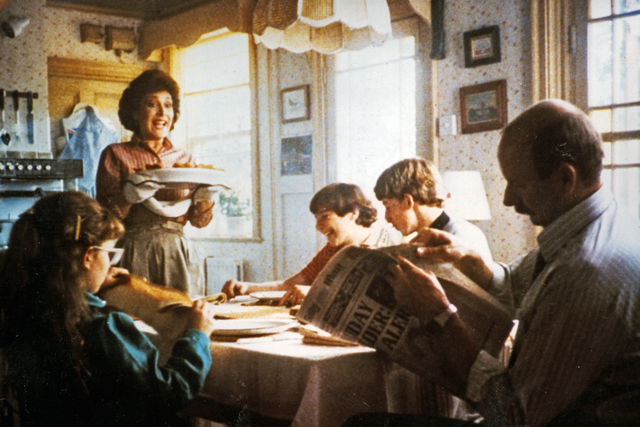
This is not new for brands. Think the BT Beattie ads or the Oxo family. Same characters, same world, each instalment adding context and familiarity. That built memory and preference over time.
That is the value of episodic work. It compounds. People recognise it faster, trust it sooner, and return when they are closer to making a decision.
Why episodic actually works
A series works because it fits how people actually learn and decide, not how we wish they would.
Three behavioural effects do a lot of the heavy lifting.
The mere exposure effect. Repeated contact with the same character, format, or idea builds familiarity. Familiarity builds preference. Not because the content gets better each time, but because recognition itself feels good. The brain reads familiar as safe, and safe as worth paying attention to. BT’s Beattie ran for 32 ads. The Oxo family ran for 16 years. That was not creative stubbornness. That was compounding value over time.
The Zeigarnik effect. Unfinished things stay active in memory longer than resolved ones. Your brain keeps a tab open. That is why a cliffhanger works, why a well-paced series brings people back, and why a content arc with a clear next step can outperform a one-off post that wraps everything up too neatly. Closure feels good. Open loops travel further.
Chunking. When information arrives in recognisable, predictable pieces, it is easier to process and easier to pass on. The structure does part of the cognitive work for the audience. They spend less effort orienting themselves and more effort engaging with the point.
Streaming platforms build around all three on purpose. Open loops. Paced payoffs. Just enough to make the next episode feel worth your time. Around 6 in 10 people admit to binging content in a single sitting. That is not just a guilty habit. It is a useful clue about how attention works now.
The same logic plays out on social. People dip in with intent, check claims, compare options, and return when timing fits. They do not need reintroducing each time. They need the next step in something they already trust.
That is why episodic content lowers the effort required to engage. The structure is familiar. The value is expected. Over time it does a few very useful things for brands:
- it reduces effort so more people get to the point quickly
- it builds memory so you are easier to find again
- it creates a natural reason to come back without starting from zero
The Oxo family never sold stock cubes on their own. It sold the dinner table as somewhere worth being, across years of connected instalments. Each ad added a layer. That emotional residue is exactly what a series builds, and what a one-off post struggles to create.
Gen Z data backs the same point from another angle. Around 34% want educational content, 27% prefer episodic series, and 26% want behind-the-scenes formats. The common thread is not polish. It is predictability of value. When people know what they are going to get from you, they come back without needing to be convinced.
That is what a series gives a brand that a spike rarely can. It builds a habit. Habits become preference. Preference shortens the distance to a decision.
Oh, and momentum beats moments
This is about building momentum, not just posting.
A single post carries all the weight. A sequence gives you room to do the job properly.
The formats that hold attention tend to follow a pattern:
- a clear hook that creates curiosity early
- a developing thread that adds value without resolving everything
- a partial payoff, followed by a reason to continue
That is not accidental. Unfinished ideas stay active in memory, so people are more likely to return.
Translate that into social and it becomes practical: Episode 1 frames the problem Episode 2 explores what matters Episode 3 brings proof or experience Episode 4 answers the questions people are holding back
Each instalment moves the idea forward. That is what creates return behaviour.
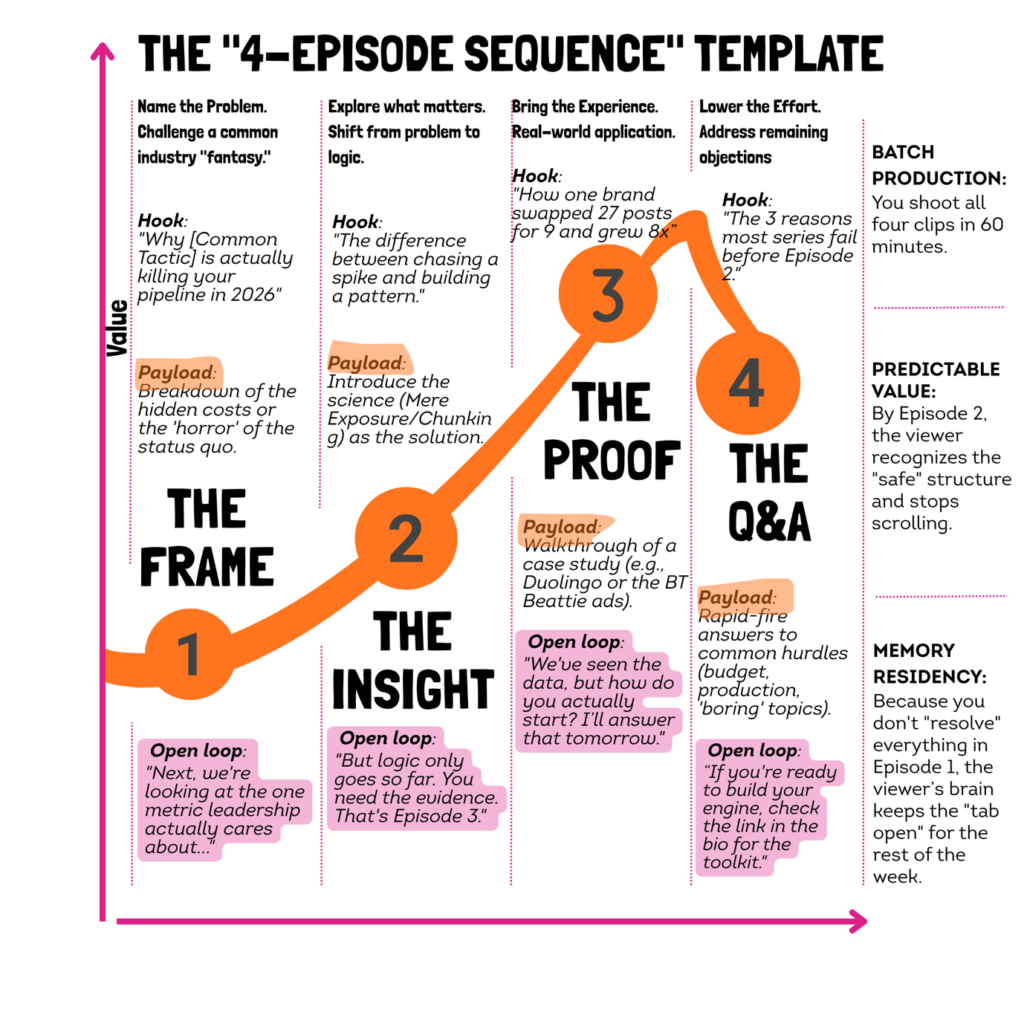
You are not forcing a funnel. You are creating a sequence that helps people move forward in steps.
Episodic content earns its keep
This is where episodic stops being a creative choice and starts looking commercially valuable.
Series-based content improves the signals platforms reward and the signals buyers actually respond to. One 2026 performance study compared 27 standalone posts with 9 episodic videos for the same brand. The standalone posts averaged about 16,000 views. The episodic videos averaged about 126,000. BrightTALK and TechTarget report a 71% higher re-engagement rate for series-based content. Sprout shows 57% of users want brands to prioritise original content series.
That is useful because return behaviour is where value starts to build. Reach introduces you. Return gives the idea time to hit the spot. Repeated exposure makes the message easier to remember. A run of connected posts also gives you more chances to answer the next question someone has before they are ready to act.
It changes what you can point to internally as well. With a one-off post, you mostly have a reaction in the moment. With a sequence, you can start to see whether people come back, whether they watch the next instalment, whether saves rise, whether it gets shared, and whether the same content keeps reappearing in live sales conversations.
That is closer to the kind of evidence commercial leaders actually need. Not perfect attribution, but a clearer picture of how social is helping familiarity build, objections get answered, and momentum carry forward.
There is an operational gain too. One shoot can produce multiple instalments. One creator can front a run of connected content instead of delivering a single spike and disappearing. That gives teams more mileage, more consistency, and fewer blank-page moments.
Where most brands still trip themselves up
The mistake is not choosing the wrong format. It is mistaking repetition for structure.
You see a recurring visual, a repeated headline, a familiar intro. It looks like a series, but there is no real spine underneath it. No clear question the sequence is answering. No progression from one instalment to the next. No sense that the audience is being helped from one stage of understanding to another.
That is where episodic turns into wallpaper.
A useful series earns its keep because each instalment has a role. One opens the issue up. One sharpens the trade-off. One brings proof. One deals with the customer questions. One gives someone the language to explain it to somebody else.
That is also why this matters commercially. The audience is being helped to move from interest to confidence, and from confidence to action.
The practical answer is simpler than most teams make it. Start with one tension the audience is genuinely trying to resolve. Build a recognisable format around that tension. Let the sequence unfold in a way that makes the next step feel obvious.
Then measure the signs that the work is travelling. Saves, shares, return visits, branded search, repeated references in sales conversations. Those are the signals that the series is doing more than filling the feed.
The story the business can understand
This is a stronger conversation to have internally because it is not about making more content. It is about making social easier to defend.
Think of Thriller. Not the song. The video. Fourteen minutes long, cinematic, layered, and deliberately unresolved. It did not just promote the album. It built a world people wanted to come back to. MTV had to tell viewers when it would air again because demand was that high. The story created the pull.
That is the standard. Not more content. Better constructed content that holds attention and gives people a reason to return.
A series gives you something far more useful than a handful of isolated wins. It gives you a body of work that builds familiarity, carries proof across time, and gives other teams something they can actually use.
That matters when social is being judged on growth. A sequence makes it easier to show how awareness becomes understanding, how understanding becomes confidence, and how confidence starts to influence pipeline, preference, and conversion.
It also gives you a more credible performance story. Instead of explaining why one post briefly took off, you can show a line of progress. People came back. They watched again. They saved it. They shared it. Sales used it. The same idea stayed alive long enough to matter.
Thriller worked because it treated the audience like they had chosen to watch. Not like they needed convincing. That is the shift.
If your current content feels busy but not cumulative, this is the opportunity. Build something people want to return to, not just something they scroll past once.
If you want a clear view on whether your current work has that kind of spine, we are always happy to take a look.
Sources
https://sproutsocial.com/insights/social-media-trends-uk/
https://sproutsocial.com/insights/gen-z-social-media/
https://media.sproutsocial.com/uploads/2025/08/Sprout-Social-2025-Impact-of-Social-Media-Report.pdf
https://joybyte.com/blog/what-is-episodic-social-media-content-arcs-storytelling-over-time
https://reg.techtarget.com/rs/dell/images/ThePowerofEpisodicContentWebinarseBook.pdf
https://www.prettylittlemarketer.com/blog/how-social-media-is-outstreaming-tv
https://wearepowerhousestudios.com/get-more-with-episodic-content-marketing/
https://www.ofcom.org.uk/media-use-and-attitudes/online-habits/from-apps-to-ai-search-how-the-uk-goes-online-in-2025
https://immediatefuture.co.uk/blog/how-to-master-b2b-episodic-content/
FAQs about episodic content
What is episodic social content and why does it outperform one-off posts?
Episodic social content is a connected series of posts or videos built around one recognisable idea, format or tension. It tends to outperform one-off content because it gives audiences a reason to return, makes the value easier to recognise, and creates stronger signals for platforms such as repeat views, retention and re-engagement. In the Serial Thriller draft, series content outperformed one-off posts by almost 8x, and series-based content showed a 71% higher re-engagement rate. The commercial upside is simple: episodic work builds memory, trust and momentum over time, while one-off posts often vanish before they have done much more than create a brief spike.
What to do
- Start with one tension your audience is genuinely trying to resolve.
- Build a recognisable format around that tension so people know what they are getting.
- Give each instalment a clear role. Open the issue, sharpen the trade-off, bring proof, answer the awkward question.
- Keep enough unresolved that people have a reason to come back.
What to measure
- Saves
- Shares
- Return visits
- Branded search
- Repeated references in sales conversations
- Watch-through and next-installment views
Does episodic social work for B2B as well as consumer brands?
Why do audiences come back to episodic content?
Because a good series uses familiarity, open loops and predictable structure. The audience recognises the format, knows the value, and gets the next useful step without starting from scratch.
What makes a social series different from repetition?
A repeated headline or recurring visual is not enough. A real series has progression. Each instalment moves the audience from one stage of understanding to the next. Without that spine, episodic content turns into wallpaper.