


May 27, 2026
The issue is not the form fill. It is what happens after it.
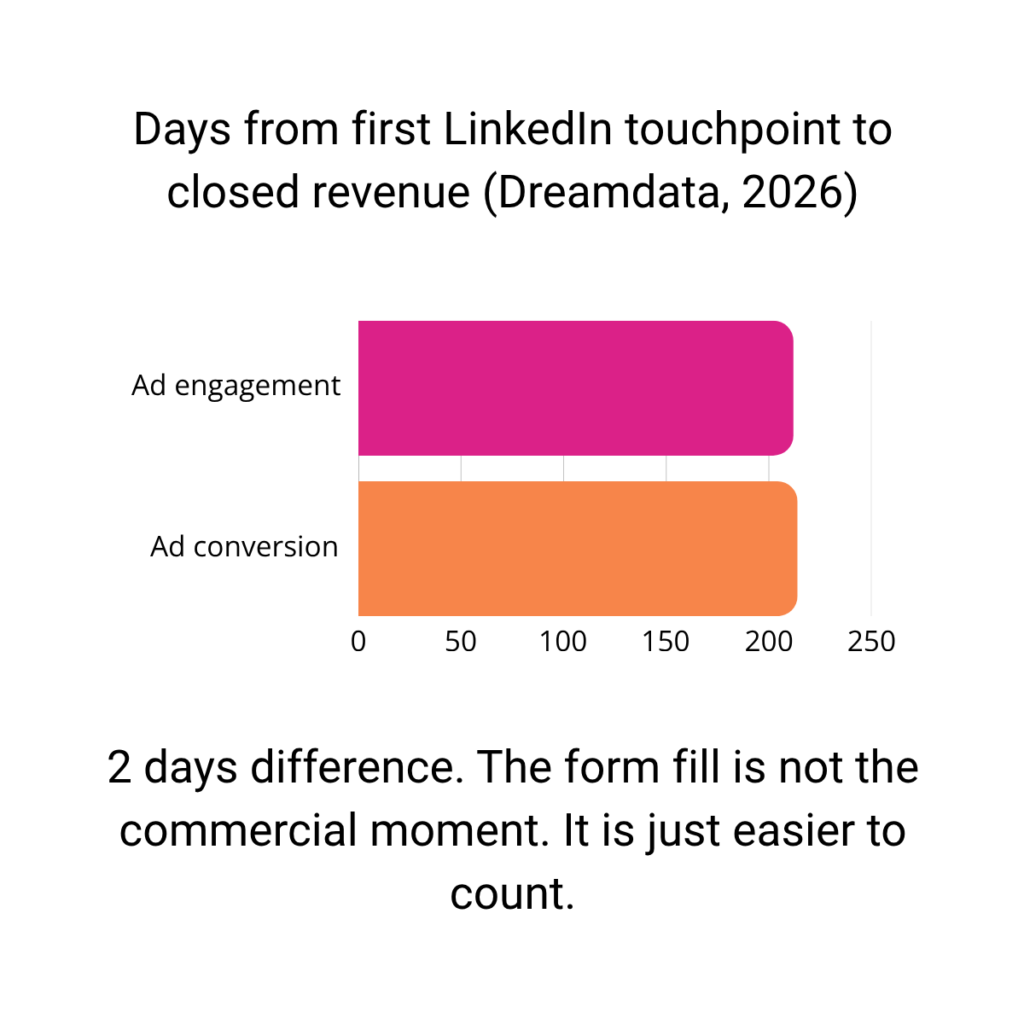
A LinkedIn ad engagement took 212 days to become revenue. A LinkedIn ad conversion took 214. It’s the clue as to why B2B leads go silent.
That finding from Dreamdata should make every B2B marketer pause for a second. The thing we often treat as soft commercial interest performed, on time-to-revenue, almost the same as the thing we treat as hard intent.
Lovely bit of CRM jiggery-pokery, that.
It does not mean conversions do not matter. Of course they matter. It means the form fill is not the whole story, and sometimes it is not even the most interesting bit.
B2B lead generation gets into trouble when we obsess over the visible moment: the download, the webinar registration, the demo request, the name appearing neatly in the CRM. Useful, yes. Enough, no.
The sale often cools down after that first signal because the decision has moved back into the buying group. People are still comparing, checking, waiting for timing, worrying about risk, and trying to bring others with them.
Social has a job here that too many lead-gen plans undercount. It keeps the commercial conversation alive when nobody is ready, willing or brave enough to book the next call. No jazz hands required.
The lead is only the visible bit
A lead tells you someone did something. Social helps you understand what they are trying to work out.
Dreamdata also found organic LinkedIn company page impressions appeared in 17.9% of closed deals in its dataset, with an average of 90 days from first organic company page impression to closed revenue. I would treat that as directional rather than universal gospel, because it is one benchmark from one platform ecosystem. Still, it is commercially useful.
It tells us that company page activity should not be brushed off as background noise. It can be a sign that someone is checking your story, proof, people and point of view while the deal is forming elsewhere.
That is a better question for B2B marketers. Not “did LinkedIn generate the lead?” but “what is LinkedIn telling us about how this account is warming up, checking us out and deciding whether we are worth the risk?”
This is where many teams miss the value of social. They look for a clean source-of-lead answer, when social is often working as the connective tissue between interest, trust and action.
Buying groups need proof they can carry
A lead is usually one person. A decision is usually a small crowd with different worries.
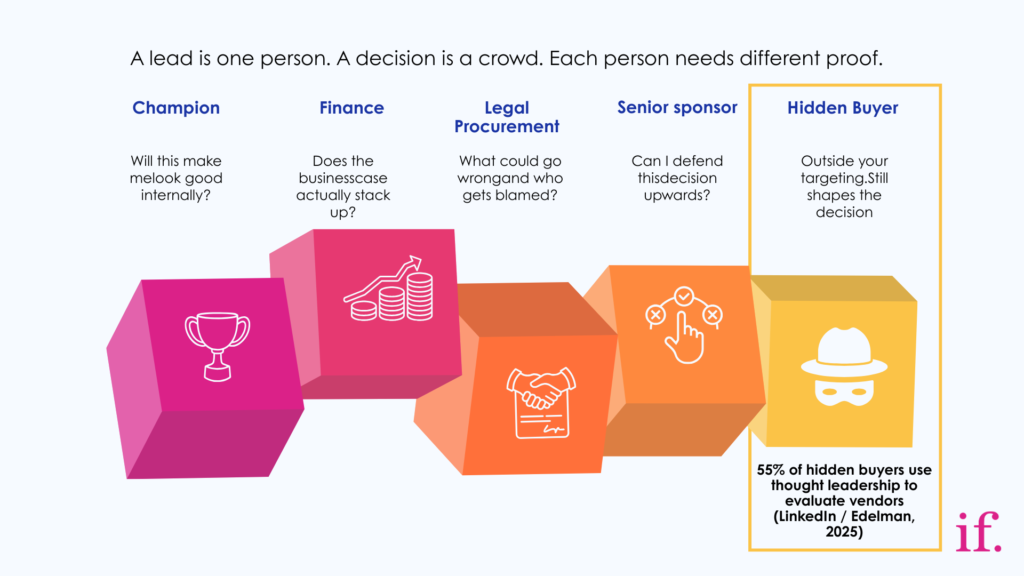
The person who fills in the form may like you. That’s nice. Sadly, nice does not survive procurement, budget scrutiny, internal politics and the quiet fear of backing the wrong supplier.
The buying group needs proof it can pass around. Not boastful proof. Not “we are delighted to announce” proof. Useful proof that helps someone explain the problem, the risk of doing nothing, and why your approach makes sense.
This is where B2B content often falls short. It tries to win the click, when it should be helping the buyer carry the argument.
LinkedIn and Edelman’s 2025 B2B thought leadership research found that 56% of target buyers use thought leadership as part of vendor evaluation, and 55% of hidden buyers do the same. Hidden buyers are often outside your neat campaign targeting, but they still influence whether a decision moves or stalls.
That matters because social is one of the few places where proof can travel without feeling like a sales push. A sharp LinkedIn post, a clear expert view, a useful comment, a case line that says what changed. Small pieces of public proof can do a lot of commercial work.
And this is where “credible” gets rinsed to death in B2B. A brand does not become trusted because it says it is trusted. It becomes trusted when its thinking helps the buyer make sense of the decision.
The Reddit Hidden B2B Journey report found that 55% of B2B decision-makers struggle to know which information sources to trust when researching business purchases. So more claims will not help. Specific proof will.
Social keeps the decision moving
Follow-up is often treated as an email sequence. A few automated touches, a replay link you know what I mean.
That is not enough for a cautious buying group.
The buyer needs repeated, useful prompts that reduce the effort of making the case internally. Social can do this brilliantly because it keeps your thinking visible without forcing the next sales step too soon.
A good social system makes the problem feel current, makes the next step feel safe, and keeps the brand remembered over time. That is very different from posting more. Posting more is often just a faster route to more beige.
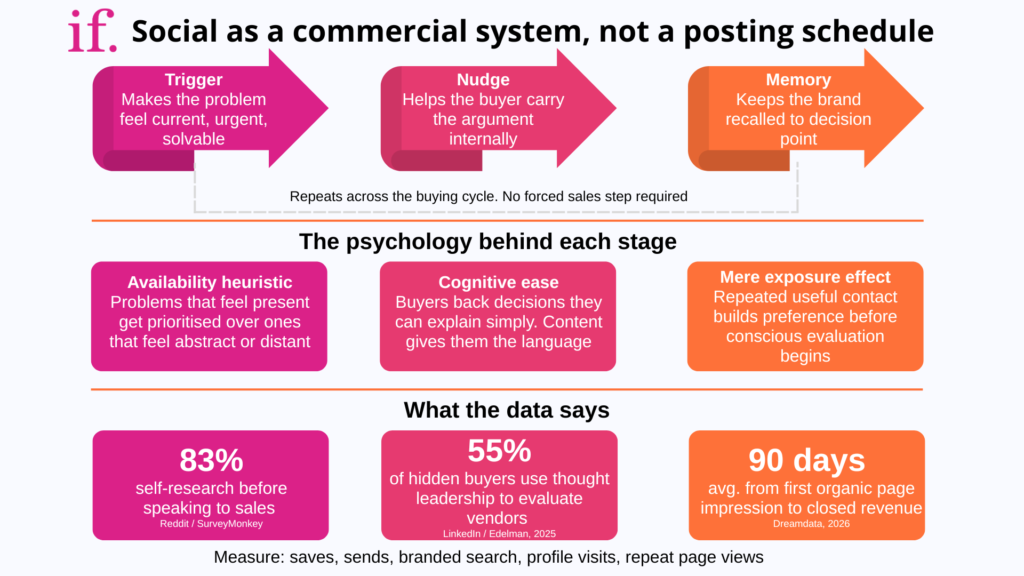
The better work is knowing what the buyer needs next. A clearer explanation. A sharper comparison. A proof point that answers the objection. A point of view that gives them language they can use with colleagues.
That is social doing commercial work.
The signals are already sitting there
Senior marketers do not need another lecture about SQLs, pipeline and attribution. The better question is what social is telling you before the CRM has anything neat to report.
Reddit and SurveyMonkey found that 83% of B2B decision-makers self-research before speaking to sales. They also found buyers use different sources for different jobs: vendor sites for quick facts, and peer or community spaces for trade-offs, risk, experience and comparison.
That is why social listening should not just ask, “what are people saying about us?” The sharper question is, “what is the market trying to understand before it trusts anyone enough to buy?”
Reddit threads, LinkedIn comments, saved posts, profile views, repeat company page visits and the language people use around a problem all give clues. They show what buyers are nervous about. They show which claims are not believed. They show the proof people need before they move.
Feed that back into the social plan, sales story, webinar follow-up and LinkedIn page. That is how social becomes commercial intelligence, not just a place to publish the bits and bobs marketing already made.
Memory is a sales asset
B2B buyers are cautious, but they are not boring. They remember the brands that help them think.
That is the bit too many LinkedIn pages miss. They are active, but forgettable. They announce, celebrate, promote and repeat, but they do not give the buyer a useful idea to hold onto.
Memorability in B2B is not fame for its own sake. It is whether a buyer can recall your point of view when the internal conversation gets difficult.
Social helps because it gives you repetition without deadening the idea. The same commercial thought can appear through leadership, customer proof, event content and practical explanation, each time helping the buyer make the case with a little less effort.
People remember what helps them explain the problem. They remember the brand that gave them better language. They remember the team that made the decision feel less risky.
That is the hidden job of social in B2B lead generation. It keeps the brand useful in the spaces between the big conversion moments.
Your LinkedIn page has a commercial job
If lead gen is getting sticky, start with the public layer buyers are already using to judge you.
Your LinkedIn company page should not just prove the business is alive. It should show what you believe, what problem you are best placed to solve, what proof exists, what risks you understand, and what step makes sense next.
If it cannot do that, it may be active. It may even look busy. But it is not doing enough commercial work.
That is why we built the LinkedIn Commercial Check. It is a quick diagnostic for senior marketers who want to know whether their company page is helping buying groups keep moving, or just keeping the content calendar fed.
B2B leads do not usually go cold because one email missed the mark. They go cold when the buying group runs out of reasons to trust the next step.
Social can give them those reasons. Repeatedly. Usefully. No jazz hands needed.
Take the LinkedIn Commercial Check
Want to know if your LinkedIn page is helping buyers move, or just making the brand look busy?
Take the LinkedIn Commercial Check at https://if-linkedin-check.scoreapp.com. It takes a few minutes and gives you a clearer view of whether your company page is building trust, carrying proof and creating useful commercial signals.
Sources
https://sproutsocial.com/insights/data/social-media-roi-report
https://www.edelman.com/expertise/Business-Marketing/2025-b2b-thought-leadership-report
https://dreamdata.io/blog/announcing-linkedin-ads-benchmarks-report-2026