



May 13, 2026
Social teams have been sitting on commercial insight for years. Now Google, Reddit and AI platforms are making that insight harder to ignore.
Google has just made the comment your buying signals.
On 6 May, Google announced new AI search updates that bring perspectives from public online discussions, social media and other firsthand sources into AI Mode and AI Overviews. Not just links. Not just website copy. Actual social conversations, with extra context such as creator names, handles and community names.
Google’s own wording matters here. These AI responses will now include perspectives from public online discussions and social media. That is not a tiny formatting tweak. That is search pulling human context closer to the answer.
That might sounds like a search update.
It is bigger than that.
It means the messy, useful, awkward, funny, grumpy, specific things people say around brands are moving closer to the moment someone is trying to choose.
And if you work in social, brand, demand, comms or customer experience, that matters. Quite a lot, actually.
For years, we treated search and social as different jobs. Search captured intent. Social built attention. Nice little boxes. Very neat. Deeply comforting. Mostly wrong now.
Because people do not move neatly. They see something in a feed, search it later, ask an AI tool, scan Reddit, check the comments, look at reviews, send a screenshot to a colleague, then arrive on your website already half-convinced or quietly suspicious.
People care what other people say. They always have.
The new bit is that search and AI are starting to surface those conversations for them.
This is not an SEO story. It is a trust story.
I know the immediate reaction will be to file this under search. There will be charts. There will be diagrams. Someone will say “AEO” in a meeting and everyone will nod while secretly wondering if they now need another agency, another dashboard, or a lie down.
But the more useful question is simpler.
What does your brand look like when people search around it, not just for it?
That is where this gets interesting. Social is no longer just the place you publish the message. It is part of the public signals people use to judge whether you are worth their time, money, attention or recommendation.
A Reddit thread. A TikTok comment. A LinkedIn debate. A brand reply. A customer complaint. A creator’s aside. A question asked in public and answered well. These are not soft little social moments floating about in the ether. They are signals.
The commercial issue is already here
The pain for senior marketers is not that Google has changed a feature. The pain is that social is already influencing trust, search, enquiries, shortlists and sales, while too many teams are still asked to report it like a publishing schedule.
Sprout Social’s 2025 research gives this a useful commercial backbone. Marketing leaders say social drives awareness at 67%, customer acquisition at 60%, customer loyalty at 58%, revenue at 56%, and R&D or decision-making at 54%.
But only 44% rate their teams as expert at measuring social’s business impact.
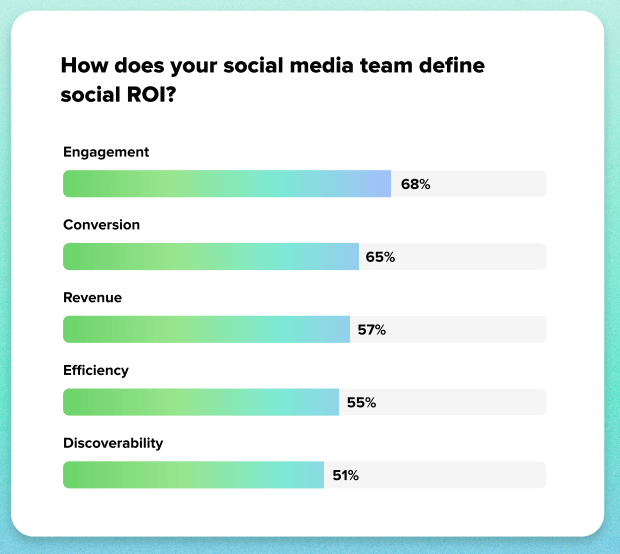
That gap is the problem.
Not because every comment can be tied beautifully to a purchase order. It can’t. We are marketers, not magicians.
But because the value of social is increasingly happening in places many dashboards treat as secondary. Comment depth. Search behaviour. Saves. Sends. Screenshots. DMs. Community threads. Repeated questions. The phrases customers use before they ever land on your site.
This is where buying confidence starts to form.
For B2B, that might mean a buyer seeing your expert posts before they ask sales for a call. For retail, it might mean someone checking comments to see whether a product lives up to the claim. For food, travel and leisure brands, it might mean people looking for reassurance from other customers before they book, buy or recommend.
The comment section has become a research tool
Vogue Business reported that 52% of Gen Zs said they go to the comments section when researching brands and products on social media, compared with 37% who visit brand profiles and posts. The same piece also notes that organic reach on Instagram has dropped from 10 to 15% in 2020 to 2 to 3% in 2025, making comments a more valuable place for brands to be seen.
That does not mean every brand should start “popping off” in the comments.
It does mean comments now carry more commercial weight than many teams give them.
A good comment strategy is not about being funny on demand. That is exhausting, and usually quite painful to watch.
A funny reply might work under a creator post, but feel careless under a service complaint. A short clarification might calm a product question, while a warmer, more detailed answer might help someone who is clearly worried about delivery, safety, value or whether the brand can be trusted.
Good community management is knowing the difference. When to help, when to clarify, when to stay quiet, when to be warm, when to escalate, and when a small answer in public can do more for confidence than a polished campaign line.
If your brand voice only appears when there is a viral comment to chase, you do not have a brand voice. You have a social manager with good instincts and probably too many tabs open.
Reddit is not a side alley anymore
Reddit is useful here because it is built around questions, experience and peer judgement.
People do not go to Reddit for brand polish. They go for the slightly chaotic comfort of hearing from other people who have tried the thing, hated the thing, loved the thing, fixed the thing, compared the thing, or asked the question they were too embarrassed to ask elsewhere.
Google knows that. Its latest AI search updates make that obvious.
Reddit knows it too. In January 2026, Reddit announced Max Campaigns in beta, powered by Reddit Community Intelligence and AI. Reddit says this turns more than 23 billion posts and comments into structured signals to help advertisers understand audiences.
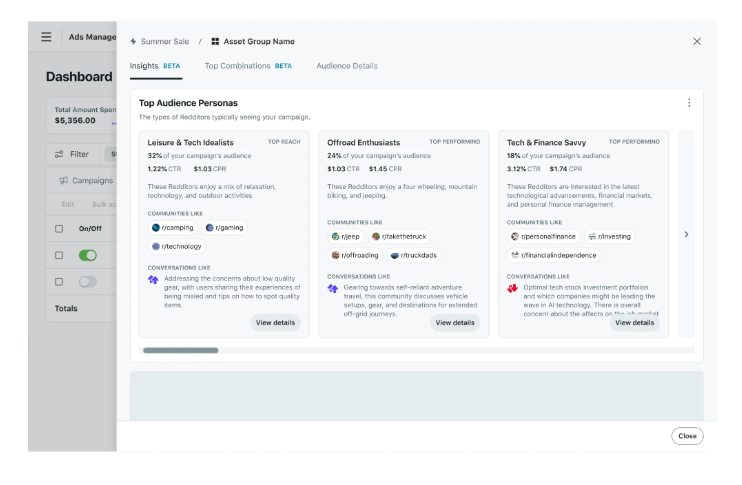
The performance numbers are worth noting, with a sensible pinch of salt because platforms do like marking their own homework. Reddit says early split tests saw 17% lower CPA and 27% more conversions on average compared with advertisers’ business-as-usual campaigns.
That is a very clear commercial signal.
Community conversation is being turned into marketing infrastructure. Search engines want it. AI platforms want it. Ad platforms want it. Customers already use it.
The question for brands is whether they are learning from it, participating with care, and building content that answers what people actually ask.
That is where social teams have been sitting on gold for years.
AI has made average content very easy
There is another reason this matters now.
AI is making competent content faster and cheaper to produce. That sounds useful, and it is. But it also means feeds are filling up with more perfectly passable, instantly forgettable work.
AI Forensics has been tracking AI-generated content designed to perform in social algorithms. Its investigation into AI-generated algorithmic virality looked at TikTok and Instagram search results across 13 hashtags in Spain, Germany and Poland. It found synthetic AI imagery in 25% of TikTok’s top search results, with over 80% of that AI content coming from what it calls “Agentic AI Accounts”. It also found that over 80% of the AI content it analysed was photorealistic.
You can see where this goes.
More volume. More sameness. More content that looks acceptable for half a second and leaves absolutely no dent in the brain.
This is why distinctiveness becomes more valuable, not less.
AI can help you make more content. It cannot give you a reason to exist in someone’s feed. Annoying, but true.
Brands will need clearer thinking, sharper language, better social judgement and stronger public behaviour. They will need a point of view that can be repeated. They will need comments that sound like the same brand as the campaign.
That is where the advantage sits.
So what should social teams do differently?
I do not think the answer is “go and do Reddit”. That is not a strategy. That is a cry for help.
The better answer is to change what you think social is for.
For too long, social has been treated as the output layer. The place the campaign goes after the strategy has already been decided. The place where someone asks for “a few posts” and then wonders why nothing meaningful changes.
Social now needs to be much closer to the behaviour layer.
And it changes the work.
Instead of only asking, “what should we post?”, social teams need to ask:
- what does someone need to feel safer choosing us?
- what are people already saying in comments, forums and communities?
- where does our public story get misunderstood?
- which questions should we answer before the buyer has to ask?
- what language is distinctive enough to be remembered and specific enough to be useful?
That is how social becomes commercially useful. Not louder. Better connected to the way people decide.
The new operating model is less content factory, more signal system
Sprout’s report found that many senior leaders still believe their teams need to increase publishing volume to increase impact. But the same report points out that posting more has no clear correlation to the bottom line, and that consumers want more originality, authenticity and community, not brands posting for the sake of it.
The wider B2B picture says something similar. Demandbase’s 2025 State of B2B Marketing report found that 96% of B2B marketers already run emerging or advanced go-to-market strategies, yet fewer than half feel equipped for the demands they face. Only 45% feel very confident connecting data across products, teams and platforms. In other words, the issue is not that marketers lack tools. It is that the signals are not joined up well enough to help people make clearer commercial choices.
That tracks with what we see every day.
The teams under the most pressure are often the ones asked to create more, faster, across more platforms, with more approvals, more stakeholders and less time to think. Then leadership asks why social is not driving enough commercial value.
That means four practical changes.
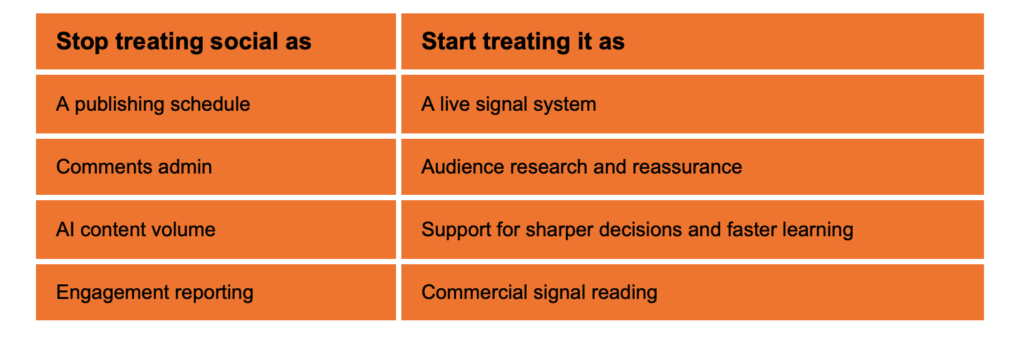
This is not about making social sound grander than it is.
It is about admitting what it already does.
The bit around the post matters now
The big lesson from Google’s update is not that every brand needs a Reddit strategy.
The lesson is that the public conversation around your brand is becoming easier to find, summarise and use.
That includes the good stuff. The helpful answers.
It also includes the neglected stuff. The ignored comment threads. The generic answers. The unresolved complaints.
The stuff around the post is starting to matter as much as the post.
That is the buying signal hiding in plain sight.
And for senior marketers, there is an opportunity here. A positive one, not another doom-laden “everything has changed, please panic” moment.
You already have access to more live customer and buyer insight than almost any other function. It is in the comments, the community questions, the saves, the sends, the social search patterns, the DMs, the creator conversations, the repeated doubts and the language people use when they are trying to decide.
The job now is to stop treating those signals as noise.
Read them properly. Build around them. Make social the place where the business learns what people need to feel confident enough to act.
At Immediate Future, we do not make social louder. We make it work for growth, reputation and demand by designing for what happens around the content, not just what happens to it.
Because social is where people decide whether the message is worth believing.
Sources
https://blog.google/products-and-platforms/products/search/explore-web-generative-ai-search
https://www.theverge.com/tech/924993/google-ai-search-mode-overviews-update-reddit-links
https://www.techradar.com/ai-platforms-assistants/a-new-search-ai-tool-from-google-will-summarize-tips-from-reddit-and-social-media-the-expert-advice-panel-will-include-a-preview-of-perspectives-from-public-online-discussions-and-other-sources-as-part-of-its-updates-to-ai-mode-and-ai-overviews
https://www.vogue.com/article/should-brands-really-be-popping-off-in-the-comments
https://www.business.reddit.com/advertise/max-campaigns
https://aiforensics.org/work/gen-ai-slop
https://arxiv.org/abs/2508.01042
https://sproutsocial.com/insights/data/impact-of-social-media-marketing
https://www.demandbase.com/resources/report/state-of-b2b-marketing
FAQ On Buyer Signals
Why do social comments matter more now?
Social comments matter more because people use them to check what others really think about a brand, product or service. Comments can reveal customer doubts, praise, complaints, product questions, delivery worries, service tone and peer recommendations. As AI search and platforms like Google surface more public discussion, comments are becoming easier to find and more influential in how people judge brands.
How is AI search changing social media marketing?
AI search is changing social media marketing by pulling public conversations, social posts and community discussions into search-style answers. This means social content can influence discovery beyond the feed. A useful reply, Reddit thread, creator comment or public discussion may now help shape what someone sees when researching a brand, product, issue or category.
Is Reddit important for brand discovery?
Reddit is becoming more important for brand discovery because people use it to ask specific questions, compare experiences and hear from peers. It is not right for every brand as a posting channel, but it is increasingly valuable as a source of customer language, doubts, needs and market insight.
What should social teams do differently?
Social teams should treat comments, community discussions, saves, sends, DMs and social search behaviour as live commercial signals. Instead of only asking what to post, they should ask what people need to understand, trust or feel confident about before they act. That changes social from a publishing schedule into a learning system for the business.
Why is AI making distinctiveness more important?
AI is making average content faster and cheaper to produce, which means more feeds will fill with competent but forgettable work. Distinctive thinking, recognisable tone, useful replies and clear judgement become more valuable because they help a brand stand out, be remembered and be trusted.