


June 3, 2026
Social commerce is growing fast. For DTC brands, the interesting question is what behaviours it encourages along the way.
DTC brands have spent years trying to make social work harder commercially.
And now, in some categories, it really does. TikTok Shop, creator codes, affiliate content, livestreams, product demos and in-app checkout have made the distance between “I like that” and “I’ve bought that” beautifully short.
The growth is hard to ignore. Retail Economics estimates UK social commerce will almost double from £7.4bn to nearly £16bn by 2028, while 82% of social users already engage in shopping-related activity across social and entertainment platforms.
That is good news. Nobody is going to argue against making it easier for people to buy.
But there is a quieter question sitting underneath the sales numbers. It is not whether social commerce works. It is what kind of customer relationship it creates when every social moment starts behaving like a checkout.
Because there is a trap here. A very tempting one.
If every interaction becomes “buy now”, “viral deal”, or “TikTok made me buy it”, then the brand may get the sale but lose the value story.
People start remembering the discount more than the brand. They trust the creator more than the product. They learn to wait for the next offer.
That is the social sell trap.
Not because selling on social is wrong. It absolutely is not. But because social commerce is so efficient that it can quietly train behaviours that become difficult to reverse.
It’s a behaviour shift.
The more interesting thing about social commerce is not that platforms have added better checkout tools. It is that they have compressed several stages of the buying journey into a single experience.
The creator becomes part salesperson, part product demonstrator and part source of reassurance. The comments become a review layer. The content answers questions that would once have been handled by a product page. By the time a discount code or offer appears, much of the decision-making has already happened.
That is powerful because it removes friction. People no longer need to leave the app, search for the brand, compare options and then decide. Much of that process now happens inside the feed.
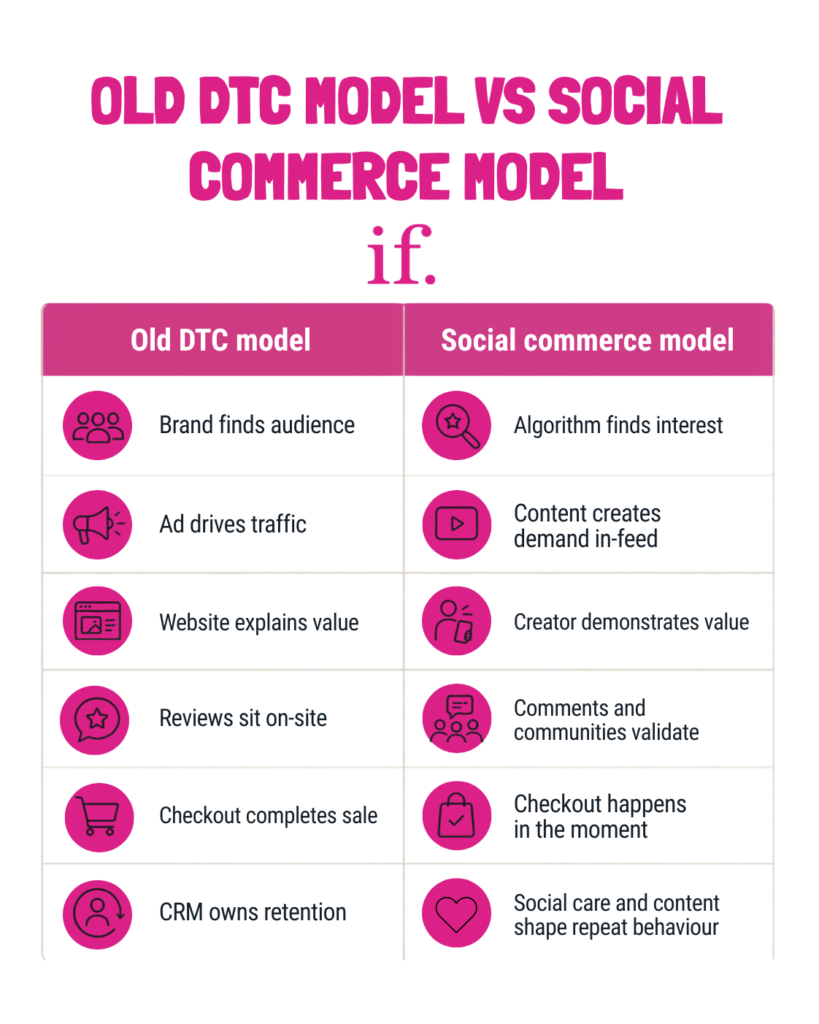
DTC brands were built around ownership. Own the relationship. Own the data. Own the customer experience.
But customers are increasingly building their own understanding of brands in public.
They are piecing together creator content, comments, reviews, recommendations and shared experiences, sometimes buying without ever spending meaningful time with the brand itself.
So the job is not simply to shorten the purchase journey. It is to make sure the brand still means something inside that shortened journey.
The danger is conditioning.
Discounting gets blamed for a lot. Sometimes fairly. Sometimes not.
The deeper issue is not the discount itself. It is the reference point it creates.
If the first relationship someone has with your brand is a creator code, that code becomes part of how they understand your value. If they only ever see you during sales, full price starts to feel unusual. If your product is consistently framed as a bargain, it becomes harder to defend everything that makes it worth paying for.
Social commerce can create brilliant commercial moments, but if those moments are disconnected from brand memory, they become transactional. Useful today. Expensive tomorrow.
A simple way to look at it:
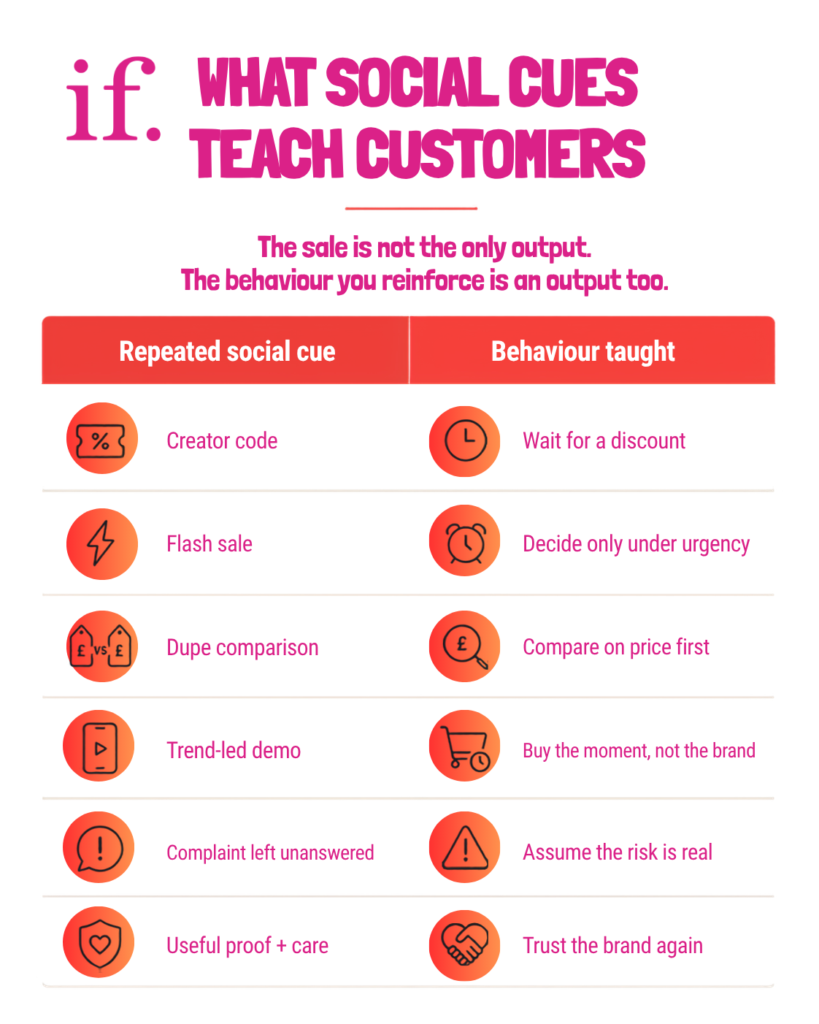
That last line is the opportunity.
The answer is not to stop selling. It is to make every selling moment do more than sell. The strongest social commerce content reinforces why the brand is worth choosing, not just why it is worth buying right now.
Because the sale is not the only output. The behaviour you reinforce is an output too.
Many social purchases look impulsive. The reality is usually more complicated.
There is a slightly patronising way people talk about social shopping, especially TikTok shopping. As if people are simply wandering around the internet being ambushed by lip gloss and air fryers.
That is too simplistic.
Yes, social commerce captures impulse. The format is designed for speed, ease and momentum.
But a lot of what looks like impulse is actually familiarity.
Someone may have seen the brand several times, watched creators use it, read comments, absorbed enough proof to feel comfortable and then bought when the right cue appeared.
From the outside, that looks like a sudden sale. From the customer’s perspective, it may feel like a decision that has been forming for days or weeks.
The numbers support that idea. Research from GWI consistently shows a gap between what consumers say influences them and what actually shapes behaviour. People often underestimate the cumulative effect of repeated exposure, recommendations and social proof.
This is where DTC marketers can get measurement wrong. If the only moment that gets credit is the final click, the brand starts over-investing in the cue that closed the sale and under-investing in the reassurance that made the sale possible. That is how you end up with too much urgency and not enough memory.
It is understanding what made the brand feel relevant, credible and worth remembering before the conversion happened.
That is a more useful commercial conversation. It moves social from “content that sells” to a system that creates demand, reduces uncertainty and protects value.
The post-purchase moment is now part of acquisition
For DTC brands, the sale is not the end of the social journey. It may be the point where the next buyer starts paying attention.
A customer buys, then returns to social. What they say, ask or share becomes visible evidence for everyone else considering the same purchase. And public evidence is now part of the conversion environment.
A helpful reply under a complaint can reassure hundreds of people who never comment. A clear how-to video can reduce returns and increase satisfaction. You get the gist.
This is where DTC brands need to think beyond “social as acquisition”. For DTC brands, customer care is acquisition content.
That does not mean every social manager suddenly becomes customer service. It means businesses need to stop treating social care, creator content, ecommerce, product feedback and brand as separate functions.
Research from Sprout Social found that business leaders increasingly expect social teams to contribute not just to awareness and acquisition, but also customer care and business intelligence. The challenge is that fewer than half believe they are highly effective at measuring that broader impact.
The stronger DTC brands will build social systems that connect the whole experience.
Social commerce should sell, reassure, remember and repeat.
A good DTC social system should do four jobs.
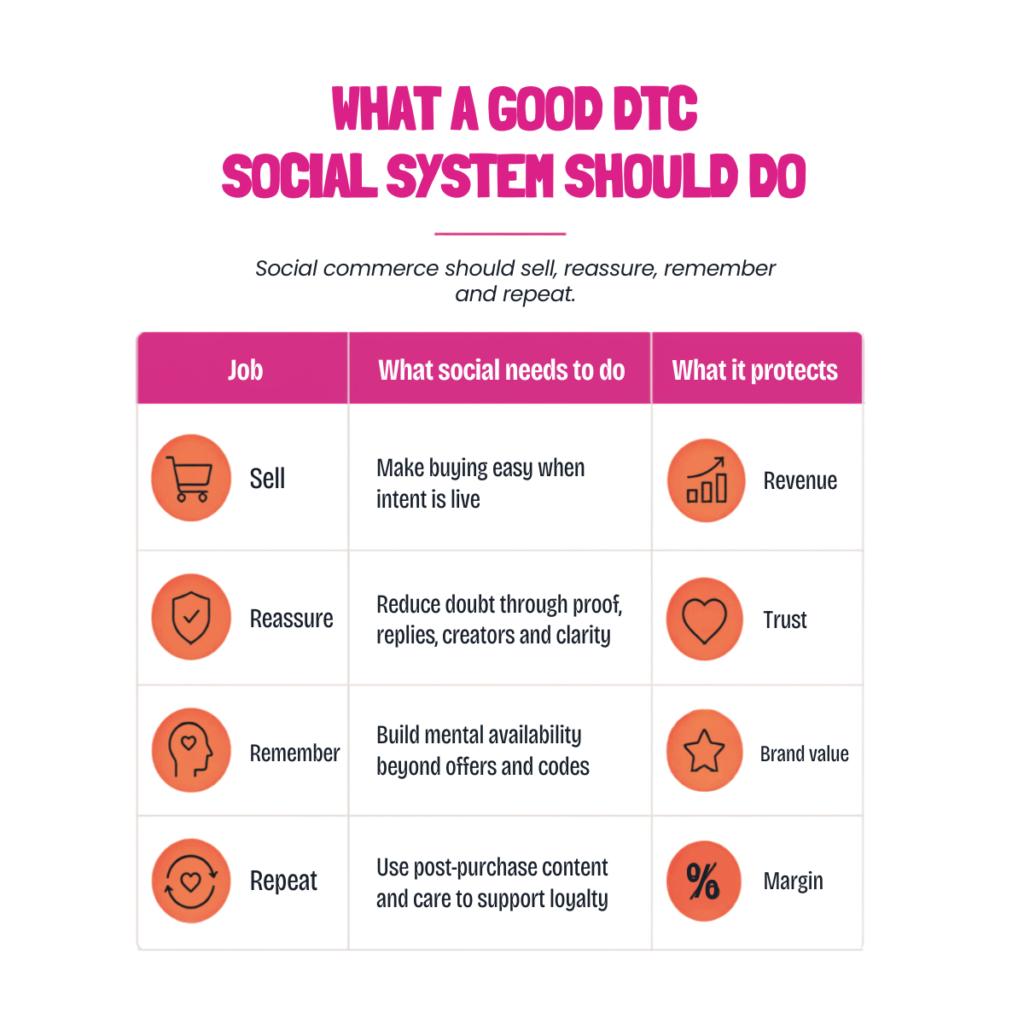
Most brands are comfortable with the first job.
The competitive advantage sits in the other three.
Reassurance is where trust gets built. Memory is where the brand becomes more than the deal someone happened to see. Repeat is where the economics start to work, because growth becomes expensive when every sale has to be won from scratch.
That pressure is becoming more visible. NIQ’s latest consumer research shows shoppers are increasingly selective about where they spend, while marketers face growing demands to prove short-term ROI. That combination makes it even more tempting to optimise for immediate conversion at the expense of long-term value.
That is why this is not really a TikTok Shop story. Or an Instagram Shop story. Or even a creator commerce story.
It is a behaviour story.
If social commerce trains people to buy quickly and forget quickly, the brand has a margin problem waiting around the corner. If it trains people to understand the value, trust the proof, enjoy the experience and come back, it becomes a genuine growth system.
There is a lot to be excited about.
Social commerce is giving DTC brands more ways to turn attention into action. It is making product discovery more entertaining, more human and often more accessible. For smaller brands, it can open doors that search and paid media have made increasingly difficult to push through.
The momentum is real. TikTok Shop sales grew by more than 80% year-on-year in 2025 according to NielsenIQ data, while TikTok reported selling 27 products every second during Black Friday in the UK.
But the more useful question is not “how do we sell more through social?” It is “what does every social moment teach the customer to do next?”
Some moments should drive action. Others should build understanding, confidence or memory. The strongest brands understand that social has to do all of those things, not just the first one.
Because once a brand trains people to respond only to urgency, discounts and creator codes, it becomes much harder to bring the conversation back to value.
And that, really, is the social sell trap.
URLs
https://www.retaileconomics.co.uk/retail-insights/thought-leadership-reports/the-power-of-social-commerce-building-brands-in-the-tiktok-era
https://newsroom.tiktok.com/en-gb/retail-economics-report
https://www.emarketer.com/content/tiktok-shop-sales-growth-2026-social-commerce
https://newsroom.tiktok.com/tiktok-shop-uk-breaks-record-with-highest-sales-on-the-platform-ever-this-black-friday?lang=en-GB
https://www.theguardian.com/technology/2025/dec/24/uk-small-businesses-sign-up-to-tiktok-shop
https://www.ofcom.org.uk/media-use-and-attitudes/online-habits/from-apps-to-ai-search-how-the-uk-goes-online-in-2025
DTC on social FAQs
What is a good DTC social system?
A good DTC social system helps customers buy, trust, remember and return. It makes purchase easier when intent is live, reduces doubt through proof and care, builds brand memory beyond offers, and supports repeat purchase after the first sale.
How has social commerce changed the DTC model?
Social commerce has compressed the DTC journey. Discovery, product education, social proof, comments and checkout can now happen inside the social feed, rather than across separate stages of ads, websites, reviews and CRM.
Why does customer care matter in social commerce?
Customer care is visible to future buyers. Public replies, product answers, complaint handling and helpful guidance can reduce perceived risk and increase confidence before someone buys.
How do creator codes affect customer behaviour?
Creator codes can reduce friction and encourage purchase, but repeated use can train customers to wait for discounts. DTC brands should make sure creator activity also explains value, builds trust and supports memory.
Why should DTC brands think beyond conversion?
Conversion shows the immediate sale. Behaviour determines what happens next. DTC brands need social commerce to support revenue today while also protecting full-price confidence, repeat purchase and long-term brand value.