


June 4, 2026
Why CMOs need to stop treating paid social like a media buy, and start treating it as a commercial system
B2B paid social is still being bought like a campaign, but judged like a revenue system.
That mismatch is where the frustration starts. The campaign performs on paper, but the commercial impact is unclear. Marketing is then left explaining the gap between platform metrics and business outcomes.
It was a theme that came up repeatedly in a recent LinkedIn Live discussion between Tom and CJ. We were exploring why B2B paid social often looks successful in platform reports but still struggles to answer the commercial questions coming from sales, finance and leadership teams. As Tom put it: “You can know why paid social has not obviously moved the business yet, but still have to explain it to people who quite reasonably want the proof.”
The problem is rarely just the ad. It is the system around it.
Paid social has become deceptively easy to launch and much harder to make commercially useful. Platforms have simplified campaign setup, but the real value now sits elsewhere: audience understanding, data quality, CRM integration, campaign design and the ability to turn engagement into meaningful commercial signals. CJ summed it up well: “The biggest things B2B marketers misunderstand are the data and the speed of evolution.”
The challenge is not whether you can launch a campaign. It is whether your business is set up to learn from it.
The market is making this less optional
Paid social is not a small line item anymore. IAB UK reports that social media spend reached £11.5bn in 2025, up 21% year on year, accounting for 28% of UK digital ad spend. At the same time, Gartner reports that marketing budgets remained flat at 7.7% of company revenue, while NIQ found that 74% of CMOs face increased pressure to prove ROI.
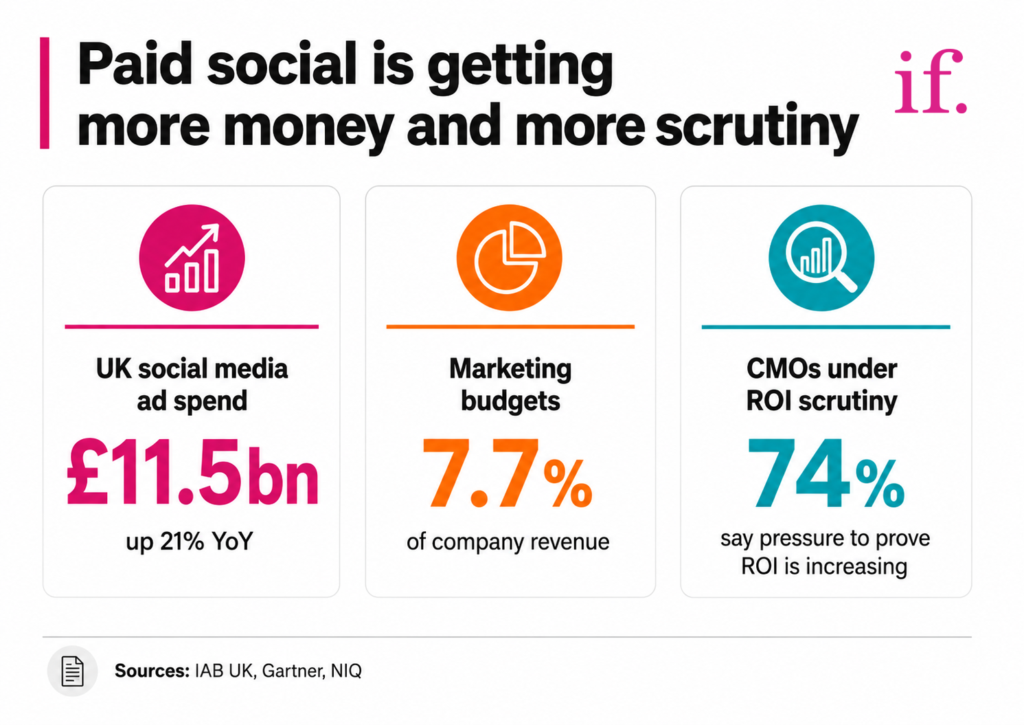
That combination creates a clear challenge: more money is flowing into paid social, but scrutiny is increasing too.
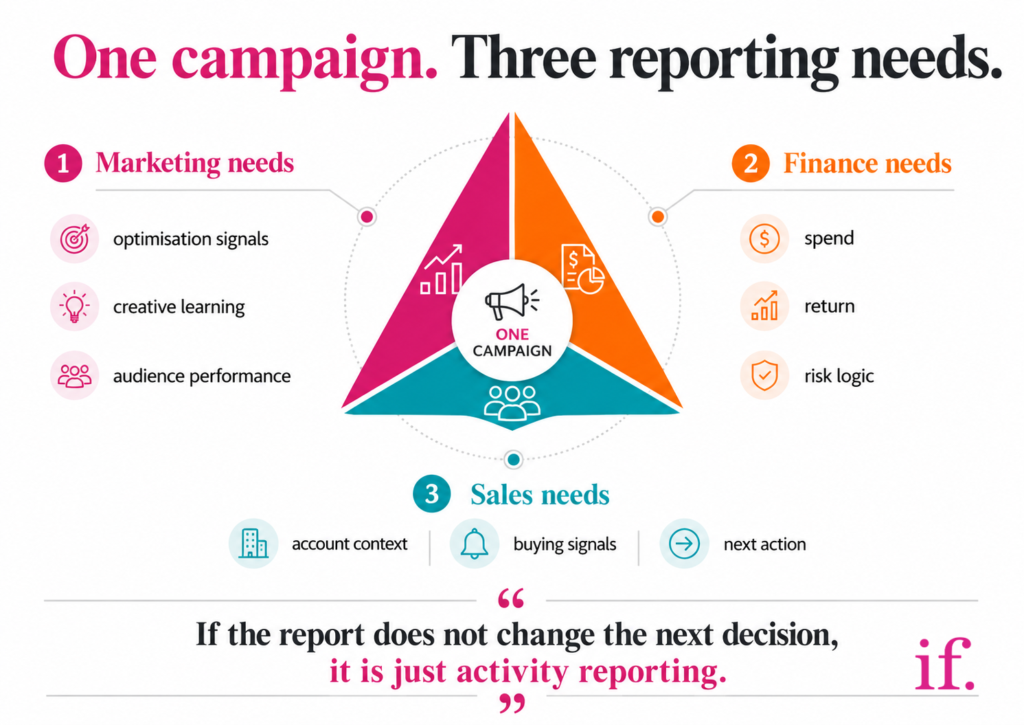
When platform reporting, GA4, CRM data and sales feedback all tell slightly different stories, reporting becomes a debate rather than a decision-making tool. CMOs do not need more dashboards. They need confidence in what is working, what is not, and where investment should go next.
Easy deployment creates a false sense of progress
Anyone can launch a campaign today. The platforms are designed for it.
But a campaign that runs is not the same as a campaign that proves value.
Effective B2B paid social requires more than targeting and budget. It needs meaningful tracking, CRM connectivity, sensible attribution and enough data flowing through the system to understand what is actually influencing buyer behaviour.
Without that foundation, two things happen:
- Good activity gets undervalued because nobody can see its impact.
- Poor activity gets overvalued because platform metrics make it look busier than it really is.
Neither outcome helps commercial decision-making, and both can lead businesses to invest in the wrong areas or cut activity that is quietly creating value.
LinkedIn matters, but it needs a job
LinkedIn remains one of the most important paid channels in B2B, but that is hardly news to most experienced marketers. The challenge is not deciding whether LinkedIn matters. It is deciding what role it should play in the wider commercial system, and being honest about where it creates value versus where it is simply the default choice.
CJ made an interesting point during the Live. He said he has rarely walked into a B2B meeting where the expectation was anything other than, “We’re doing it on LinkedIn, and we need demand generation quickly.” You can understand why. LinkedIn feels like the obvious answer for B2B. It offers professional targeting, access to decision-makers and a platform built around business conversations.
But the issue is not LinkedIn itself. The issue is assuming it can do everything.
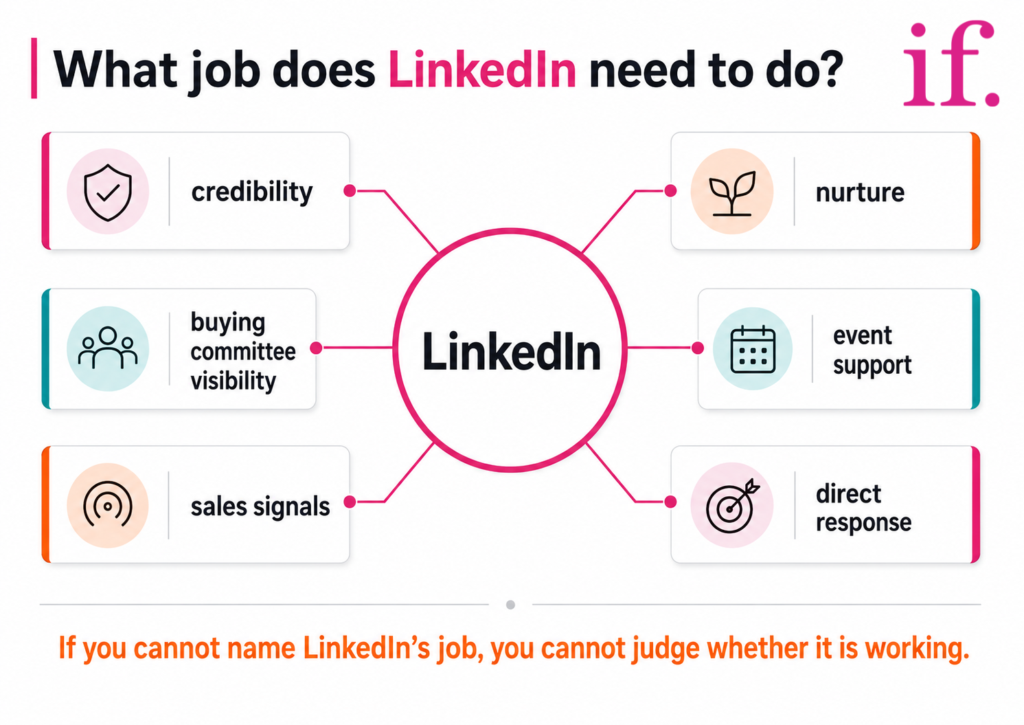
The better question is not “Should we use LinkedIn?” It is “What job does LinkedIn need to do?”
It may be there to help a buyer recognise your brand long before they are ready to engage, to keep your business visible during a long decision process, or to create the signals that tell sales where interest is beginning to form. In other situations, it might play a more direct role in generating enquiries or supporting a specific commercial objective. Each of those objectives requires different creative, measurement and expectations. Treating LinkedIn as one catch-all solution usually leads to disappointment because success looks different depending on the role it is being asked to perform.
When marketers are clear about that role, LinkedIn becomes far more useful. When they are not, it often becomes a very expensive way of buying reassurance rather than a channel with a clearly defined commercial purpose.
Buyers do not move because a platform wants them to
B2B decisions are rarely simple.
Buyers are not just evaluating products. They are evaluating risk, credibility, effort and internal consequences. That is why familiarity, trust and social proof matter so much.
CJ referenced the idea that buyers often need multiple interactions before they remember and trust a brand enough to act. Whether that number is five touchpoints or nine is less important than the principle: meaningful B2B decisions rarely happen after a single ad exposure.
This aligns with what behavioural scientists call uncertainty reduction. In B2B, buyers are often making expensive, visible decisions with personal and organisational consequences attached. When uncertainty is high, people look for signals that reduce perceived risk before they commit. Repeated exposure, consistent messaging, credible proof points and familiar brands all help create that sense of confidence. Technology can improve execution, but it cannot remove the buyer’s need to feel certain enough to act.
Stop asking for the lead before you have earned the trust
One of the most useful questions in the Live came from one of the viewers, who asked why people click lead forms but fail to complete them.
Sometimes the answer is tactical. The offer is weak, the form is too long or the landing page creates friction. But often the issue is timing.
A click signals interest. It does not automatically signal readiness.
CJ’s advice was simple: if the lead form is the first meaningful interaction, do not be surprised when completion rates suffer. Buyers often need more explanation, proof and reassurance before they are willing to exchange their details.
A click without a form fill is not always failure. It can be an indication that interest exists, but trust has not yet caught up. Understanding that distinction helps marketers avoid judging campaigns too harshly or too early.
Short campaigns create bad lessons
One of the easiest mistakes in B2B paid social is judging campaigns too quickly.
A short campaign may not generate enough exposure, enough learning or enough data to tell you anything useful. Yet businesses often use those early results to decide whether paid social works.
CJ argued that many B2B campaigns need eight to twelve weeks to generate meaningful insight, particularly when targeting senior audiences who are not constantly active on LinkedIn.
A six-day campaign can tell you what happened quickly, but it cannot tell you whether awareness is building, consideration is increasing or future pipeline is being influenced. Those outcomes take longer to emerge and require patience if marketers want to understand the true impact of their activity.
AI can speed up the wrong work
AI is already embedded in modern marketing workflows. It can help with research, testing, content creation and optimisation. Used well, it creates efficiency and frees up time for higher-value thinking.
Used badly, it simply accelerates weak decisions.
CJ’s example was useful. AI can identify people interested in golf. That does not mean it can automatically identify people likely to buy an expensive golf product.
The same principle applies in B2B. AI improves execution, but it does not replace judgement. Businesses still need clear objectives, strong audience understanding and experienced decision-makers to ensure technology is being applied in the right way.
Sales needs signals, not suspicion
One of the most valuable outputs of paid social is insight.
Campaigns can reveal which accounts are engaging, which topics resonate and where interest may be developing. That information becomes powerful when it helps sales have better conversations.
As Tom noted, paid social often supports multiple stakeholders within a buying committee. Its role is not simply to generate clicks. It is to create context.
The mistake is treating engagement signals as permission to pounce. Sales teams need useful context, not surveillance data. The goal should be to make conversations more relevant and timely, rather than creating the impression that prospects are being monitored.
What I would ask before spending more on Paid social
Before increasing investment in B2B paid social, I would ask five questions:
- What behaviour are we trying to influence?
- What role should LinkedIn play in that journey?
- Have we earned enough trust before asking for a lead?
- Is our data strong enough to support decisions?
- Does sales know how to use the signals being generated?
Those questions tend to reveal whether the challenge is media performance or something deeper. In many cases, the issue is not the platform itself but the way the wider system has been designed.
Paid social has outgrown the campaign mindset
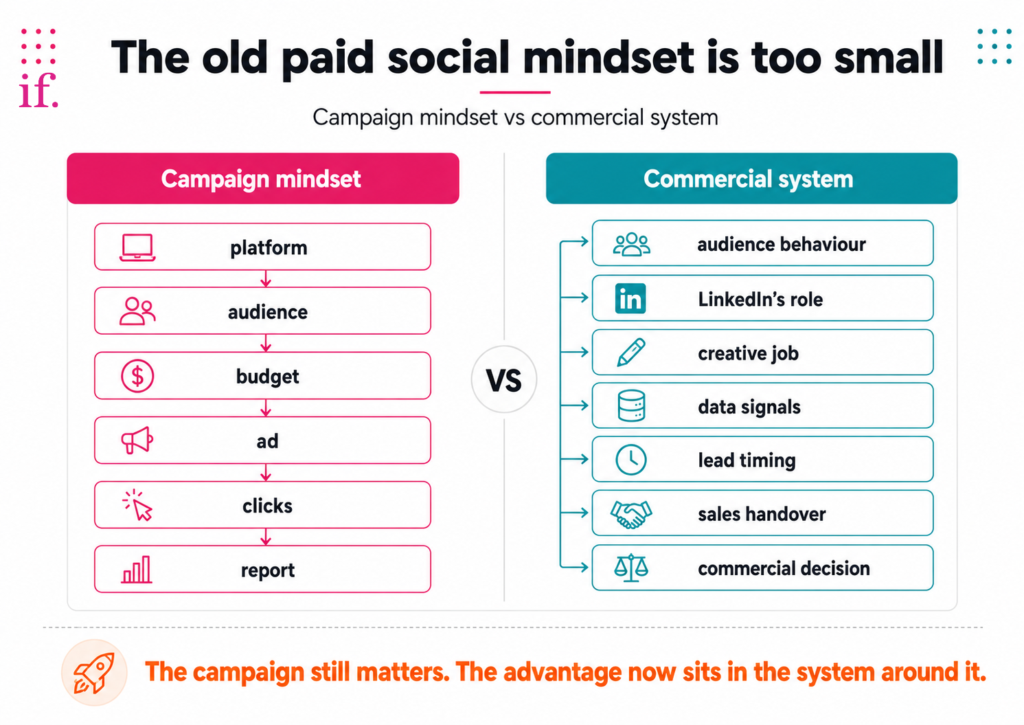
B2B paid social remains one of the most useful tools available to marketers. But its value no longer comes from launching campaigns quickly. It comes from building a system that connects audience insight, creative, data, technology and sales action.
The campaign is no longer the unit of advantage. The system is.
When those pieces work together, paid social becomes far more than a lead-generation channel. It becomes a source of commercial insight, demand creation and better decision-making. Before spending more on LinkedIn, make sure it is performing the role your business actually needs it to perform.
Start with the LinkedIn Commercial Check
If this article has raised uncomfortable questions about how LinkedIn fits into your commercial growth strategy, that is exactly why we created the LinkedIn Commercial Check.
It is a practical resource designed to help B2B marketers and business leaders assess whether LinkedIn is doing the job they need it to do. Not just generating activity, but supporting awareness, demand creation, lead quality, sales conversations and commercial outcomes.
The check helps you step back from campaign metrics and look at the bigger picture: audience assumptions, content effectiveness, paid activity, data signals, reporting and how LinkedIn connects to the rest of your marketing and sales process.
Before investing more budget, changing platforms or launching another campaign, it is a useful way to identify where the real opportunities and gaps might be.
Access the LinkedIn Commercial Check here (It’s free)…
Sources and useful reading
https://www.linkedin.com/events/7460700543708086273?viewAsMember=true
https://www.iabuk.com/news-article/digital-adspend-2025-uks-digital-ad-market-reaches-ps405bn
https://www.socialmediaexaminer.com/social-media-marketing-industry-report-2026
Paid social FAQs
What is the biggest mistake in B2B paid social?
The biggest mistake in B2B paid social is treating it like a short campaign while expecting it to prove revenue impact. Paid social needs a wider system around it: audience insight, creative, data quality, CRM integration, reporting and sales follow-up.
Why does LinkedIn need a defined role in B2B paid social?
LinkedIn needs a defined role because it can support different commercial jobs, including awareness, demand creation, lead generation, sales signals and retargeting. Each job needs different creative, measurement and expectations.
Is a click the same as a lead in B2B paid social?
No. A click signals interest, but it does not automatically mean the buyer is ready to speak to sales. In B2B, buyers often need more proof, reassurance and context before they exchange their details or enter a sales conversation.
Why do B2B paid social campaigns struggle to prove value?
B2B paid social campaigns often struggle to prove value because platform metrics, CRM data, GA4 reporting and sales feedback do not always connect cleanly. Without a shared view of performance, reporting becomes a debate rather than a decision-making tool.
What should CMOs ask before spending more on LinkedIn?
Before spending more on LinkedIn, CMOs should ask what behaviour they want to influence, what role LinkedIn should play, whether enough trust has been built before asking for a lead, whether the data supports decisions, and whether sales knows how to use the signals generated.