


February 11, 2026
You know what’s oddly cheering.
Most brands have loads of proof that they’re worth buying.
By proof I mean the specifics that make a claim believable when someone repeats it to a friend, or a colleague, or their partner on the sofa.
Customer stories with detail. Before-and-after that feels properly human. What’s included and what isn’t. What it costs and why. Returns, delivery, guarantees, allergens, sizing, setup, battery life, the bit you wish you’d known before you bought.
The stuff that stops buyer remorse.
They’re just keeping it in the marketing equivalent of ‘The Drawer’. You know the one. Full of whatchamacallits, half-finished decks, a spreadsheet called FINAL_FINAL_v9 (seriously, we are an agency, we have loads of those documents!), and the one person who “knows the story” but is on holiday when you need them.
So the market does what the market always does.
It fills in the blanks.
Sometimes generously.
Sometimes not so good. Social becomes the evidence it is worth buying from you. Yes even your carefully crafted recipes, your fun offers, or your celeb promotions. They all get viewed by the “is this true” squint eye. Then checked out on social before folks buy.
This newsletter is about making that less likely.
Not by posting more. Not by chasing formats. By treating proof of your credentials like the product.
Content, content everywhere
and not a drop to share
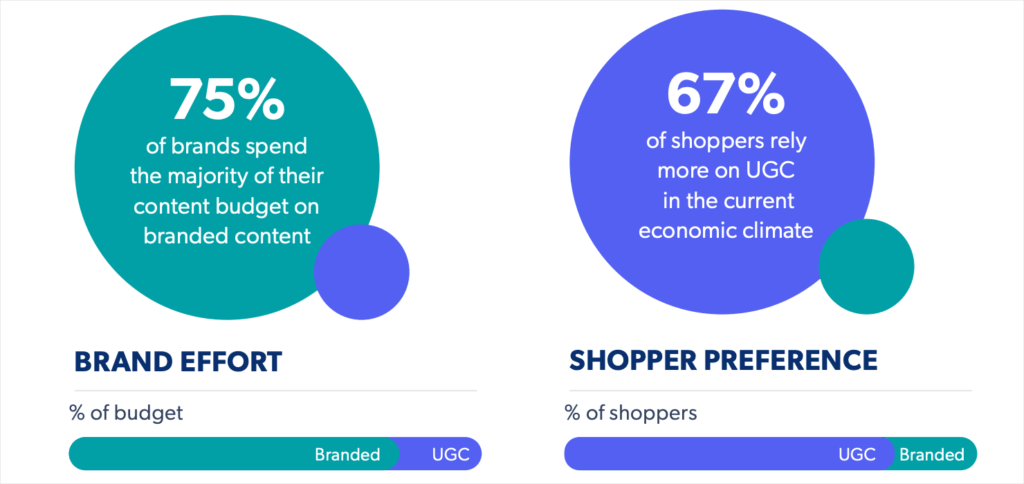
Most brands don’t have a content problem. They have a proof supply chain problem.
The evidence that should make you easy to choose is scattered across decks, inboxes, internal docs, customer calls, and tribal knowledge. So when people skim, sanity-check, and share privately, they can’t quickly find the bits that make you feel solid. They grab whatever is easiest to reach, comments, reviews, old threads, a screenshot from someone else.
Fix how proof moves through the business, and social gets calmer. Not quieter, calmer. It becomes a system that makes you easier to understand, easier to trust, and easier to repeat.
Two shifts are making proof more valuable
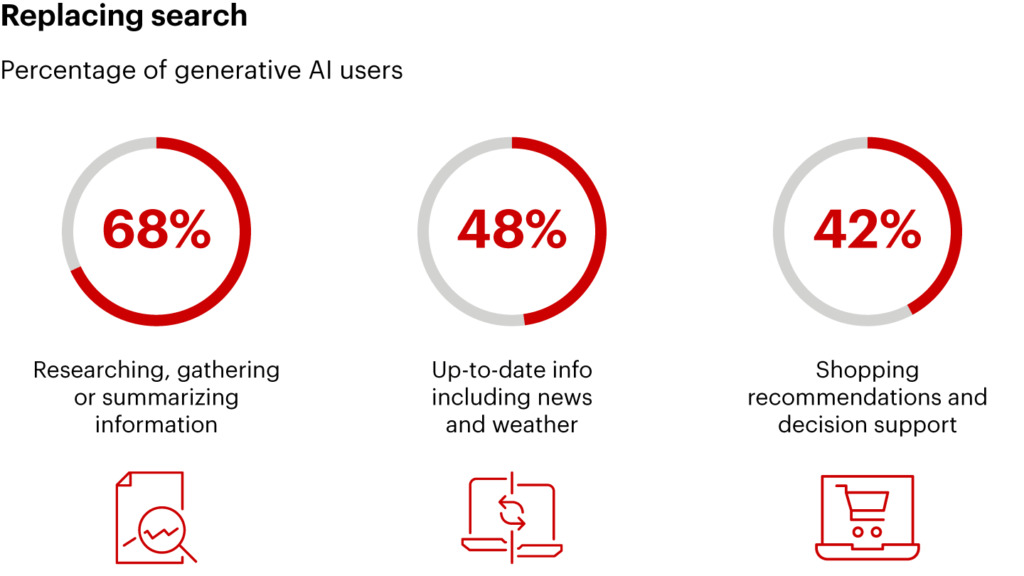
First, more decisions are being shaped without the click.
Bain talks about a zero-click reality where 80% of consumers rely on zero-click results for at least 40% of their searches, and estimates organic traffic is down 15–25% as a result. Bain on zero-click search
Second, people are faster at deciding whether something is worth their time.
Nielsen Norman Group’s work on information foraging is a good explanation, people follow “information scent”, and abandon the trail the moment the next step looks like effort with uncertain reward (well a good read if you avoid the ghastly metaphor). NN/g on information foraging and NN/g on information scent
Put those together and you get a useful lens.
People aren’t browsing for inspiration. They’re hunting for enough certainty to buy.
That’s not cynical. It’s efficient. We’re all doing it.
So the brands that win aren’t necessarily the loudest. They’re the easiest to verify.
Your best proof is trapped inside the business
Most organisations already have excellent evidence.
It’s just living in places buyers will never see.
For consumer brands, that’s customer service transcripts, product team notes, returns reasons, store staff feedback, delivery complaints, recipes and usage tips, safety guidance, the answers people keep asking on Instagram and TikTok, the bits that get said in reviews but never make it onto the product page.
For B2B brands, it’s customer success notes, sales call recordings, support tickets, implementation plans, security Q&As, the internal slide that explains pricing, the real trade-offs, the stuff that makes a FD relax.
This is good news, because it means you’re not starting from scratch.
The job is to get that proof out of captivity and into a form that can travel.
Private sharing is the real distribution layer
Public engagement is lovely.
It is also an incomplete picture.
If you want a better mental model, assume the most important sharing happens where you can’t see it.
GWI found people are more likely to share via messaging platforms like WhatsApp and Facebook Messenger (63%) than on open social platforms (54%), and around 20% say they share only via private channels. GWI on dark social sharing
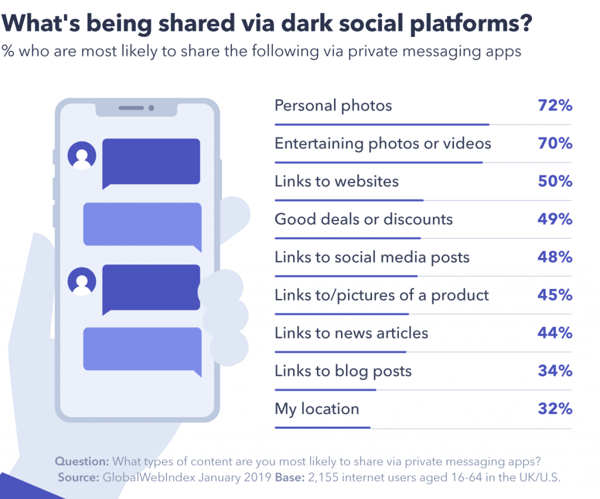
That matters because private sharing is often how people borrow certainty.
A link in a group chat is rarely “look at me”. It’s more like, “Is this any good?”, “Have you used them?”, “Am I being a mug?”
So the content that matters is the content that survives being forwarded.
The stuff that clarifies.
The stuff that makes the sharer look sensible.
The stuff that can be repeated without a paragraph of caveats.
Trust has become more forensic
People haven’t become miserable.
They’ve become experienced.
BrightLocal’s 2025 survey found only 42% of consumers trust online reviews as much as personal recommendations, down from 79% in 2020. BrightLocal consumer review survey 2025
That’s not “reviews don’t matter”. It’s “reviews are read like evidence now”.
People scan for specifics. They check dates. They look for patterns. They discount anything that sounds too perfect, because perfect usually means someone has been a bit scurrilous with the copy.
That habit doesn’t stop at reviews.
It shows up in how people treat brand claims.
If your proof is vague, inconsistent, or tucked behind a form, people don’t get angry. They just move on.
Fair enough.
The proof supply chain
If you want one mental model to take into planning, it’s this.
- Proof is a supply chain.
- You source it.
- You validate it.
- You package it.
- You distribute it.
- You refresh it.
Not because you adore process.
Because buyers keep asking the same questions, and you shouldn’t have to reinvent the answer every single time.
Here’s the table I use to map it.
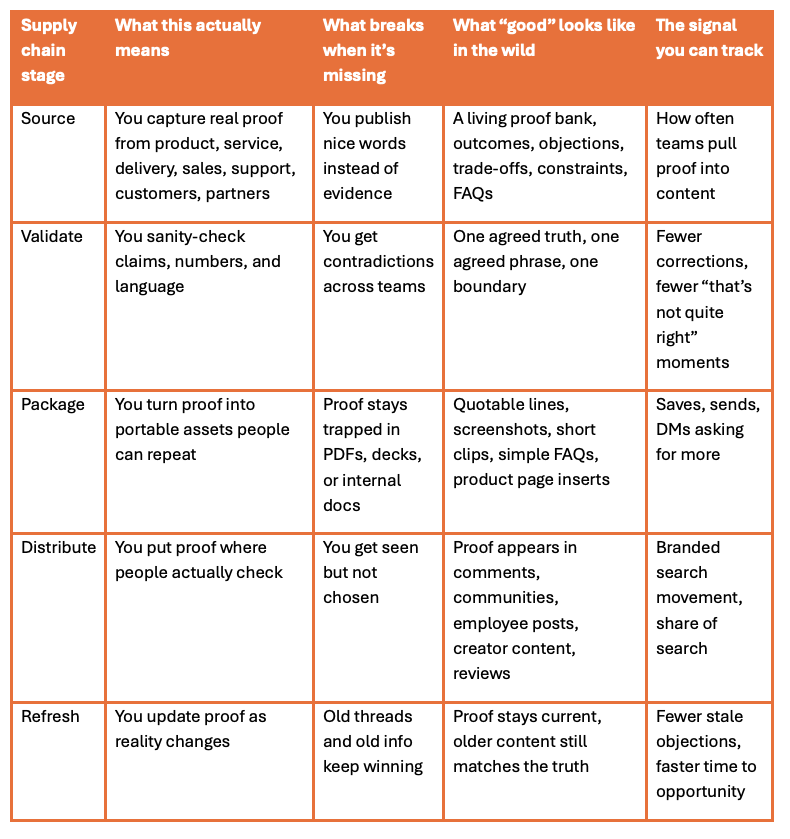
If you want the one-line test.
If your best proof you are worth buying can’t be forwarded, it’s not doing enough work.
How to use this without creating more busywork
This is the bit where most frameworks get a bit bleuch and make your life worse.
So let’s keep it sane.
You do not need more content or a cocktail of claims.
You need fewer, stronger truths, backed by evidence, repeated consistently, carried by humans.
Pick three repeatable truths.
Pick the proof that makes each one believable.
Pick the people who can carry it in public.
Then let the calendar serve that, instead of the other way around.
Because once the proof supply chain is in place, it starts feeling like you’re building something that holds.
If you want help
If you’re leading social at a big brand, you don’t need another lecture.
You need a system that turns what you already know into proof the market can actually use.
That’s what we do.
We don’t run your social.
We make it work, for growth, reputation, and pipeline.
FAQs on social proof
What do you mean by “proof” in marketing
Proof is the specific evidence that makes a claim believable and repeatable. It can be numbers, but it’s often specifics like what’s included, what isn’t, trade-offs, returns, delivery, security, setup, and real customer experiences.
Why does proof matter more on social now
Because people use social as a public checking environment. They skim, compare and validate quickly, then share privately. If proof is missing, they fill gaps using whatever they can find, comments, reviews, old threads.
What is a “proof supply chain”
A system for how evidence moves through the organisation so it can travel externally. Source the evidence, validate claims and language, package it into portable formats, distribute it where people check, and refresh it as reality changes.
What counts as proof for consumer brands
Returns and delivery clarity, sizing and ingredients/allergens, warranty/guarantee terms, real usage tips, review detail, customer service responses, and specific before-and-after outcomes.
What counts as proof for B2B brands
Implementation reality, security and compliance answers, pricing logic, trade-offs, customer outcomes with context, support experience, and credible practitioner commentary that matches the product truth.
What should we measure if proof is working
Look for signals of verification and sharing: saves, sends, DMs asking for specifics, branded search movement, and fewer repeated objections showing up late in the journey.