


April 28, 2026
Marketing gets more useful the moment you start asking questions.
That is the point, and it’s the thread running through the webinar with the amazing Luan Wise, B2B marketing consultant, trainer and author (of 8 books!) Luan has spent years helping teams cut through panic and get back to stronger fundamentals, which is exactly why she was the right person for this discussion.
Too much marketing effort still gets swallowed by asks that sound practical on the surface. More posts. More reach. More followers. More signs of life that look busy and do very little to help a business make a better decision.
The way through is better questions.
Better questions sharpen the brief. They improve the work before anyone starts making it. They make reporting more useful. They help social do a more serious job. They give teams a way to push back, politely and intelligently, when the ask is not clear enough yet.
“Have I got what I need? Or am I just jumping into the tactical side of things?”
It is the kind of question that stops a team mistaking movement for progress. Most marketers are carrying a lot, moving quickly, and trying to do a decent job in conditions that are not exactly calm and spacious.
NIQ found that 74% of CMOs are under more scrutiny to prove marketing ROI. It also describes leaders trying to prove impact while dealing with fragmented data, leaner teams, and a growing pull towards short-term conversion. So the pressure is very real. The difficulty is that the pressure can easily get translated into shallow asks. More posts. More followers. More reach. And before long, the team is working very hard without getting much closer to the commercial answer the business wanted in the first place.
Questions are a commercial tool
Questions are not just a soft skill. They are a commercial skill.
They shape what gets prioritised, what gets measured, what gets challenged, and what gets waved through. They decide whether social is being used to support business goals or simply to keep the feed warm.
“We’re not having the solid strategic questions early enough.”
I think that is exactly right.
A lot of marketing conversations still start with the detail too early.
That is happening at the same moment marketers are trying to work with more complexity, not less. Brandwatch’s 2026 research found only 25% of marketers say they understand their audience very well, while 79% say they are spending more time managing AI and automation workflows. That is a lot of noise to cut through before anyone has even got to the actual point of the work. Best time to post. How many posts a week. Which channel. What format. Those questions are fine once the foundations are in place. They are much less helpful when the team has not yet agreed what success looks like, what the work is supposed to change, or what role that activity is actually playing.
The better questions are usually simpler and slightly braver.
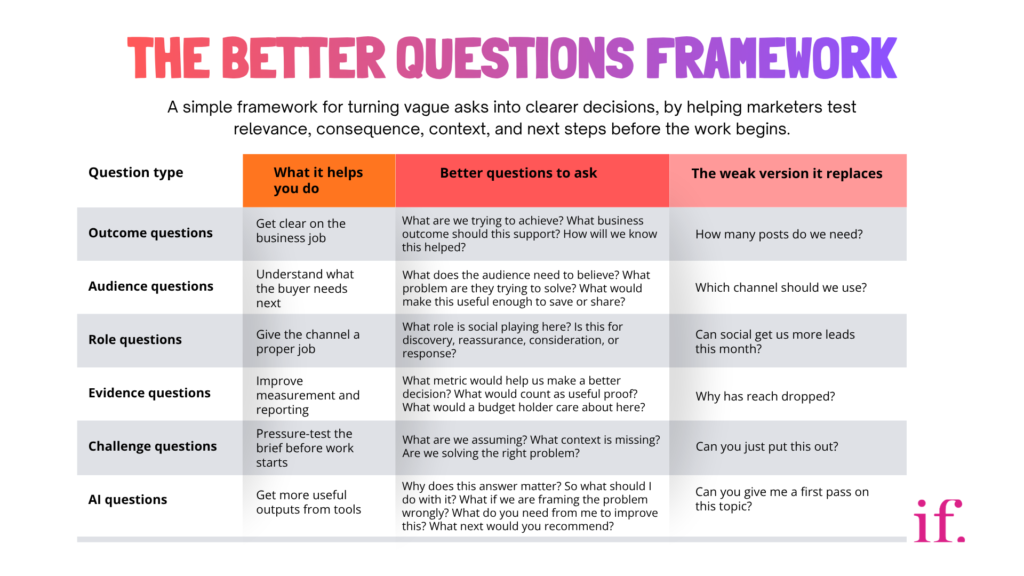
- What are we trying to achieve here.
- What outcome matters.
- What does success look like from the business point of view.
- What does the audience need to believe or understand before they act.
- What would make this useful.
Those questions do not slow things down. They stop waste.
A simple way to make this more practical is to sort your questions by what they are there to do.
Good marketing starts before the content
Good marketing starts before the content.
It is shaped in the brief. In the assumptions. In the context that gets included or missed. In whether the team has enough space to understand what the work is there to do before the rush begins.
“Tell me what the problem is, and then let me help diagnose the root.”
That is such a useful line because it shifts the marketer’s role. It puts you back in the position of helping the business think, rather than simply producing what was requested as fast as possible.
This is also why I still have a lot of time for old frameworks. Not because I want marketing to disappear into box-filling, but because a good framework slows the team down just enough to see the problem more clearly.
SWOT, PESTLE, weighted decision matrices, simple prioritisation tools. They are still useful when they help you look at the issue from different angles, choose properly, and explain your thinking later.
Luan’s broader point on future-ready marketing is very good here. Her model is not breathless or trend-led. It is built on strong fundamentals, supportive technology, and better decision-making. That feels much more grown-up than pretending the answer to everything is a shinier tool or a faster content cycle.
“Take steps back to be able to move forward.”
That is probably a good line for more of us than we’d care to admit.
Future-ready does not mean shinier
Future-ready marketing is more practical than fashionable.
AI matters. Tools matter. Technology matters. Of course they do. They can save time, help synthesis, support planning, and make the mechanics of the work lighter.
But only when the thinking is decent to begin with.
“If your post isn’t great, and it isn’t aimed at the right audience, and all those other things, it doesn’t matter when you’re going to post it or how many times you post it.”
A vague brief does not become clearer because AI helped it arrive faster. An unclear objective does not become more strategic because it got turned into a nice slide. Better tools still need better thinking.
That is why I liked the way Luan talked about AI as something that responds to the quality of your question and the context you give it. Used well, it helps you think further. Used without enough context, it tells you something that sounds plausible and often a bit generic.
The fix is not to get gloomy about AI. It is to use it with more discipline.
This is where the Why to what next framework comes into its own.
It is a simple sequence, but it does a lot of work.
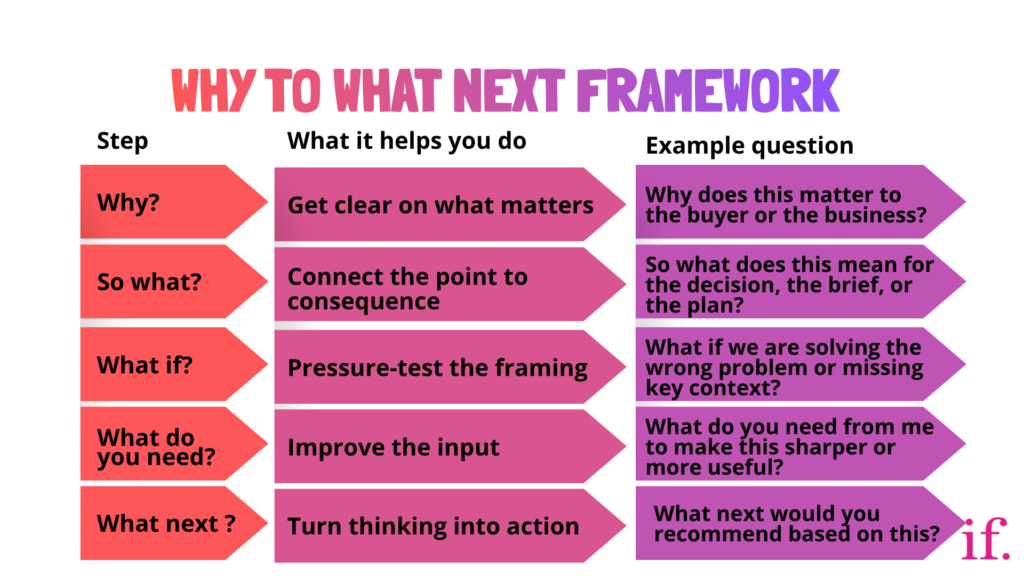
- Why helps you get clear on what matters.
- So what connects the answer to consequence.
- What if helps you test whether you are framing the problem well.
- What do you need improves the input.
- What next turns the thinking into a decision.
That is useful with AI, but it is just as useful in briefs, reporting, and day-to-day marketing conversations.
- Why does this answer matter.
- So what should I do with it.
- What if we are framing the problem wrongly.
- What do you need from me to improve this.
- What next would you recommend based on this.
There is something oddly reassuring in that. The future is not asking marketers to become robots. It is asking us to get better at judgement.
Thought leadership has a more useful job than looking impressive
It was not about building a giant personal brand. It was not about producing occasional heroic pieces of content and hoping everybody swoons. It was about helping the right people understand what you know, what you believe, and why your point of view is worth paying attention to.
“Thought leadership content doesn’t need to be big stuff.”
That is such a relief.
It gives marketers permission to think less about size and more about clarity, consistency, and proof. It also makes social more useful, because social is often the place where that credibility matters.
“You don’t need to be a thought leader amongst hundreds of thousands or millions of people. It’s more in your niche, in your topic, and that’s kind of where the magic happens.”
That is the right lens, I think. Niche authority. Specific expertise. Repeatable proof. A clear stance. Enough consistency that people know what you stand for. That is far more commercially useful than looking famous in the abstract.
There is good evidence for that too. Edelman and LinkedIn’s 2025 thought leadership work found 95% of hidden buyers say strong thought leadership makes them more receptive to sales and marketing outreach, and 79% are more likely to champion a vendor during an RFP if that vendor consistently publishes quality thought leadership.
If you want social treated seriously, explain it better
There is still a credibility gap around social in plenty of organisations. We all know the familiar lines. My son does that. Can we make it go viral. Why has the reach dropped. Can you just put this out.
I do understand where some of that comes from. People know social from personal use. They see the visible layer. They do not always see the role it plays in trust, discovery, reassurance, early evaluation, and commercial confidence.
That is why I think one of the marketer’s jobs now is to market marketing a bit better. Especially social.
We have seen this ourselves in the way we built the LinkedIn Commercial Check. The point of that diagnostic was to look past posting frequency and surface engagement and ask sharper questions instead. Is the page making the business easier to understand? Easier to trust? Easier to choose? Is it building clarity, credibility, and commercial confidence with the people you actually want to reach? Those are much more useful questions, and they tend to lead to much better decisions.
If this is the bit that has made you sit up a little, give the LinkedIn Commercial Check a go. It is useful because it helps you step out of day-to-day posting mode and look at your page the way a buyer, budget holder, or nervous stakeholder might. You get a sharper sense of whether your LinkedIn presence is building commercial confidence or just keeping busy.
Explain the role of the work. Explain the choices. Explain what changed. Explain why that matters.
“What do you mean by that? What do you think that will deliver? How does that impact? What value will the business get out of it?”
Not because we want to sound clever. Because it helps the business make better decisions, and that is usually when marketing starts earning back confidence.
Better questions do not add work. They remove waste.
That is probably the most hopeful thing I took from the session.
This is not about turning marketing into a philosophy seminar. It is about making a pressured job more doable.
- A better question can save a team from an unclear brief.
- A better question can improve the quality of the content before anyone starts making it.
- A better question can stop reporting from turning into admin.
- A better question can make AI more useful.
- A better question can help social hold a more serious place in the business.
Luan’s framing of future-ready marketing is a very good one to keep hold of because it brings the whole thing back to earth. Strong fundamentals. Supportive technology. Better decision-making.
And in practical terms, that preparation often starts with something very small.
Pause.
Ask a better question.
Then start.
Which is also why I’d suggest trying the LinkedIn Commercial Check if you want a practical place to start. It is a quick way to pressure-test the questions you are asking of your page, your content, and the role LinkedIn is playing in the wider commercial story.
That is a much better place to begin than another debate about the best time to post.
Sources
https://nielseniq.com/global/en/insights/report/2025/cmo-outlook-for-2026/
https://www.brandwatch.com/webinars/marketer-of-2026/
https://www.oktopost.com/blog/b2b-social-drives-engagement-and-lead-generation-oktopost-research/
https://www.edelman.com/insights/hidden-buyer-b2b
https://6sense.com/science-of-b2b/buyer-experience-report-2025/
https://immediatefuture.co.uk/resource/the-linkedin-commercial-check/
FAQs on asking better questions
Why do better questions make marketing easier?
Better questions make marketing easier because they reduce wasted effort early. Instead of jumping straight into output, they help teams clarify the brief, the business outcome, the audience need, and the role of the channel before work begins. That leads to clearer priorities, more useful reporting, and content that is easier to defend internally. It also helps marketers push back politely when the ask is still fuzzy. In practice, better questions save time because they improve judgement before the activity starts.
What questions should marketers ask before creating content?
Marketers should ask what they are trying to achieve, what outcome matters to the business, what the audience needs to understand or believe, what role the channel is playing, and what signal would help the team make a better decision next. These questions are more useful than asking only about posting frequency or reach because they improve the work before it is made. They also make it easier to connect content to commercial value, not just activity.
How should marketers use AI when planning content or strategy?
AI is most useful when it helps marketers think further, not when it replaces thinking. A practical way to use it is through the Why to what next framework: why does this matter, so what does it mean, what if the problem is framed wrongly, what do you need from me to improve this, and what next would you recommend. That sequence gives AI better context and usually produces more helpful outputs than a vague request for a post or plan.
What metrics matter more than surface engagement on social media?
Surface engagement still has a role, but it is often more useful to pay attention to signals such as saves, shares, screenshots, reuse by sales teams, and content that helps someone explain a point internally. These signals suggest the work is being kept, used, and carried forward. Oktopost’s 2025 LinkedIn research also shows there is often a trade-off between engagement and clicks, which is why marketers need to judge a post by the job it is doing rather than by one metric alone.
How can marketers check whether their LinkedIn page is doing a commercial job?
A useful starting point is to stop looking only at posting frequency and surface engagement and ask sharper questions instead. Is the page making the business easier to understand, easier to trust, and easier to choose? Is it building clarity, credibility, and commercial confidence with the people you want to reach? That is the thinking behind Immediate Future’s LinkedIn Commercial Check, which helps teams look at their page from the perspective of a buyer, budget holder, or stakeholder rather than just a channel manager.
What is the difference between tactical questions and strategic questions in marketing?
Tactical questions focus on execution details such as timing, volume, and format. Strategic questions focus on outcome, audience, channel role, and commercial value. Tactical questions matter, but they are more useful once the strategy is already clear.
Why do shallow questions lead to weak marketing?
Shallow questions tend to pull teams towards activity signals rather than business outcomes. That can make the work look busy while making it harder to explain why it matters.
Do better questions help with ROI reporting?
Yes. Better questions help teams define success earlier, choose more relevant signals, and connect activity to consequences the business actually cares about.
How do better questions help with social media strategy?
They give each channel a clearer job to do. That makes it easier to decide whether a post is there to support discovery, reassurance, credibility, consideration, or response.