


January 14, 2026
Buyers are hunting answers, and social is deciding who they trust
The short answer
Mahoosive behaviour change for customers is already here.
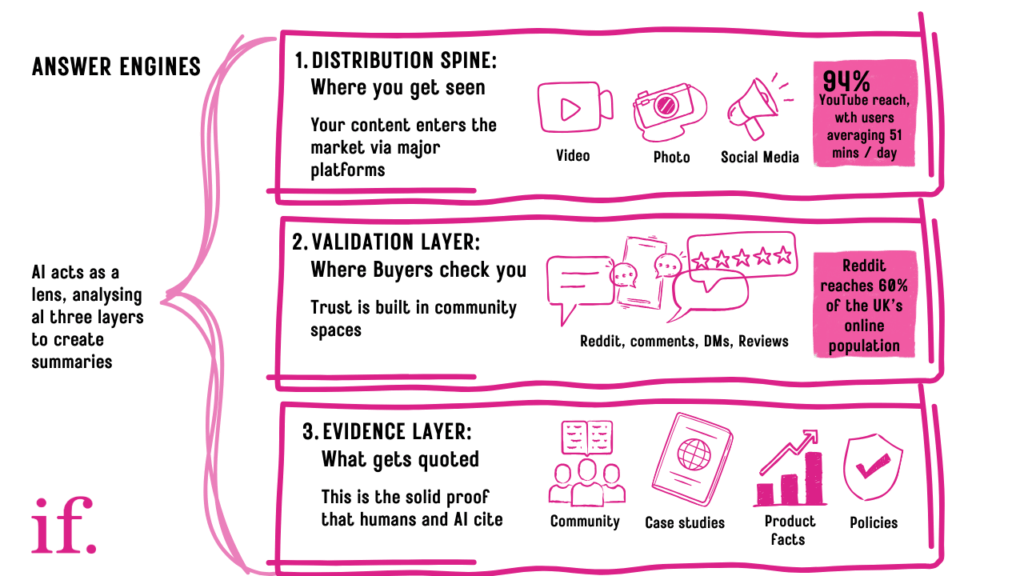
Search is being replaced by an answer layer, and social is feeding it. When Google’s AI Overviews show up, people click less, sessions end sooner, and your carefully-crafted story gets compressed into a summary you don’t control. And social search is the infrastructure.
Meanwhile, Reddit has become the UK’s fourth most visited social platform, reaching 60% of online adults, largely because Google is surfacing forum content and AI models are citing it. This is the new attention stack: YouTube, Facebook and Instagram still dominate time, TikTok owns attention, and communities act like the public FAQ.
The strategic move for brands is to become cite-able, consistent, and genuinely useful across the places buyers validate. Treat trust as the KPI, build an evidence trail that models can quote, and measure discovery.
Why I’m banging on about this now
Every January, marketing fills up with plans, priorities, and shiny new calendars.
I’m more interested in the stuff that breaks those plans by February.
The biggest one is simple. Discovery isn’t a journey any more, it’s a selection process. Your buyer gets an answer, a snippet, a thread, a recommendation, then they decide what deserves their attention.
If that answer layer gets your brand wrong, or skips you entirely, your “plan” becomes a nice internal document.
What has actually changed
Google is rolling AI Overviews into search at scale. Ofcom reports that around 30% of keyword searches deliver AI-supported summaries, and 53% of people say they often see them.
That matters because the user’s behaviour changes. Ofcom summarises research showing people who see AI Overviews are far less likely to click through, and more likely to end the session.
At the same time, Google’s ranking changes have boosted forums. Reddit’s UK reach has jumped fast, and it’s now sitting in the top tier of platforms by monthly reach.
This is why your social strategy can’t be treated like “brand awareness on the side”. It’s now part of the data layer that trains models, shapes what gets cited, and decides which brands feel credible.
The six moves shaping 2026 discovery
1) The citation economy
A lot of teams still optimise for clicks.
Clicks still matter, but citations are now the upstream battleground.
If your audience gets an AI Overview, they may never land on your site. Your content has to work even when it’s reduced to a sentence, or pulled into a summary next to competitors.
The uncomfortable bit is brand safety. We’ve already seen high-profile examples of AI summaries getting things wrong, including around health information, which shows how messy this can get.
Our view
You need a “cite-able” layer of content, built to be quoted accurately.
This is not a new SEO checklist. It’s a trust system.
What that looks like in practice
Clear, stable answers to the questions buyers ask, written in plain language, backed by proof.
A consistent set of facts across your site, social, spokesperson content, and third-party profiles.
A deliberate point of view that’s hard to confuse with anyone else’s.
Sector lens
B2B tech and finance: buyers want certainty, compliance clarity, proof, and minimal regret.
Consumer electronics and travel: buyers want reassurance, comparisons, lived experience, and “what happens if it goes wrong”.
2) Reach is not attention
UK reach stats are still impressive, but attention is uneven.
YouTube reaches 94% of UK adult internet users and averages 51 minutes a day. Facebook and Messenger reach 93% and average around 43 minutes. Instagram reaches 78% and averages 20 minutes.
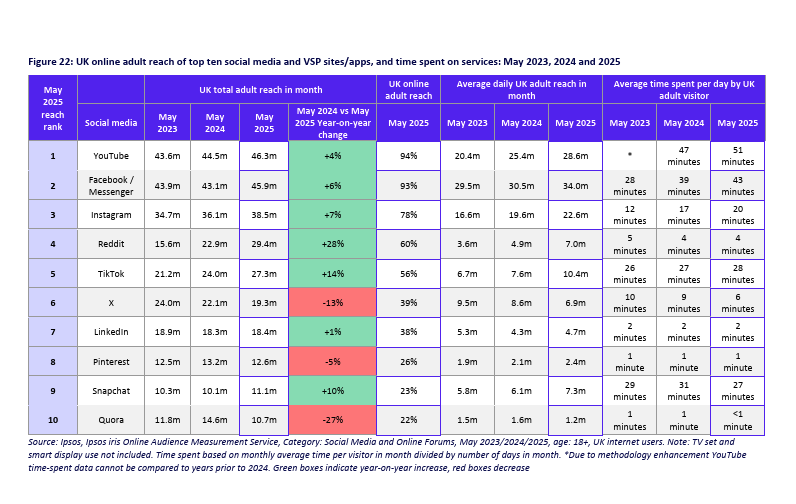
TikTok’s overall reach is 56%, but among 18–34s time spent is far higher.
This is why “we need more reach” is rarely the real problem. The issue is usually relevance, usefulness, and the ability to earn time.
Our view, treat attention as a scarce resource, not a distribution problem.
For senior marketers, this becomes a planning discipline. It changes how you brief creative, how you prioritise channels, and how you defend budgets.
Oh and stop treating platform reach like a proxy for impact.
Plan content around the job it does for the buyer, and the state they’re in when they see it.
If you cannot say what your content is for, your audience will scroll and your data trail will teach the algorithms you’re ignorable.
3) Reddit has become the public FAQ
Reddit now reaches 60% of UK online adults, with daily reach at 7.0m.
Time spent per visitor is low compared to entertainment platforms, which tells you what it’s being used for. Drop in, decide, validate, leave.
Ofcom also notes that Reddit has agreed deals allowing its content to be used as training data for LLMs. That’s part of why it keeps showing up.
This is a big shift for brands, because the buyer’s “truth” is often being formed in community language.
Most brands should treat Reddit as a research and narrative environment first, a participation channel second.
When brands do engage, it has to be human, specific, and genuinely helpful. Anything else reads like marketing and gets binned.
Observe and mine language. Use it to understand the questions buyers really ask, the objections they have, the words they trust. Oh and participate with care, through credible humans with a clear mandate and a proper voice.
Build partnerships with creators and community voices who already have legitimacy.
4) Two ecosystems still own half our time
Ofcom reports that half of time online is spent on services owned by Alphabet or Meta.
This creates a strategic trap. Brands think they’re building diversified marketing, but behaviour is still heavily concentrated.
It also creates a dependency risk. When these ecosystems change the rules, your pipeline feels it.
Your job is to reduce single-point-of-failure marketing. That doesn’t mean doing everything everywhere. It means building assets, proof, and narratives that travel across the two dominant ecosystems, plus the community layer where validation happens.
5) Social is still the dominant media format
GWI’s numbers are the clearest antidote to lazy “social is dying” takes.
Global weekly time spent on social is 7:06, and short-form video is 6:39. Combined, that’s about 13.5 hours a week, more than broadcast TV, streaming, and radio combined.
This matters because attention follows habit. Social is where people learn, decide, and pick what feels trustworthy.
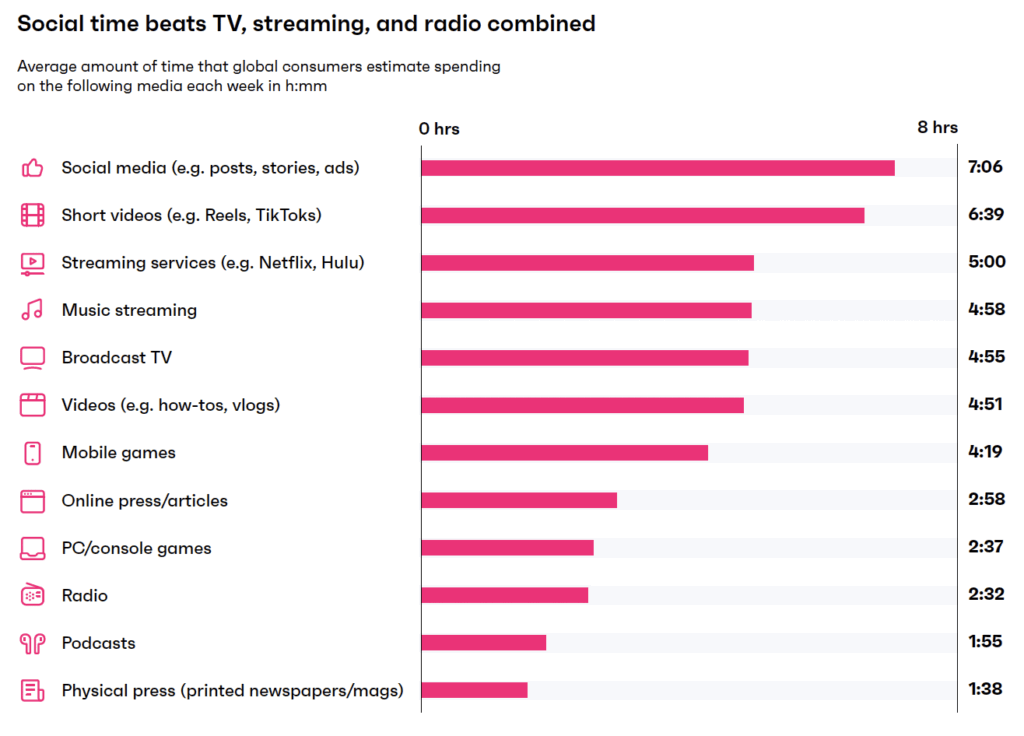
Our view, stop treating social as content distribution. Treat it as discovery infrastructure.
If you want to be found in search and AI, you have to show up in the places those systems learn from. Social is one of those places.
6) Multi-networking is flourishing, and it changes how you plan
GWI reports that 1 in 5 consumers are active on more than 10 platforms, and 1 in 4 Gen Z.
People aren’t “on a platform”. They’re in a behaviour.
Keeping up with friends and family is still the top reason for social, but “filling spare time” is right behind it. That tells you a lot about the mindset your content lands in.
Our view
Planning by platform is too blunt.
Plan by behaviour, intent, and proof needs.
Then execute with platform-native craft so it feels like it belongs there. You need a single narrative spine, with local platform expression.
So what should brands do with this
You do not need a bigger plan.
You need a sharper definition of what you want the world, and the machines, to be confident about.
Three recommendations we’d bet on.
- Build an evidence trail.
- Make sure your proof is easy to find and easy to quote
- Be consistent across channels.
The year-ahead plan most teams are writing assumes the world will politely stay the same.
It won’t.
Discovery is becoming a contest for credibility, citations, and community validation. Brands that treat social as infrastructure will earn attention, trust, and pipeline resilience. Brands that treat it as content scheduling will be shouting into the void, then blaming the algorithm.
If you want to talk this through
If you’re feeling the pain of being harder to find, harder to trust, and harder to measure, we can help.
We’ll map where your category is being decided, what language buyers trust, and what proof the answer engines are already using. Then we’ll build a simple, resilient system that makes social work for the business.