


April 29, 2026
Social content now has a longer commercial life
You’re being asked to prove social is driving growth, and half your content disappears before it’s even had a chance to matter.
Post it, watch it, report it, move on. That used to be the rhythm of social, and to be fair, it made sense when feeds felt more fleeting.
It does not reflect how people make buying decisions now. They keep useful posts. They come back to them. They send them to colleagues. They search the brand later. They use public content to work out whether you sound credible, consistent and worth a second look.
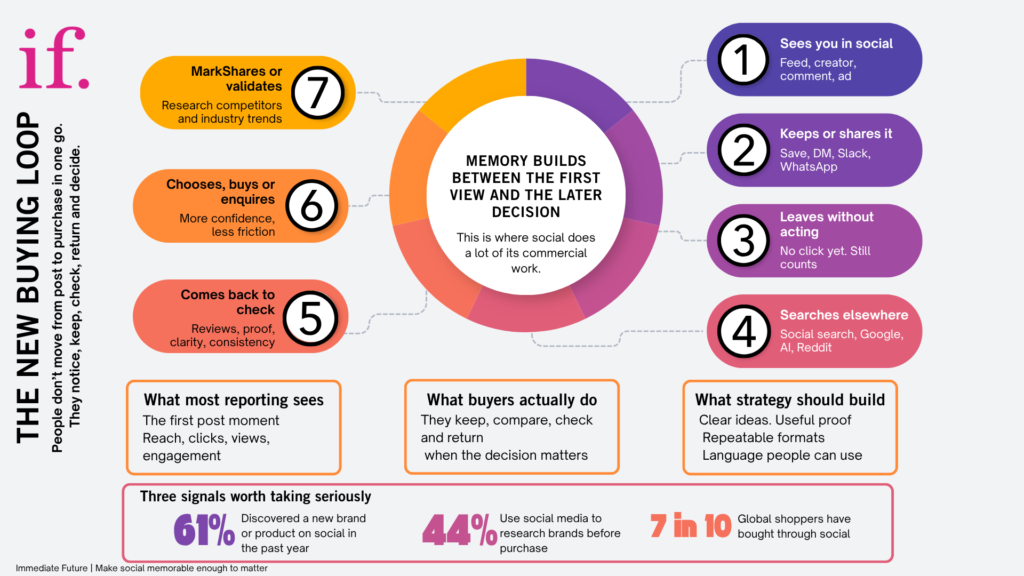
That gives social a bigger job. It has to earn attention on the day and build memory over time. The first job gets you seen. The second helps you get chosen.
Posts fade, memory compounds
Performance is moving from one-off spikes to accumulated memory. People watch, save, revisit, share, search and recognise. Those behaviours shape what they see next and what they trust.
A post can become a cue, a proof point, a reminder, a sales asset, or the thing someone forwards when they need to make a case internally. That is a serious commercial role, and it deserves a better measurement story than “engagement was up”.
This is where social starts to look like a memory system. I know that sounds a bit grand (and maybe a wee bit overblown), but it is what is happening. Public content now gets searched, summarised, reused, quoted, cropped and passed around in ways that rarely show up cleanly in a dashboard.
Old posts can still create new signals
Platforms learn from behaviour. what people watch, come back to, keep, share and look for again all give the system clues about what people find useful.
A buyer might see your post today and save it for later. A colleague might search your brand weeks after that. Someone else might watch more from the same expert. Another person might ask an AI tool and receive an answer shaped by public content, source consistency and brand clarity. You get the gist eh?
The data is already pointing in that direction. In 10Fold’s 2025 content research, social media was the top place qualified prospects first heard about a company at 46%, with AI search platforms second at 34%, ahead of organic search, email and paid media. Discovery is happening across social, search and AI, often before you know who is looking.
It is harder to measure cleanly, but it is too important to ignore.
Memory is a growth job
If people cannot recall you, they will find it harder to choose you. If your message changes every month, trust becomes harder to build. If your proof is scattered, buyers struggle to use it.
There are five levers that make memory work, and they are often missed because teams are too busy feeding the calendar.
Familiarity makes you easier to choose
Repeat the core idea and keep your point of view steady. People should be able to place you quickly without having to work too hard.
There is solid evidence behind this. Repetition research shows repeated exposure strengthens recognition and recall. One advertising study found recall of message content increased significantly with repetition, while summaries of repetition research point to the same broad truth: repeated exposure helps ideas stay retrievable later.
My view is simple. If your audience has to relearn what you stand for every time you post, your social programme is making the buyer do too much work.
Repetition with variation keeps the idea alive
Same idea, different angle. Same point, different format. More routes back to the same message, without the feed feeling like a broken record.
The memory literature supports this. Research on spaced learning found that introducing variations across repeated exposure can improve memory performance. For social, that means one strong thought can appear through different hooks, examples, formats and moments.
Many brands change the thought too quickly. They mistake consistency for dullness and end up with activity that never has time to stick.
Recognisable formats reduce effort
If people know what they are looking at, they get to the value faster. Repeatable formats create a small moment of ease in a feed full of noise.
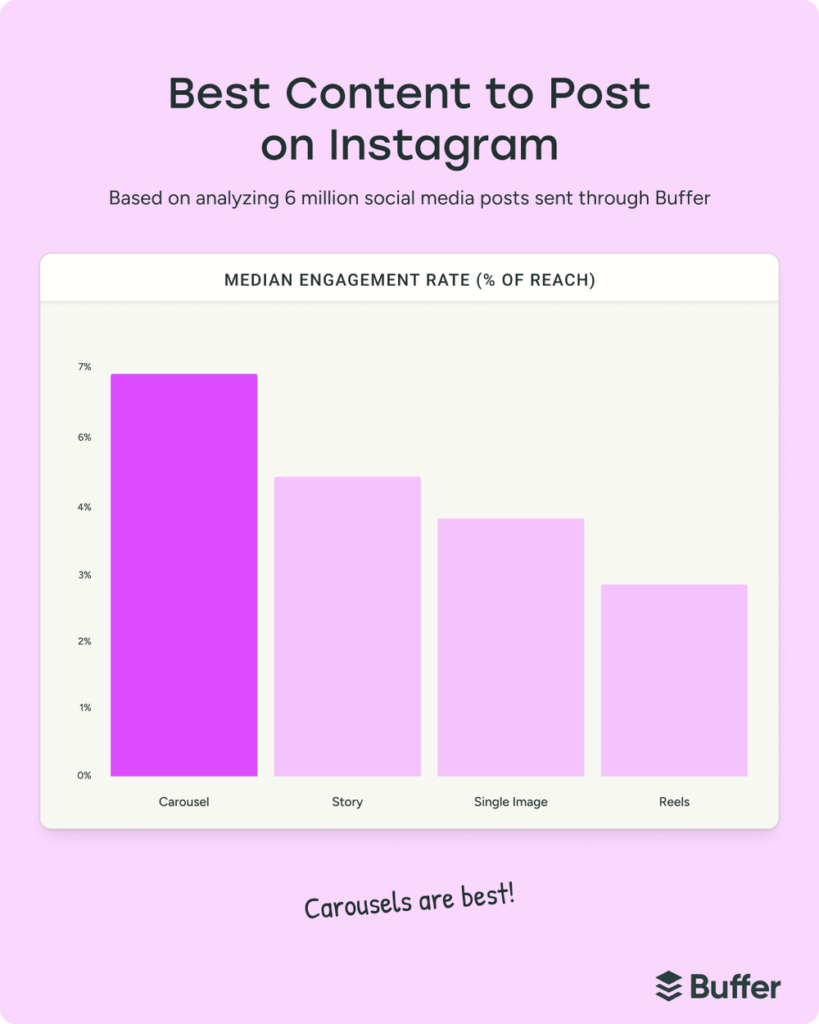
Carousels are a useful example. Buffer’s analysis found LinkedIn carousels had a median engagement rate of 22%, and Instagram carousels generated 109% more engagement per person reached than reels, even though reels reached more people. Another Instagram analysis found that for accounts with 50,000 to 500,000 followers, carousels had higher median reach than reels.
That makes structure worth taking seriously. A recognisable format helps useful thinking get kept.
Useful proof makes ideas travel
Give people something they can use. A stat, a clear example, a simple before and after, or a short demo or ‘using in real life’ moment they’d actually save and share. Think a supermarket post that clearly calls out allergens and substitutions, or a quick recipe that solves tonight’s dinner. If it helps someone make a decision or avoid a mistake, it will travel.
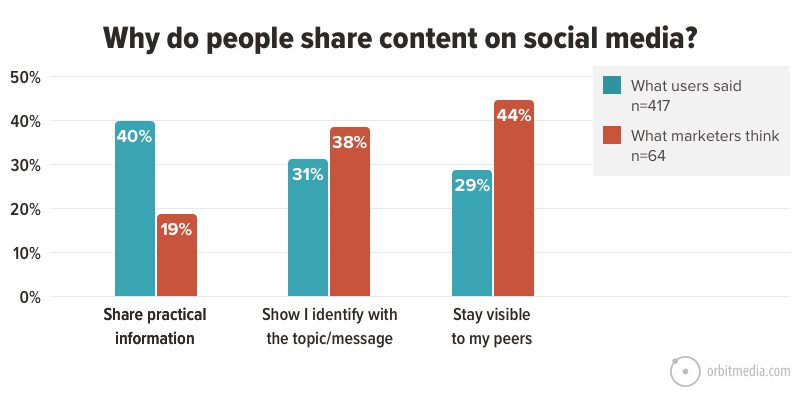
The New York Times Customer Insight Group found 94% of people share content because they believe it will be useful to others. That is the bit marketers should pay closer attention to. People share to help, to signal value, and to carry something into another conversation.
Broad claims disappear quickly. Specific proof travels further. “This campaign created £38m pipeline in 12 weeks” gives someone a line they can remember, repeat and defend.
Simple language makes it stick
Short, clear and easy to pass on. The job is to be useful enough that someone else can repeat the idea without mangling it.
Large-scale analysis of social comments found a trend towards shorter text and lower lexical complexity over time. That fits what we see every day. People are moving fast. They are half-reading, half-working, comparing, saving and forwarding.
Plain language is commercially useful. It lowers effort, exposes weak thinking faster, and gives good ideas a better chance of being remembered.
The pattern is simple enough to use: one strong idea, repeated with variation, in a format people recognise, backed by proof, written in language people can carry.
Remembered content gets used
Feeds learn from what people pause on, save, send and return to. Timing still matters, and consistency still matters, but volume on its own will not carry the strategy.
A stronger question is what behaviour you want people to associate with you. Saving your work. Coming back to it. Using it in a sales conversation. Mentioning it when they brief a colleague. Searching your brand because your content made the issue clearer.
I would be quite firm on this. A social strategy built around post count is measuring busyness. A better strategy builds around what people remember, use and repeat.
Build content people can keep and use
Content that builds memory tends to do four things well, and it does them consistently.
It is easy to recognise, with a clear point of view and steady themes. It is worth keeping, because people know they will need it later. It carries proof, so it can hold up in a conversation. It creates learning, so you know what to keep, stop or change.
Repeatable series work well when they are built with care. The format gives the audience a shortcut. The variation keeps the idea alive. The proof gives people something to carry. The language makes it repeatable.
Measure what people keep, use and act on
The pressure to prove social will keep rising, and too much reporting still leans on the easy numbers.
Sprout Social’s 2025 report found marketing leaders believe social drives awareness, customer acquisition, loyalty and revenue. Less than half rated their social teams as expert at measuring business impact. That gap matters. Leaders believe social has value, but many teams still struggle to turn that belief into evidence budget holders can use.
You need a fuller picture. Immediate signals show whether something earned attention. Memory signals show whether it had future use. Commercial signals show whether it helped move the business.
Immediate signals include reach, views, watch time and engagement. Memory signals include saves, sends, repeat visits, profile views, branded search and content reused by sales. Commercial signals include quality of inbound, influence on deals, better conversations and faster movement.
No single number will do this job. Together, they give you a more credible story. The job is to make social’s contribution visible, believable and useful.
Social influences the whole buying journey
At discovery, social builds recognition. During consideration, it helps people compare. Around the decision, it reduces doubt. After purchase, it supports confidence.
This is especially true in B2B, where decisions are rarely made by one person and rarely follow a straight path. Forrester’s 2025 predictions point to younger B2B buyers using wider external networks, including social media and online communities, to support purchase decisions.
That makes public proof a serious asset. It helps the buying group make sense of you before anyone has filled in a form, booked a call, or admitted they are looking.
We make social work as a system.
That means clear strategy, strong proof, consistent execution and ongoing learning. Social has to do more than look busy. It has to support real decisions.
My view is that many brands are still underplaying this. They are using social to feed the week when they could be using it to build memory, proof, trust and preference over time.
Make social memorable enough to matter.
https://www.deloittedigital.com/us/en/insights/research/state-of-social-research-2025.html
https://wearesocial.com/uk/blog/2025/12/the-global-trends-that-shaped-social-in-2025/
https://www.dhl.com/global-en/microsites/ec/ecommerce-insights/insights/reports/2025-social-commerce-trends.html