


June 8, 2026
The social commerce system behind 6x ROAS
A 6x ROAS on high-ticket sports equipment is an exceptional result. We saw this first-hand with Motocaddy, where a joined-up approach to social, paid activation and measurement delivered approximately 6x ROAS. With paid social ROAS for sporting goods brands often sitting between 2x and 4x, achieving 6x reflects far more than increased content output or media spend. It is the outcome of a well-engineered social commerce system.
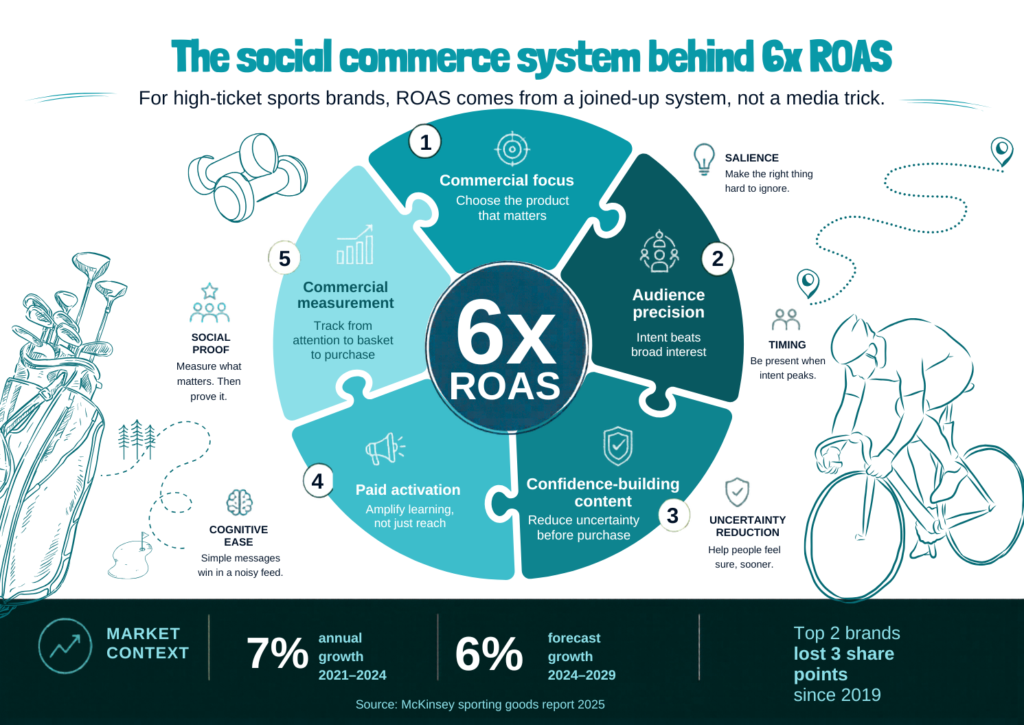
The result comes from alignment. Social is not merely generating awareness; it is advancing prospective buyers towards a decision. Content resolves uncertainty before it becomes friction, paid activity learns from stronger behavioural signals, the ecommerce journey exposes where confidence is gained or lost, and measurement reveals what genuinely influenced purchase behaviour.
That distinction matters because sports marketers are operating in a more demanding environment. Consumers continue to invest in sport, fitness and outdoor pursuits, but purchasing decisions are increasingly deliberate. According to McKinsey, the global sporting goods market grew by around 7% annually between 2021 and 2024, but growth is expected to moderate to approximately 6% through 2029. At the same time, challenger brands continue to gain share while marketing budgets face greater scrutiny.
The challenge is straightforward: how do you sustain growth when acquisition costs rise, buyers become more selective and every pound of investment must justify itself?
For high-ticket DTC sports brands, social can provide a compelling answer, but only when it is treated as a commercial growth mechanism rather than a communications channel.
The Motocaddy result was not driven by a single campaign or creative execution. It came from understanding how buyers move from discovery to purchase and designing a social programme that supported each stage of that journey.
As CJ says when asked about the campaign:
“Social media is not a media channel. It’s a behaviour.”
Brands that understand that distinction are typically the ones converting social activity into measurable commercial growth.
The sale is harder when the buyer needs trust before they spend
High-consideration sports purchases behave differently from low-cost impulse buys. The investment is greater, the decision cycle is longer and buyers require more confidence before committing. Decisions are rarely spontaneous. Instead, consumers compare alternatives, evaluate specifications, seek validation and gather enough reassurance to justify the expenditure.
This pattern is consistent across the sector. Whether someone is investing in performance equipment, premium apparel, technical footwear or specialist outdoor gear, they are assessing value, credibility and suitability. The purchase is seldom triggered by a single piece of content or promotion. It is the culmination of multiple interactions that build conviction over time.
These purchases are driven as much by confidence as desire. That is why social must do more than create visibility. A golfer considering a new trolley, a cyclist evaluating an upgrade or a runner researching premium footwear often uses social as part of the decision-making process. They are looking for evidence, reassurance and signals that validate their choice.
For DTC sports brands, social frequently sits within the research phase of the customer journey, shaping perception long before the transaction occurs. Motocaddy illustrates this perfectly. Buyers were not making impulse purchases; they were researching products, comparing alternatives and seeking confidence before spending. Social therefore needed to facilitate decision-making rather than simply generate reach. Content, targeting and paid activation worked together to reduce hesitation and strengthen trust.
When that happens, social becomes a revenue driver rather than another marketing channel.
Audience precision is where performance begins
“People interested in golf” is not a buyer audience.
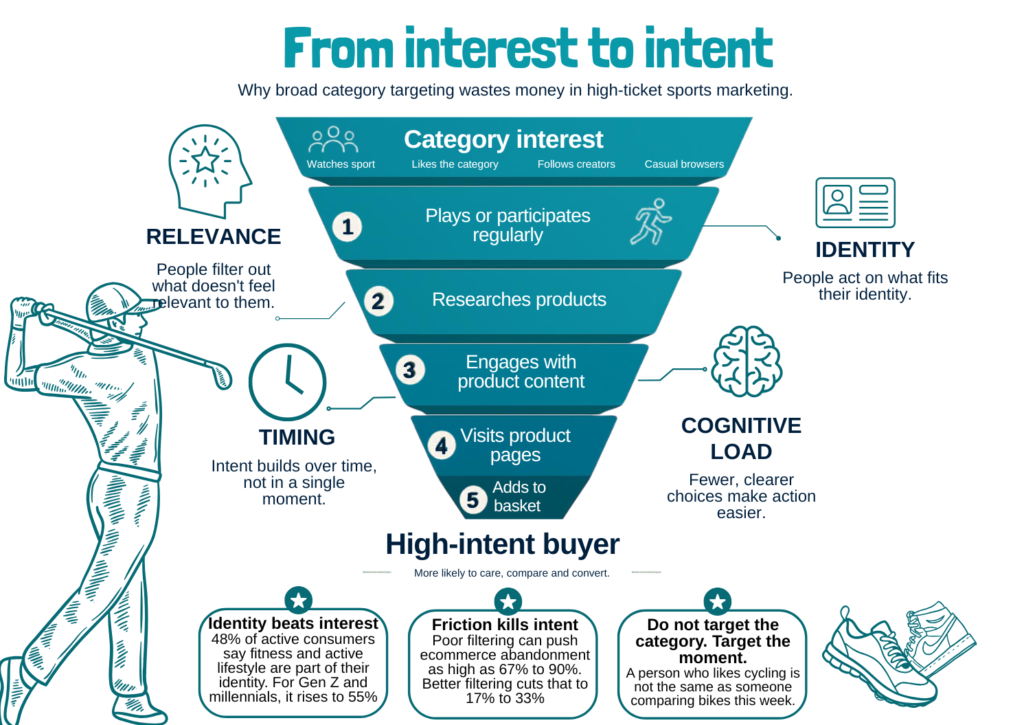
It sounds logical, but it encompasses everyone from committed golfers actively researching equipment to casual fans who simply watch tournaments. The same challenge exists across cycling, running, fitness and outdoor categories, where interest alone is a weak predictor of purchase intent.
One of the most valuable lessons from the Motocaddy programme was the importance of identifying stronger buying signals. Rather than relying on broad category audiences, we focused on behaviours that indicated genuine intent. That gave paid activity a stronger foundation and ensured content reached people with a higher propensity to convert.
The shift appears subtle but changes everything. Instead of asking who likes the category, marketers begin asking who is exhibiting behaviours associated with purchase. That distinction improves efficiency, relevance and ultimately commercial performance.
Organic content still matters, just differently
Organic social has evolved. Public engagement metrics are less visible than they once were, leading some marketers to question its value. The reality is that organic content remains influential; its role has simply changed.
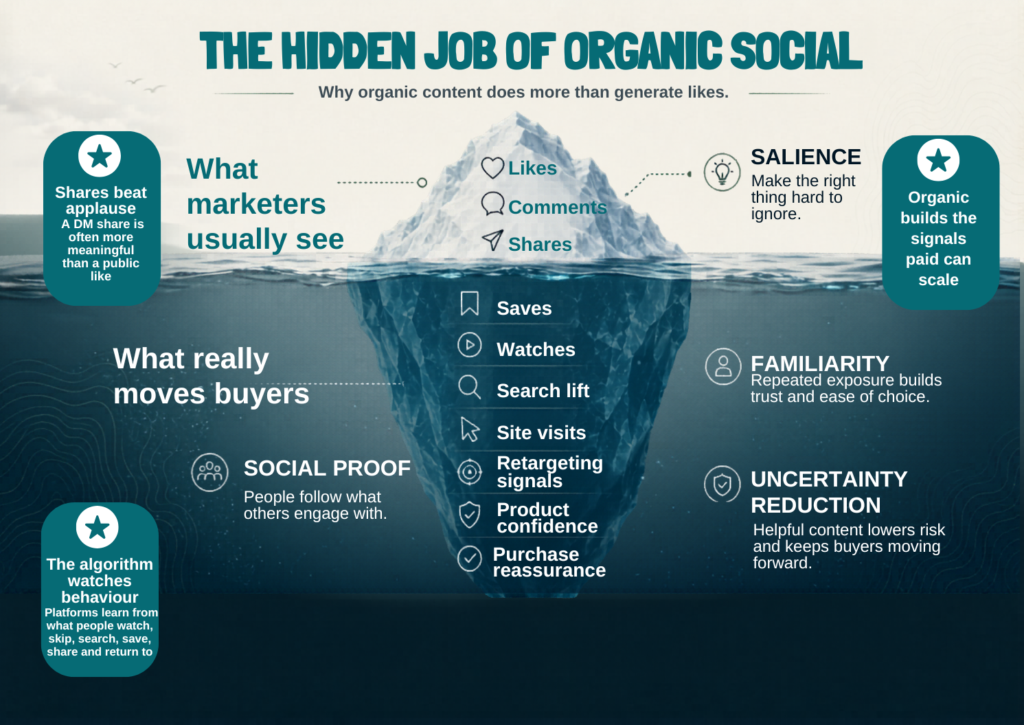
For high-ticket sports brands, organic content often works long before a buyer is ready to purchase. Someone may watch a product demonstration, save a post, visit the website later or recall a useful insight weeks afterwards. None of those actions create spectacular engagement reports, yet they can materially influence future revenue.
Research from Meta consistently shows that consumers exposed to both organic and paid brand activity are more likely to convert than those exposed to paid activity alone. With Motocaddy, content played a critical role in helping buyers understand product benefits and build confidence in their choices. Rather than relying solely on promotional messaging, content educated, demonstrated value and reinforced credibility.
Paid activity was not simply introducing products to a cold audience or amplifying content for the sake of reach. It was doing a more useful commercial job: scaling familiarity where awareness already existed, and building confidence where the brand was entering newer markets. In both cases, the role of paid was to learn from stronger audience signals, reinforce the right product messages and move buyers closer to purchase.
At the core of CJ’s planning is:
“People don’t buy because they understand you. They buy because they feel understood.”
The strongest organic content achieves precisely that. The question is no longer, “Did people like this post?” Instead, marketers should ask:
“Did this content help the right buyer move closer to a decision?”
ROAS is created by the system, not the platform
The Motocaddy programme delivered approximately 6x ROAS. The headline figure is impressive, but the underlying lesson is considerably more valuable.
Success did not come from paid media alone. It came from integrating audience strategy, content, activation and measurement into a coherent commercial framework. Stronger audience signals improved targeting, better targeting increased content relevance, more relevant content improved paid performance and better performance generated cleaner data. Each component reinforced the next.
This creates a fundamentally different conversation from relying solely on platform-reported metrics. For senior marketers, understanding what happened between awareness and purchase is often more valuable than the ROAS figure itself.
The real achievement of the Motocaddy programme was not proving that social could generate sales. It was demonstrating why those sales occurred and identifying which audiences, messages and journeys contributed most effectively to commercial outcomes. When commercial pressure intensifies, that level of insight becomes indispensable.
The smarter system has five parts
For DTC sports brands, the framework is straightforward. The challenge lies in execution, and Motocaddy’s results were built on these principles.
1. Commercial focus
Everything begins with a commercial objective. Too many social programmes start with content calendars and only later consider business outcomes. The stronger approach identifies where social can create measurable commercial value from the outset.
For Motocaddy, activity was aligned to products and opportunities that mattered commercially. Success was measured against revenue outcomes rather than social metrics alone.
2. Audience precision
Audience strategy should be grounded in evidence rather than assumption. The most valuable audiences are identified through behaviour. They may have visited key product pages, engaged with relevant content, purchased similar products or demonstrated signals associated with intent.
This audience-first approach improved efficiency throughout the funnel and ensured activity was focused on people most likely to convert.
3. Confidence-building content
High-consideration products require confidence, and that confidence is rarely built through promotional messaging alone. Buyers need to understand why a product is different, how it performs and whether it suits their needs.
For Motocaddy, content answered those questions directly. Product demonstrations, educational content and proof points helped prospects move from curiosity to consideration. The objective was not attention; it was certainty.
4. Paid activation
Paid media performs best when it amplifies learning rather than simply generating traffic. It becomes a mechanism for testing audiences, validating messaging and identifying the signals most closely linked to conversion.
The Motocaddy programme used paid activity to build upon audience insight and content performance, creating a feedback loop where every campaign generated intelligence for future optimisation.
5. Commercial measurement
Measurement must extend beyond impressions and clicks. The most valuable reporting connects social activity to ecommerce behaviour and commercial outcomes. It reveals where people progressed, where they disengaged and which interactions contributed most significantly to revenue.
This was one of the most important aspects of the Motocaddy programme. By connecting social activity with ecommerce performance and CRM data, we could understand not only what worked but why it worked and where future investment would generate the greatest return. The objective is not better reporting; it is better decision-making.
Growth comes from learning, not just spending
When sales slow, many brands increase activity. Sometimes that works. Sustainable growth, however, comes from understanding what drives performance before increasing investment.
That was one of the most valuable outcomes of the Motocaddy programme. By analysing audience behaviour, content performance and conversion data, the team improved efficiency, reduced waste and made better commercial decisions.
The strongest DTC sports brands approach social in the same way. They use it as a learning system that reveals which audiences demonstrate intent, which messages build confidence and which journeys convert. That is considerably more valuable than reporting higher engagement.
McKinsey’s 2025 Sporting Goods Report describes an industry balancing growth and productivity amid increasing competition. Notably, the two largest incumbent sporting goods brands lost approximately three percentage points of market share between 2019 and 2024, while challenger brands gained ground.
For established brands, social must strengthen preference and accelerate conversion. For challengers, it must build trust and credibility. For every DTC sports marketer, it should protect margin while driving growth.
So what should DTC sports marketers test?
Test whether social can play a more explicit commercial role.
Start with a product or category that matters commercially, then examine the buyer. What questions are they asking? What concerns are preventing purchase? What information would increase confidence?
Build content around those answers, use paid media to reach audiences demonstrating genuine intent and measure behaviour throughout the journey rather than focusing exclusively on top-level metrics.
The Motocaddy programme provides a useful blueprint because it followed precisely that process: a clear objective, a defined audience, confidence-building content and meaningful measurement.
Refine, repeat and scale. That is how social evolves from a marketing expense into a growth engine.
Immediate Future’s DTC sports conversion pilot
We have developed a focused social commerce conversion pilot for DTC sports brands selling high-consideration products.
It is designed for brands across golf, cycling, outdoor, running, fitness and specialist sports retail where buyers require confidence before purchase and businesses require clearer evidence before increasing investment.
The pilot combines strategic planning, audience development, paid social testing and measurement within a single programme. Rather than delivering activity in isolation, it demonstrates how social contributes to commercial performance and identifies where future growth opportunities exist.
The objective is simple: choose the right product, reach the right audience, run a focused social commerce programme and understand what to scale next.
The approach is built on the same principles that helped deliver approximately 6x ROAS for Motocaddy. Because 6x ROAS is not the result of a single tactic; it is what happens when social is built to sell.
Want the pilot overview?
If you are selling high-ticket sports products and looking for a more accountable approach to social commerce, ask us for the DTC Sports Conversion Pilot overview.
Sources
https://www.mckinsey.com/industries/retail/our-insights/sporting-goods-industry-trends
https://www.fashiondive.com/news/mckinsey-sporting-goods-survey-2025/742938/https://www.ispo.com/news-article/sports-business/the-new-sporting-goods-2025-report-revealed-how-brands-can-turn-inactivity-into-opportunity
FAQs on ROAS
High-ticket sports brands can improve ROAS from social media by designing social around buyer behaviour. That means targeting audiences with stronger buying signals, creating content that builds confidence before purchase, using paid social to test and scale high-intent journeys, and measuring what happens from attention to product view, basket and sale. ROAS improves when social, content, paid activation and ecommerce measurement work as one system
What is a good ROAS for high-ticket sports brands?
A good ROAS depends on product margin, price point, sales cycle and media cost. For high-ticket sports equipment, a 6x ROAS is a strong result because the purchase is considered, comparison-heavy and often requires multiple confidence-building touchpoints before conversion.
Why does audience precision matter in sports marketing?
Audience precision matters because category interest is not the same as purchase intent. Someone interested in golf, cycling, running or outdoor activity may not be actively researching or ready to buy. Stronger social performance comes from identifying behaviours that suggest intent, such as product engagement, site visits, product page views, basket activity and repeat content interaction
Why does organic social still matter for DTC sports brands?
Organic social matters because it builds confidence before the buyer is ready to purchase. It can generate useful signals such as saves, watches, searches, site visits and retargeting audiences. For high-ticket sports products, organic content helps buyers understand product value, reduce uncertainty and feel more confident before paid activity asks them to act.
How does paid social support high-ticket sports sales?
Paid social supports high-ticket sports sales by reaching and retargeting audiences with stronger buying signals. It can test messages, reinforce product benefits, build familiarity in established markets and create confidence in newer markets. It works best when connected to content strategy, ecommerce behaviour and commercial measurement.
What should DTC sports brands measure beyond clicks and impressions?
DTC sports brands should measure product views, basket additions, abandoned baskets, completed purchases, basket value, product category performance, repeat visits, retargeting behaviour and ROAS. The most useful reporting explains what changed, why it changed and what the brand should scale next.