


January 26, 2026
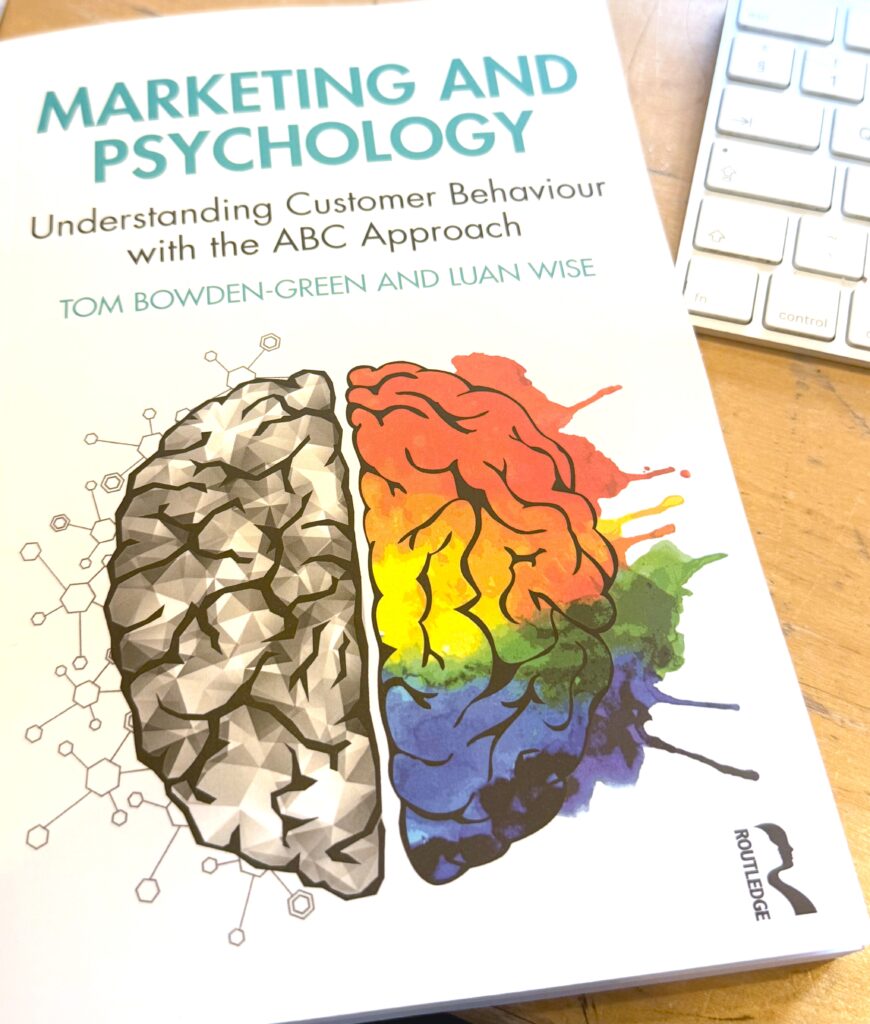
I don’t read a lot of marketing books cover to cover. Most get a flick-through, a speed read (or even a Blinkist), then quietly shelved. But Marketing & Psychology by Dr Tom Bowden-Green and Luan Wise, I read it properly. With a pen. And post-its. And a highlighter.
Because this one’s different. It’s not a rehash of old frameworks. It’s not trying to be clever for the sake of it. It’s proper thinking, grounded in psychology, made usable for marketers like us. You know, the ones actually doing the work.
This book shows its working. You can feel the years of research, teaching, client-side reality, and lived marketing experience that’s gone into it. And it gives you language to explain the stuff you know instinctively, but struggle to articulate in the boardroom.
So here’s my take. My view from the perspective of a social-first strategist who’s been in this game long enough to know what’s bollocks and what’s gold.
The ABC model is simple, but powerful
The whole book is built around the ABC approach:
- Audience
- Brand perception
- Choice evaluation
It sounds simple. It is. But it’s not reductive. What Tom and Luan have done is take the best of academic psychology (the stuff with rigour and dept) and organise it into a structure that mirrors the actual flow of a marketing strategy.
You start with who you’re talking to (and really get to grips with who they are, what drives them, and how they behave). Then you focus on how you show up. The usual, your brand, your messaging, your tone, your design. Then finally, how people make choices, what they remember, what they value, and what tips them over the edge into action.
It’s how we already think, but with sharper tools.
What’s in it for a social media marketer?
Bloody loads.
This book is a goldmine for anyone working in social, content, digital strategy or campaign planning. It takes a sledgehammer to lazy segmentation (“Dave, 42, married, drives a Skoda”) and gives you the behavioural and emotional depth you actually need to write decent briefs.
The sections on personality traits (OCEAN), values, the dark triad, and cultural context? That’s how you build real personas. Ones that tell you how to speak, not just where they live.
The chapters on brand perception dig into how people pay attention (or don’t), how memory works, how emotion drives recall, and why storytelling, humour, and visuals matter more than we often admit. For social, where you’ve got milliseconds to land your point, it’s invaluable.
And the stuff on choice architecture? Genuinely useful. Not manipulative. It helps you design messaging and journeys that work with how people actually make decisions — emotionally, fast, sometimes irrationally — rather than the neat funnel fantasy (yes and i meant to use that Em-Dash).
It’s not full of hacks (and that’s a good thing)
What I love most is that this isn’t another “10 ways to nudge your customer” listicle in disguise. There are no hacks.
It doesn’t assume the customer is stupid. It doesn’t pretend we can manipulate people into doing things they don’t want to do. It’s about understanding what’s going on in their heads and aligning with it.
That’s what good marketing is. Especially in social, where you’re not buying attention, you’re borrowing it.
A few things that really stood out
- The attack on lazy demographic segmentation: Thank god someone finally put it in writing. Just because someone’s 35 doesn’t mean they think, feel, or behave like other 35-year-olds. It’s about psychographics, worldview, and context.
- The realism about how people decide: We don’t weigh up options like a spreadsheet. We rely on gut, memory, familiarity, emotion. And we regret it later if it goes wrong. The book doesn’t shy away from that complexity.
- The application to modern media environments: There are references to digital, mobile, social, influencer culture, subscription behaviours, and online comparison
Should you buy it?
Yes. If you work in marketing, brand, content, strategy or social, this one’s worth your money. It’s not a read-once-and-forget job. It’s a keep-on-your-desk, pull-out-for-a-brief, highlight-and-quote-in-meetings kind of book.
It won’t give you a template to follow. But it will make you a sharper thinker. And that’s rarer, and more valuable, than any hack.
So Luan and Tom: hats off. You’ve made something proper. And I’ll be nicking bits of it for years.