


June 10, 2026
A high-ticket sports brand achieved approximately 6x ROAS. That is a fantastic paid social result. The real story is how it was achieved.
For any DTC marketer, a 6x ROAS result commands attention. For a high-ticket sports brand, where purchase cycles are longer, consideration is higher and buyers are naturally more cautious, it becomes even more noteworthy.
In the blog we published on Monday, CJ explains how a joined-up social commerce approach helped Motocaddy achieve that outcome. The interesting part is not simply the number itself. It is what the number reveals about how premium products are bought and how social contributes to that process.
Too often, exceptional paid social performance is framed as a media story. Better targeting, stronger creative, smarter optimisation. Those things matter, but they are rarely sufficient on their own. Particularly when the product requires a meaningful financial commitment.
People buying premium products do not move cleanly from awareness to purchase. They compare alternatives, seek reassurance, evaluate risk and look for evidence that the investment is justified. They want confidence that they are making the right decision before they commit. The brands that understand this dynamic tend to outperform because they build social strategies around reducing uncertainty rather than simply generating attention.
That is what makes this result valuable. It demonstrates what happens when social is designed to support decision-making rather than merely drive traffic.
There is another important layer underneath this: the data. Results like this are much harder to create, explain and repeat when paid social sits in a separate corner from ecommerce and CRM. When social activity is connected through to purchase and customer data, you can see what happened after the click, not just what happened inside the platform. That is where paid social becomes far more useful commercially, because the business can understand which audiences, messages and buying signals actually turned into revenue.
A result that significantly outperforms the benchmark
The benchmark context makes the achievement even more compelling.
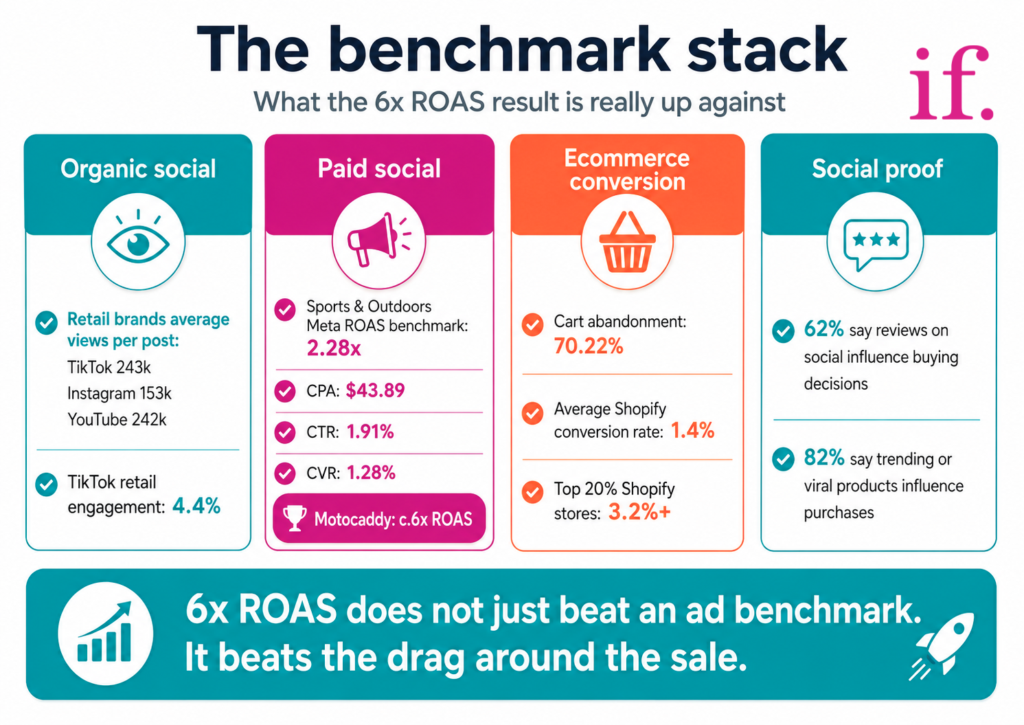
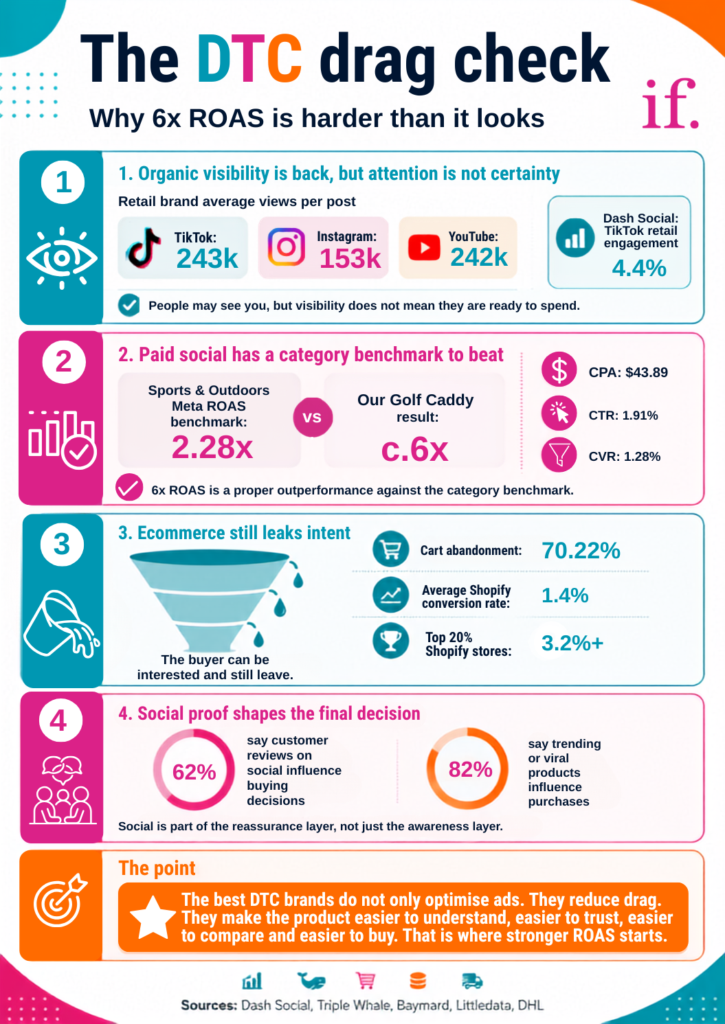
Triple Whale’s 2026 Meta ads benchmark, based on nearly 35,000 brands across 2025, puts median ROAS for Sports & Outdoors at 2.28. The same category reports a median CPA of $43.89, a median CTR of 1.91% and a median conversion rate of 1.28%.
Against that backdrop, approximately 6x ROAS (It was actually 6.18!) is not simply a strong result. It represents a level of performance that materially exceeds category norms.
What makes this particularly relevant is that attention has become increasingly abundant while commercial outcomes remain stubbornly difficult to achieve. Dash Social’s 2026 retail benchmarks show retail brands averaging 243k TikTok views, 153k Instagram views and 242k YouTube views per post, with TikTok leading retail engagement at 4.4%.
The significance of those figures is not that social generates reach. Any experienced marketer already knows that. The more interesting observation is that enormous volumes of attention continue to coexist with relatively modest conversion rates across ecommerce.
The gap between visibility and revenue remains one of the most important strategic challenges facing marketers today.
Generating awareness is rarely the limiting factor. Generating confidence often is.
The brands that consistently outperform understand how social influences decision-making throughout the customer journey and use that understanding to remove friction wherever it appears. At that point, social stops functioning purely as a communications channel and starts operating as a commercial growth mechanism.
Great ROAS is built, not bought
One of the more persistent misconceptions in paid social is that performance can be purchased through media investment alone.
In reality, exceptional performance is usually the outcome of a broader system working effectively.
When buyers are considering a premium product, they are trying to resolve a series of questions before they commit. They want to understand whether the product genuinely fits their needs, whether the premium price is justified, how it compares with alternatives, what existing customers think and whether the brand itself can be trusted.
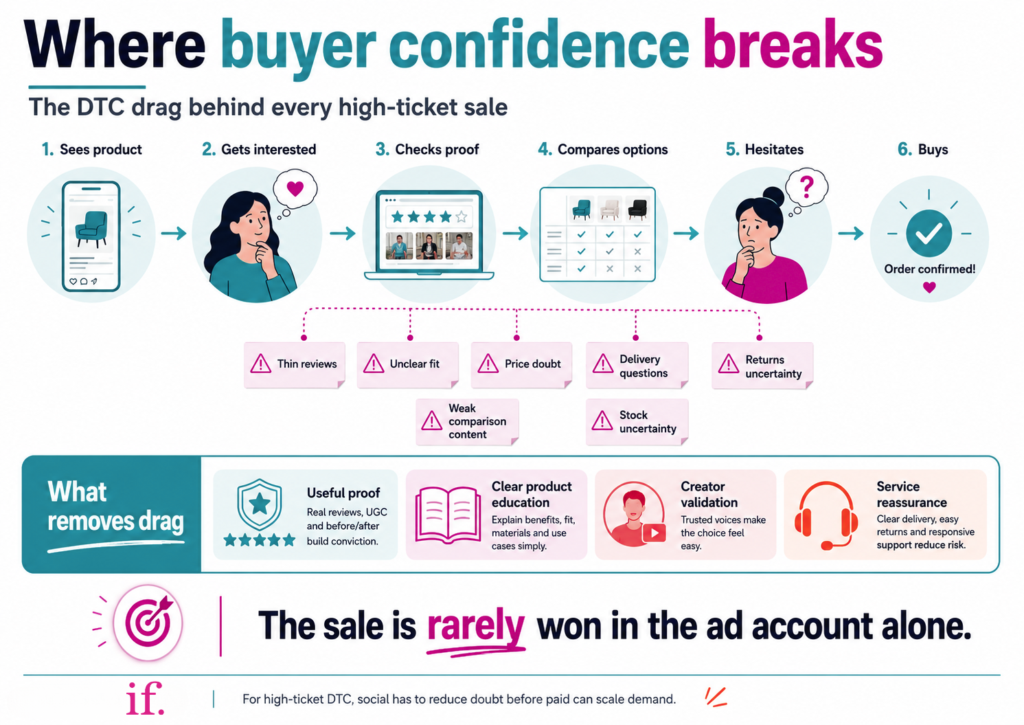
Those questions are not obstacles. They are signals.
They reveal exactly where confidence needs to be built.
The strongest brands answer those questions proactively through content, creative, customer proof and product education. They reduce cognitive effort and make the decision easier. Weaker brands leave buyers to conduct their own research and then wonder why conversion rates remain stubbornly low.
This is why exceptional ROAS is rarely attributable to a single ad. It is usually the result of multiple elements working together: targeting, creative, social proof, product understanding, customer confidence and a buying experience that reinforces rather than undermines trust.
When those components align, performance improves across the entire funnel.
Social is now part of the buying journey
This is where social commerce becomes strategically interesting.
DHL’s 2025 social commerce trends report found that 62% of shoppers say customer reviews on social media influence their buying decisions, while 82% say trending or viral products influence purchases.
The implication is not that every brand should chase virality. The implication is that social has become embedded within the evaluation process itself.
Consumers increasingly use social platforms to validate decisions before they buy. They look for demonstrations, reviews, comparisons, creator opinions and evidence from existing customers. They are not simply discovering products. They are assessing them.
For premium sports, outdoor and specialist retail brands, this matters enormously because these categories naturally involve higher levels of consideration.
Someone evaluating a premium golf trolley, bike, running watch, paddleboard or technical jacket is unlikely to purchase impulsively. They want to understand how the product performs, who it is designed for and whether it genuinely delivers value relative to alternatives. Social content can answer those questions long before a customer reaches the website.
When that confidence-building process happens effectively, conversion becomes significantly easier because much of the decision-making work has already been completed.
Why buyer confidence matters
Even when demand exists, ecommerce remains remarkably inefficient.
Baymard’s 2026 cart abandonment benchmark puts the average documented online shopping cart abandonment rate at 70.22%, based on 50 studies. Littledata’s Shopify benchmark puts average conversion at 1.4%, with stores above 3.2% sitting in the top 20%.
Those figures should remind us that attracting attention is only one part of the challenge. The larger challenge is helping buyers feel sufficiently confident to complete the transaction.
Confidence is rarely created through a single tactic. It emerges from the cumulative effect of multiple signals working together.
| Confidence signal | How it reduces buyer hesitation |
| Product demonstrations | Help buyers understand how the product works in real-world situations |
| Customer reviews | Reduce perceived risk by showing positive experiences from other buyers |
| Comparison content | Simplifies evaluation and helps buyers choose the right option |
| Creator partnerships | Provide third-party validation and increase trust |
| Educational content | Builds understanding and answers common questions |
| Delivery information | Reassures buyers about timing, fulfilment and reliability |
| Service and support messaging | Gives confidence that help is available if needed |
The more of these signals a brand can provide consistently, the easier it becomes for buyers to move from interest to purchase.
Individually, each element contributes something useful. Collectively, they create the conditions under which conversion becomes more likely.
That is often where exceptional ROAS is created.
The question behind the result
The more useful conversation is often about what sits behind the ROAS figure.
A strong result tells you that performance was there. Understanding the factors that drove it—audience readiness, creative effectiveness, buyer confidence and the wider customer journey—helps explain whether that performance can be repeated and scaled.
That is the difference between recording an outcome and understanding the conditions that created it.
Understanding why performance occurred reveals which audiences were genuinely receptive, which content formats reduced uncertainty, which proof points influenced decisions and which parts of the customer journey contributed most strongly to conversion.
Those insights are far more valuable than any individual campaign result because they create the foundation for repeatable growth.
That is why this result deserves attention. Not simply because approximately 6x ROAS is an outstanding outcome, but because it demonstrates what happens when paid social is supported by a broader social commerce strategy built around how people actually make purchasing decisions.
What high-ticket DTC brands should look at next
If you sell premium products, there are three strategic questions worth exploring.
The first is understanding exactly what buyers need to know before they purchase. Comments, reviews, customer service enquiries, search behaviour and product page interactions often reveal where uncertainty exists and where content can have the greatest commercial impact.
The second is assessing the quality of proof your social presence provides. Not the quantity of content being published, but the extent to which that content helps buyers move closer to a decision. Reviews, demonstrations, comparisons, customer stories, creator validation and educational content all contribute to confidence in different ways.
The third is examining what your paid activity is actually amplifying. If paid social primarily promotes offers and discounts, it may generate short-term demand while simultaneously conditioning buyers to wait for incentives. If it amplifies expertise, proof and product understanding, it has a greater chance of creating sustainable performance over time.
That is often where the largest opportunity sits.
The point
Approximately 6x ROAS is an exceptional result, but the lesson is not simply that paid social works.
The more useful lesson is that paid social performs best when it is supported by a broader system that builds confidence throughout the buying journey. The brands that consistently outperform are rarely the ones generating the most attention. They are the ones doing the best job of helping buyers reach a decision.
That is how standout performance is created.
If you sell high-consideration sports, outdoor, fitness or specialist retail products and want to understand how social commerce can drive stronger commercial performance, ask us for the DTC Sports Conversion Pilot overview.
We’ll take a practical look at your customer journey, identify opportunities to strengthen buyer confidence and uncover where social can have the greatest commercial impact.
No giant deck. No social waffle. Just useful.
URLs
https://www.immediatefuture.co.uk/blog
https://www.dashsocial.com/social-media-benchmarks/retail-industry
https://www.dashsocial.com/press-release/2026-social-media-benchmarks
https://www.triplewhale.com/blog/facebook-ads-benchmarks
https://baymard.com/lists/cart-abandonment-rate
https://www.littledata.io/ecommerce-conversion-ratehttps://www.dhl.com/global-en/microsites/ec/ecommerce-insights/insights/reports/2025-social-commerce-trends.html
FAQs on the social system to high ROAS
Motocaddy’s 6.18x ROAS result shows that high-ticket DTC performance is rarely created by paid media alone. Buyers of premium products need reassurance before they purchase. Social commerce can provide that reassurance through product demonstrations, customer reviews, comparison content, creator validation, educational content and clearer service information. When social activity is connected to purchase and CRM data, brands can understand which audiences, messages and proof points are actually driving revenue.
What does 6x ROAS mean?
A 6x ROAS means that for every pound spent on advertising, around six pounds of revenue were generated. In Motocaddy’s case, the result was 6.18x ROAS, which is significantly above the Sports & Outdoors Meta benchmark of 2.28x reported by Triple Whale.
Why is 6x ROAS impressive for a high-ticket DTC brand?
A 6x ROAS is impressive for a high-ticket DTC brand because premium products usually involve longer consideration cycles and more buyer hesitation. People are more likely to compare alternatives, check reviews and seek reassurance before purchasing. Strong performance therefore depends on more than reach. It depends on confidence.
How does social commerce improve paid social performance?
Social commerce improves paid social performance by helping buyers understand, trust and evaluate a product before they purchase. Reviews, demonstrations, creator content, comparison posts and customer proof can reduce uncertainty. Paid social then performs better because it is amplifying confidence, not just attention.
Why does CRM integration matter for paid social?
CRM integration matters because it connects paid social activity to what happens after the click. Without that connection, brands may only see platform metrics such as impressions, clicks and conversions. With social, ecommerce and CRM data connected, brands can understand which audiences, messages and buying signals contribute to actual revenue.
What should high-ticket DTC brands measure beyond ROAS?
High-ticket DTC brands should look beyond ROAS to understand which parts of the journey create buyer confidence. Useful signals include product page behaviour, review engagement, customer service questions, abandoned baskets, creator performance, comparison content engagement, repeat purchase, CRM data and revenue by audience segment.