


February 4, 2026
You already know the truth. The people who talk the most are rarely the people who decide.
The decision is being made by lurkers. The quiet ones who watch three videos, save one, read the comments, check a Reddit thread, then pop a link into a WhatsApp group with “Thoughts?”.
All hail the lurkers, because once you understand them, social gets easier. You stop chasing noise and you start designing for certainty.
And the data backs it all up. Ofcom says Reddit reaches 60% of online adults, and YouTube hits 94% reach with average time spent at 51 minutes a day. That’s a lot of silent research happening in public spaces.
Ofcom also reports AI-supported summaries show up on roughly 30% of keyword searches, and 53% of people often see them. So buyers don’t need to click to form an opinion. They just need enough signal.
If your 2026 plan feels solid but your results feel a bit… well…flat, this is probably the gap. This newsletter gives you a way to spot where lurkers are losing confidence, and how to fix it without turning your team into content-producing numpties.
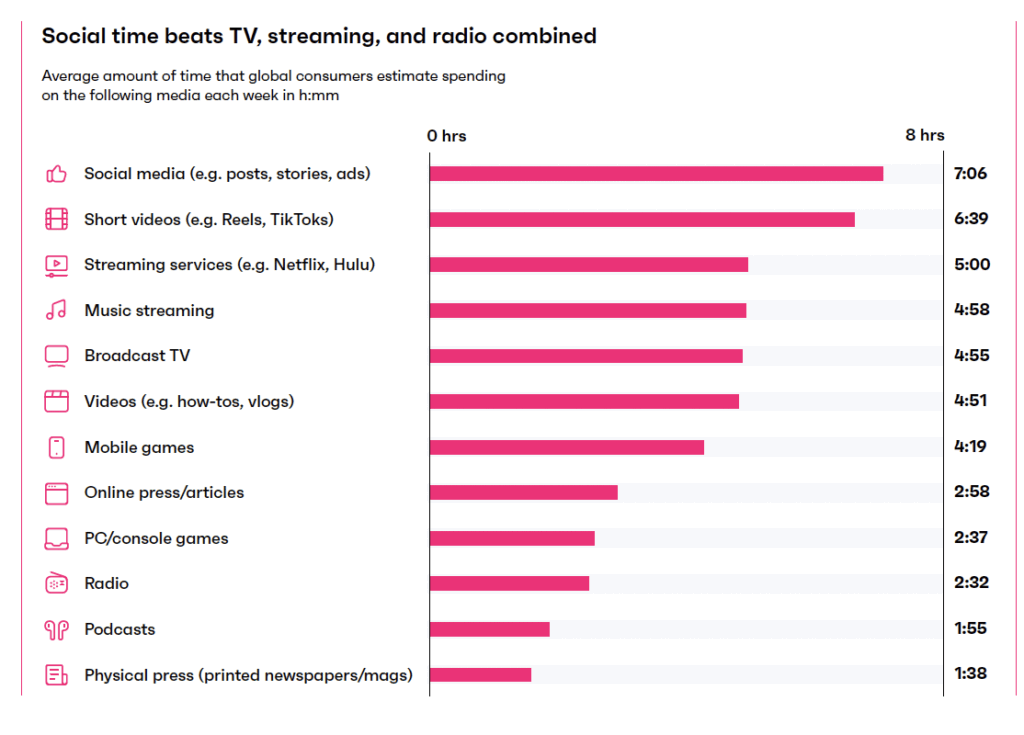
This is what lurkers do best.
They don’t announce themselves. They watch, quietly, then they judge you on whatever they find fastest, one comment thread, one Reddit post, one screenshot someone forwards with “Is this true?”.
If what they see is clear, specific, and consistent, you stay in the running. If it’s waffle, or it changes depending on where they look, you get binned without anyone telling you why.
Someone choosing toothpaste is trying to dodge regret.
Someone buying a cloud platform is trying to dodge risk, blame, and a very long week explaining themselves to a c-suite.
Social is where that judgement gets formed.
Sometimes it stacks up beautifully.
Sometimes it gets absolutely trashed in a comments thread you never even saw.
Why social feels harder
It’s not because people are fickle, or attention spans have magically shrunk again.
It’s because the way they reduce uncertainty has moved.
The click used to be the moment of truth. Now the moment of truth is the quiet check that happens before the click, sometimes without a click at all. A comment thread. A creator reply. A Reddit post from 2021 that still ranks. A screenshot forwarded with “Is this legit?”.
That’s why it feels harder.
Your work is being judged in the margins, in the side quests, in the bits that don’t show up neatly in GA4. The lurkers are doing most of the decision-making with other people’s words, not yours.
And yes, it’s happening at scale. You’ve already seen the Ofcom numbers above; the point is the same. Opinions get formed before the click, and often without one.
So yes, social can feel like more effort for less immediate reward.
But there’s a better way to read it.
Social hasn’t got worse. The job has grown up.
Lurkers don’t reward visibility
Most brands still put their energy into being seen.
Fair enough. If you’re invisible, you’re irrelevant.
But lurkers don’t reward visibility. They reward fewer regrets.
This is classic human behaviour, dressed up in new tech.
We are wired for loss aversion and ambiguity aversion. We hate being wrong in public. We hate wasting money. We hate picking the thing that makes us look like a numpty.
So we do what humans always do when the stakes feel higher than the time we’ve got.
We use shortcuts.
- Social proof. “What are other people saying?”
- Authority. “Is this coming from someone who’s actually done it?”
- Consistency. “Does the story hold together wherever I look?”
And we satisfice. We stop when we’ve got enough to act, not when we’ve read every page on your site.
That’s why the win is happening in the checking, not the seeing.
And it’s why this lurker thing is not some fragile “engagement” chat. It’s a risk-management habit.
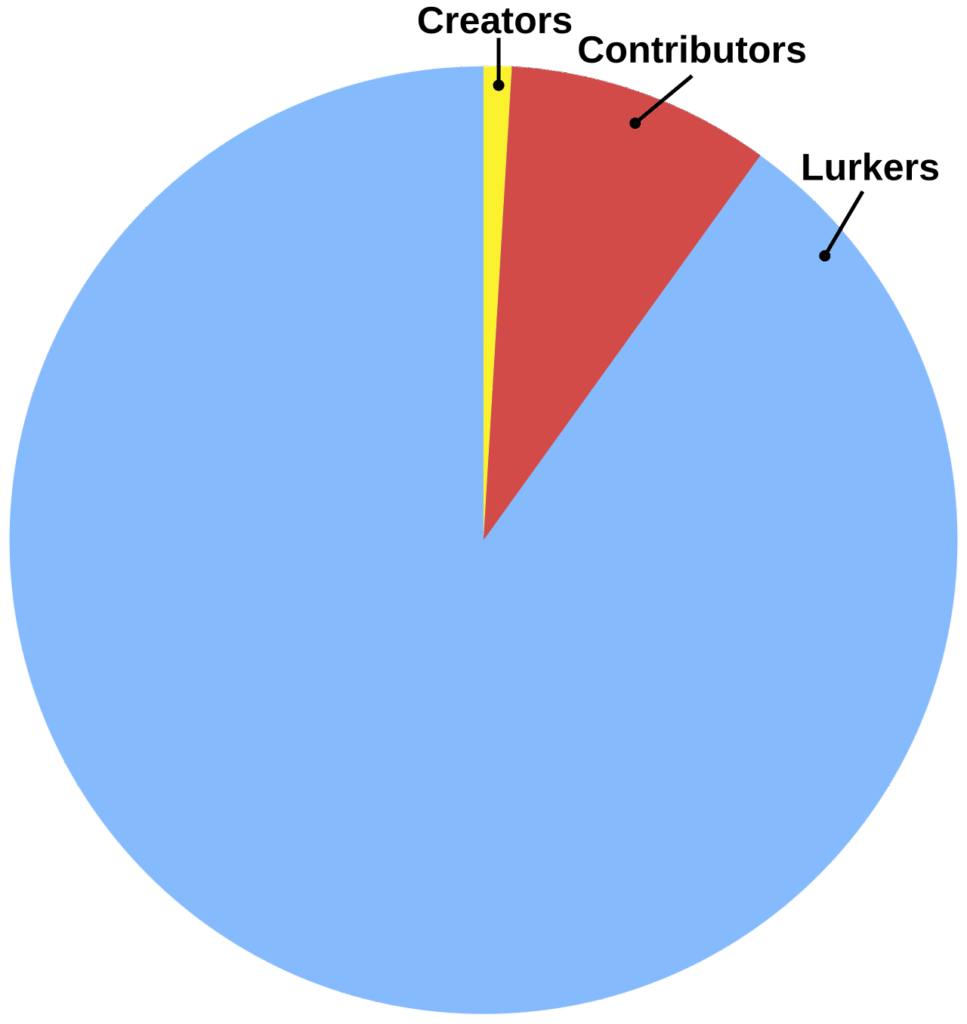
There’s a reason the old participation inequality rule still holds up. Nielsen Norman Group’s 90–9–1 pattern is the simplest way to remember it: roughly 90% of people watch, 9% chip in occasionally, and 1% do most of the talking. So the loud voices are a tiny slice, and the majority are quietly collecting signals, weighing up risk, and deciding without leaving you a single like to prove they were there.
Now layer in answer engines.
Pew’s research on Google’s AI summaries found people clicked a traditional search result in 8% of visits when an AI summary was present, versus 15% when it wasn’t. Links inside the summary were clicked in about 1% of visits. The click is no longer the moment you can rely on for judgement.
So the serious move for 2026 isn’t “post more”. It’s reduce doubt.
Build proof that survives being picked up out of context.
Proof that still makes sense when it’s skimmed, screenshot, forwarded, and discussed by someone who is half distracted and slightly sceptical.
This is why your attention stack matters. Distribution gets you into view. Validation is where you’re weighed up. Evidence is what gets repeated inside the group chat.
Lurkers don’t perform in public
If social feels like harder work for smaller wins, it’s usually because you’re optimising for the wrong behaviour.
Lurkers don’t perform in public. They verify, they compare, then they share privately.
OK, so here is what we think…
First, private sharing is the real distribution layer.
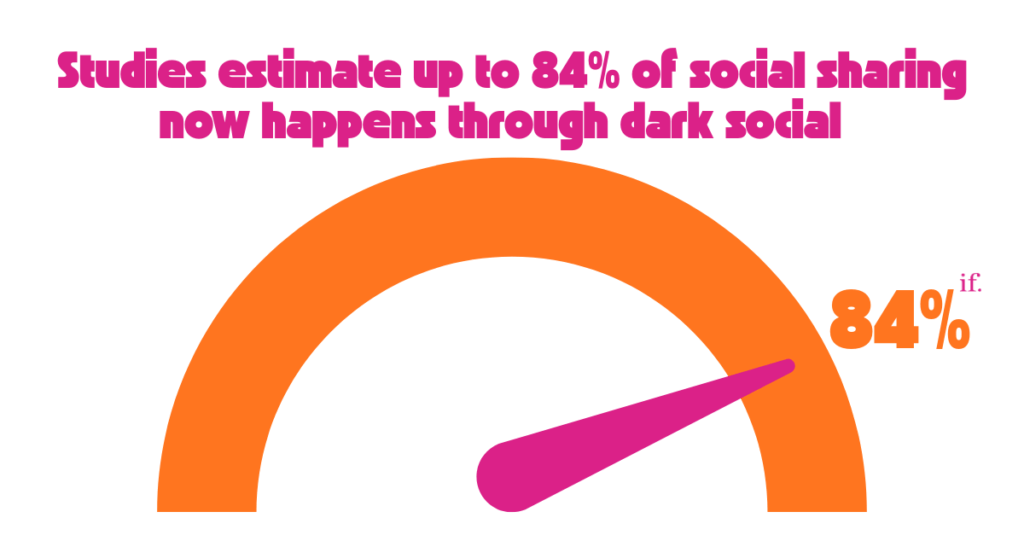
GWI found people are more likely to share content via dark social channels like WhatsApp and Messenger (63%) than on open social platforms (54%), and around 20% say they share only via these private routes. If your strategy relies on public reactions as the proxy for impact, you’re staring at the loudest sliver of the audience while the decisive bit is swapping links in group chats.
Second, “I’ll learn more on the website” isn’t the default behaviour anymore.
Bain’s survey work points to zero-click becoming normal: about 80% of consumers rely on zero-click results in at least 40% of their searches, and they estimate organic web traffic is down 15% to 25% as a result. Meaning gets formed in the wrapper, the snippet, the summary, the social post, the comment thread. The click is now just one possible outcome, not the main event.
Third, trust has got more forensic, because people have been burned.
BrightLocal’s 2025 review survey shows only 42% of consumers trust online reviews as much as personal recommendations, down from 79% in 2020. People still use reviews, they just read them with suspicion. They hunt for patterns, they check dates, they clock the over-keen five stars, and they assume anything too polished is marketing jiggery-pokery.
So I’m not interested in “more content”. That’s busywork.
I’m interested in proof that survives the lurk.
Let’s make this a bit easier then
I’d stop treating “content” as the output.
The output is reduced doubt.
If lurkers are quietly verifying you, you need a system that makes verification easy, and misinterpretation hard.
Here’s the framework I use when I’m trying to turn a busy social programme into something that actually carries weight.
- Repeatable truths.
Pick the few truths you want the market to carry for you, then hold them steady. If your story shifts by platform, lurkers assume you’re slippery. - Portable proof.
Your best evidence needs to survive the lurk. If it lives behind a form, inside a PDF, or only in a sales deck, it won’t travel. - Credible humans.
Believability comes from people, not logos. Employee voice, customer voice, creator voice, partner voice. For trust under scrutiny. - Measurement that matches behaviour.
Stop letting attribution jiggery-pokery be the only scoreboard. Lurker-led impact shows up as saves, sends, branded search lift, share of search, and time to opportunity.
And just to make life easier, here’s the “attention stack” version as a table.
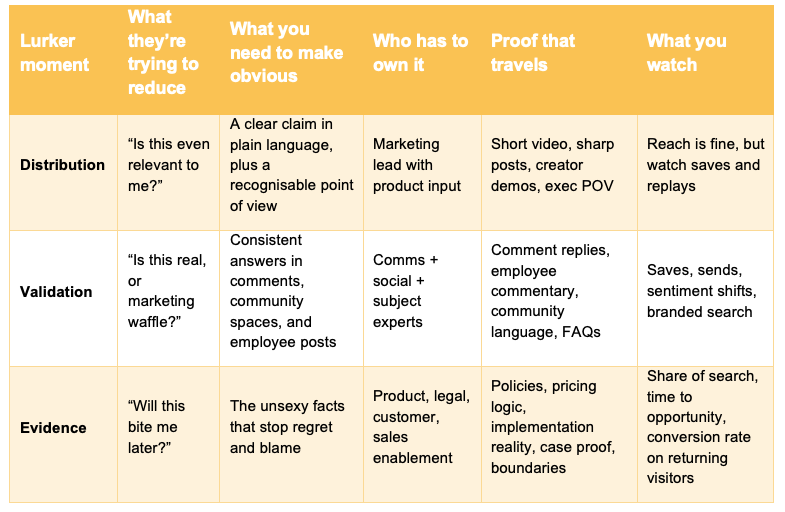
Use the table as a sense-check.
If you’re brilliant at distribution but weak on validation, you’ll feel “seen” and still lose.
If you’ve got evidence but it doesn’t travel, your buyers will rely on someone else’s summary.
If you’ve got humans but no repeatable truths, you’ll create noise, not momentum.
The funnel didn’t die.
It grew a very loud, very public “checking” layer at the front, and social is where most of that checking happens.
That’s the bit people miss when they’re staring at dashboards and wondering why the numbers feel… off. The lurkers didn’t disappear. They just stopped behaving in a way that makes marketers feel in control.
If you build only for neat attribution, you’ll keep feeling like social is expensive and unpredictable. Because you’re grading the work on the bit you can see, not the bit that’s deciding.
If you build for being checked, being repeated, and being believed, social starts doing what it’s meant to do.
It reduces perceived risk. It shortens the “Are we sure?” phase inside the business. It keeps you in the shortlist when nobody is watching.
And yes, it creates demand you can’t always count neatly. Which is, frankly, irritating.
So here’s how I’d use this in a real plan, without turning it into a highfalutin framework exercise.
Make one slide called “What lurkers need to see”, and fill it with three things.
- Repeatable truth. The one line you want buyers to say about you when they’re explaining you to someone else.
- Portable proof. The evidence that survives a screenshot. The boring facts, the boundaries, the outcomes, the policies, the ‘here’s what happens if it goes wrong’ bit.
- Human reassurance. The people who can show up in comments, in communities, in LinkedIn threads, and sound like they’ve done the job.
Then change what you report. Not every week. Just enough that the C-suite stops thinking social is a hobby.
- One line on saves and sends.
- One line on branded search movement.
- One line on time to opportunity.
- One line on what the market is asking in public.
That’s the story lurkers are writing for you anyway. You might as well make it a good one.
If you want to pressure-test yours
If you want to sense-check whether your 2026 plan matches how lurkers actually decide now, we can map your attention stack, find the weak proof, and build a system that makes social work for the business.
We don’t run your social.
We make it work, for growth, reputation, and pipeline.
FAQs on reaching the social media lurker
What is a lurker in marketing terms
Someone who consumes, compares, and decides without visibly engaging. They still influence outcomes because they forward links, repeat claims in meetings, and shortlist suppliers quietly.
Why does social feel harder in 2026
Attention is more passive, discovery is more blended across platforms, and more decisions get shaped through “answer journeys”, feed → check → repeat, without the old click path.
GWI Connecting the Dots 2026
Where do lurkers validate brands
In places that feel human and low-stakes, comments, creators, Reddit threads, reviews, and private messages. They’re looking for consistency and social proof, not brand promise.
What content works for lurkers
Content that makes a claim, shows proof early, and stays consistent across channels. The point is quotability and internal shareability, so the story survives being repeated by someone else.
What should we measure if clicks are down
Signals of decision progress, saves, shares, branded search lift, repeat questions in DMs/comments, sales feedback on “they mentioned X”, and time-to-shortlist movement.