


March 6, 2026
Why B2B marketers are getting influence wrong
If your influence plan is measured in impressions, you’re probably buying noise. ’Cos buyers are building shortlists without you, Forrester says 92% start with one.
So you know how you start planning for lead generation with a list of buyer jobs to be done and pain points. Well this now matters more than anything. Well if you want to be on that list. And let me be clear the job isn’t more content, it’s evidence that lets someone repeat you internally without feeling daft.
And that means more trust, credibility and proof. And the one thing in your B2b armoury that will make this happen is working with influencers.
That’s why I did a LinkedIn Live with Joel Harrison. He’s been digging into the data, I’ve been living the reality in feeds, comments, DMs and dark social. We landed on a point that should be obvious by now and still gets ignored, influence isn’t a content tactic. It’s a trust system.
The moment you treat influence like a media plan, you lose
This is the bit that makes me a bit twitchy. Because what I see, constantly, is marketers using influencer, thought leader, advocate like they’re interchangeable labels. And when you don’t define the role, you default to what you can measure.
“Many teams end up treating influence like a media plan”.
That’s reach, frequency, creator fee, impressions, job done. Except it isn’t. The buyer isn’t trying to be impressed, they’re trying to avoid risk. You know, buyers remorse.
And that’s the proper trust problem. Buyers are suspicious by default.
As I put it
“We look at a claim by a brand and we go, ‘yeah really is it’. Because that is our default setting. I mean, let’s face it, the world is on fire.”
If you want the macro version of why trust feels harder than it used to, Edelman’s Trust Barometer puts the UK general population trust index at 39 which is in the distrust zone. In the same UK report, only 25% say they trust social media for general news and information. That’s the backdrop you’re trying to build credibility inside.
Buyers are shortlisting without you
Buyers are shortlisting in feeds, communities and private chats long before the sales teams even get a look in.
Forrester has found 92% of buyers start with a shortlist and 41% start with just one vendor already in mind. Gartner’s reported 61% of B2B buyers prefer a rep free buying experience. So the early influence layer is doing a lot of your commercial heavy lifting, whether you manage it or not.
Which is why Joel’s framing matters. If buyers are self directing and distrustful, then the people who help them feel confident are your real growth channel.
The data shows we’re over investing in talking, under investing in proof
Joel analysed entries from over 1,000 B2B Marketing Awards campaigns plus the Elevation Awards in the US. The spread is revealing
- 28% used thought leaders
- 25% used unpaid external influencers such as journalists or analysts
- 11% used customer advocates
- 5% used employee advocates
- 4% used paid influencers in the commercial sense
When you look at Joel’s numbers, it makes total sense that B2B leans on thought leaders and independent voices like analysts and journalists. They feel “safe”. They’re respectable. They’re easier to brief. They fit the comms muscle memory most organisations already have. You can control the message, or at least you can pretend you can.
The problem is, safety for the brand is not the same thing as safety for the buyer. Buyers don’t just want smart opinions. They want proof they can borrow. They want lived experience, the boring, specific reality of “this worked”, “this didn’t”, “here’s what implementation actually looked like”, “here’s what went wrong and how we fixed it”. That’s why customer advocates and frontline employee voices matter so much. They carry the proof.
So when I say “we over invest in talking, and under invest in the proof that sits behind the trust”, I mean this. We pump out polished commentary and big claims, but we don’t do enough of the evidence layer that reduces regret. The layer that helps someone justify a choice internally.
Why the B2B matrix of influence is useful
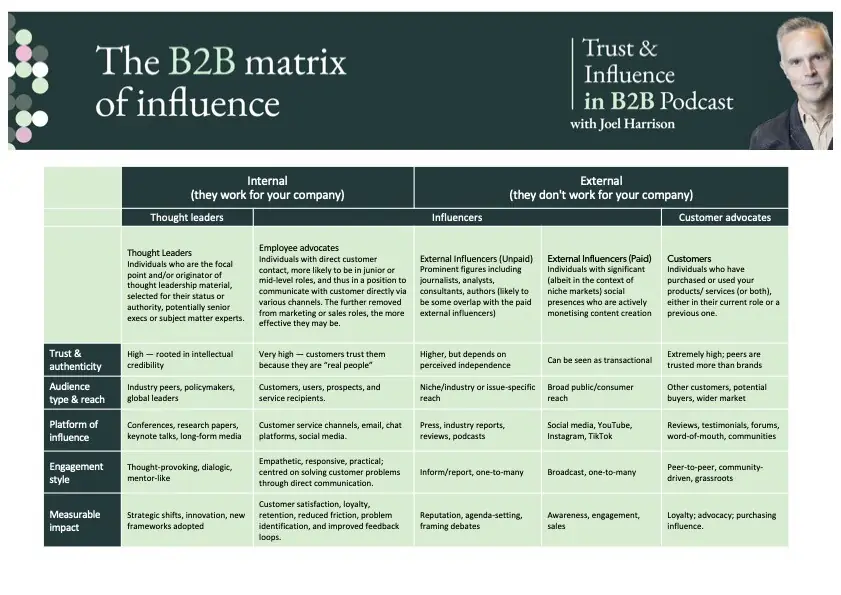
Joel built the B2B matrix of influence because B2B has turned influencer into a catch-all word. It’s made us lazy. We stop thinking, we start buying reach, then we act confused when trust doesn’t move.
The matrix is a one-page map that separates five different types of people brands borrow credibility from. Thought leaders, employee advocates, unpaid external voices like journalists and analysts, paid professional creators, and customer advocates. They aren’t interchangeable, because they earn trust in totally different ways. You can download the full B2B Matrix of influence framework here
It forces the only starting question that matters
How does this person earn trust
Not how many followers have they got
It also stops the endless circular debate about whether influence is internal or external, paid or unpaid, and that muddy middle where everyone’s half-guessing and procurement starts sweating. Once you name the persona, you automatically change how you brief them, what you can control, what you must not control, and what good looks like.
The five personas of influence
Thought leaders
Internal people who originate or front thinking based on expertise, not just seniority. When they’re good, they show their working, they cite proof, and they’re specific enough to be disagreed with.
Evidence helps here. The 2024 Edelman LinkedIn B2B Thought Leadership Impact Report found 73% of decision makers say thought leadership is a more trustworthy basis for assessing a company than marketing materials and product sheets. The sting is that only 15% rate the thought leadership they read as very good or excellent.
So yes, thought leadership dominates because it feels controllable. But quality is the whole game.
Employee advocates
Frontline people who actually see the reality. They know the awkward questions buyers ask and the friction points that kill deals.
They’re underused because organisations get scared of humans sounding human.
I said this on the live and I stand by it
If you script humans, you get corporate ventriloquists. It never works.
When brands over control employees, they either stop posting or they go beige. Neither builds trust.
If you want a simple reach and trust argument for why employee voices matter, LinkedIn has long pointed out that employees have around 10 times more connections than a company has followers, and people are 3 times more likely to trust company information from employees than from the CEO. Yes, that was framed in an employer brand context, but the behavioural truth carries.
Unpaid external influencers
Journalists, analysts, consultants, authors. People whose value is independence.
You don’t activate them. You earn them. Give them access, data, honest answers, and let them keep their integrity.
In the session I said it like this
The good ones, the ones we want to talk to, tend to walk away when they feel that they’re being over controlled.
That’s the deal. Their independence is the product.
Paid or professional influencers
This is where B2B gets weird. Everyone thinks paid equals untrustworthy, and sometimes they’re right.
But there’s a legitimate role for paid creators who educate in a niche, test tools, translate complexity, and build community. Pay for the work, be transparent, keep the independence.
The Edelman LinkedIn report gives you the commercial rationale. High quality thought leadership makes 86% of decision makers more likely to invite a company to participate in an RFP process, and 60% say it makes them willing to pay a premium. If a paid creator is genuinely doing the work of explaining, contextualising and challenging, that’s buying group alignment.
Customer advocates
Lived experience. Proof. The thing most brands say they want, then fail to operationalise.
Only 11% of campaigns in Joel’s analysis used customer advocates. That should make us all mildly ashamed.
It’s also deeply human. Nielsen has reported that recommendations from people you know are among the most trusted sources of advertising. If you want the simplest version of this, customers are hard because you can’t fake them.
Using the matrix without making it a tactics bunfight
This is how I’d explain it to a marketing leader who needs a plan
Start with the job to be done
- Category confidence
- Shortlist credibility
- Deal de risking
- Retention proof
Then choose the persona whose credibility mechanism matches the job.
Then set the rules up front, what’s paid, what’s disclosed, what’s off limits, what’s genuinely open for debate.
Finally, measure signals that look like trust, not applause. On social that’s saves, forwards, quality comments, qualified conversations, and the uplift you see in branded search and sales enablement usage.
Because if you treat every persona the same, you get average results and a lot of awkward conversations.
The thing I want you to take away
You can’t optimise what you refuse to define.
And I’ll say this one more time because it matters
Buyers are shortlisting in feeds, communities and private chats long before the sales teams even get a look in.
So choose the right trust engine, then let credible humans speak like humans.
Sources
Edelman Trust Barometer 2025 UK report
https://www.edelman.co.uk/sites/g/files/aatuss301/files/2025-01/2025%20Edelman%20Trust%20Barometer_UK%20Report.pdf
2024 Edelman LinkedIn B2B Thought Leadership Impact Report
https://www.edelman.com/sites/g/files/aatuss191/files/2024-02/_2024%20Edelman-LinkedIn%20B2B%20Thought%20Leadership%20Impact%20Report%20Final.pdf
Forrester summary of Buyers’ Journey data on shortlist behaviour
https://go.forrester.com/blogs/competition-is-fierce-and-buyers-are-evolving/
Gartner report summary on rep free preference among B2B buyers
https://www.gartner.com/en/newsroom/press-releases/2022-07-12-gartner-identifies-the-top-five-attributes-of-the-new-b2b-buyer
LinkedIn data on employee networks and employee trust (employer branding context)
https://www.linkedin.com/business/talent/blog/talent-acquisition/stats-that-prove-employees-are-your-secret-recruiting-weapon Nielsen trust in advertising overview
https://www.nielsen.com/insights/2015/global-trust-in-advertising-2015/