


May 20, 2026
FMCG brands don’t need more hacks. They need to understand the behaviour behind the feed.
This is my particular bugbear right now. The algorithm is only useful when you understand the people behind the signals.
We get endless tips about timing, hooks, formats, posting frequency and “what the algorithm wants”, as if the platform is a problem to trick rather than a behaviour system to understand.
For FMCG brands, that distinction matters. Social is not just where people notice products. It is where they look for a bit of reassurance, check claims, compare choices, and decide whether your brand is worth choosing when a cheaper alternative is staring at them from the shelf.
So yes, understand the platform mechanics. Of course. But the better question is not “how do we game the algorithm?” It is “what behaviour is the algorithm showing us?”
Let’s pinch a useful framework
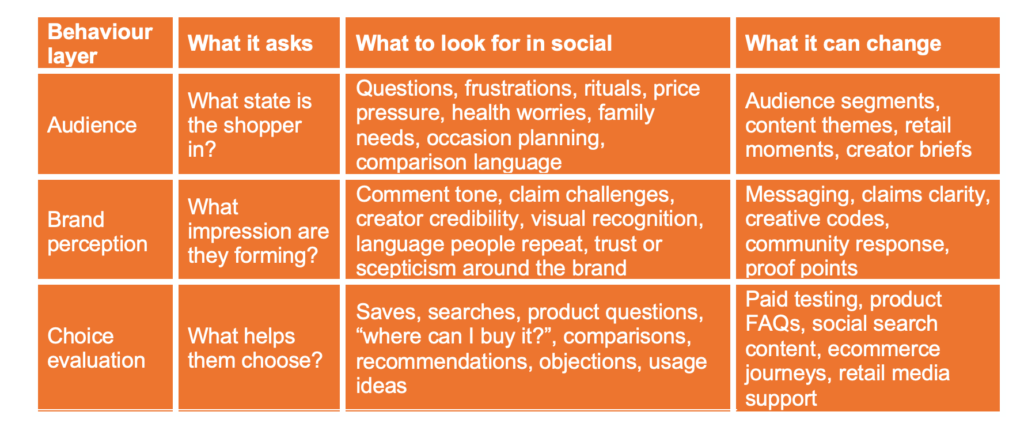
In Marketing & Psychology: Understanding Customer Behaviour in a Digital World, Dr Tom Bowden-Green and Luan Wise use a simple ABC framework for planning: Audience, Brand perception and Choice evaluation. I’m borrowing that structure here, with full credit, because it pulls us away from content tricks and back into how people actually make decisions.
First, there is the audience. What do they care about in that moment? What are they worried about? What are they trying to get done? Are they feeding a family on a tighter budget, looking for a healthier swap, planning a World Cup night in, trying not to poison the dog, or working out whether a beauty claim is worth believing?
Then there is brand perception. What impression are they forming when they see the content, the creator, the comments, the pack shot, the claim, the review, or the brand reply? Do they see quality, warmth, usefulness and trust, or do they see a brand trying too hard to look native while still sounding like a press release?
Then comes choice evaluation. Often underestimated because the product is usually low cost and high frequency. But low price does not mean no decision. People still compare, hesitate, justify, ask others, default to habit, and worry about getting it wrong.
That is the behavioural job of social. It helps people move from “I’ve seen it” to “I trust it enough to choose it”.
The ABC social behaviour readout
The algorithm is reading tiny human decisions
TikTok says its recommendation system is shaped by signals including likes, shares, comments, watch behaviour, skips, content information and user preferences. YouTube says recommendations are designed around understanding viewer behaviour, likes, dislikes, subscriptions and feedback, including satisfaction surveys.
Put simply, platforms are trying to work out what people find relevant enough to watch, continue, act on or come back to.
That should change how FMCG teams talk about social performance. The signals are rarely as simple as “worked” or “didn’t work”. A skipped video might tell you the opening promise was wrong. A saved post might tell you the content has value beyond the scroll. A question about gluten, sugar, ingredients or availability is not just something for community management to tidy up. It is a shopper need showing itself in public.
The same is true further down the journey. If search rises after a creator post, social may have created intent even if the sale happens later in-store. If people are comparing your product to own-label, they are not just chatting. They are weighing value, risk and proof in the language real shoppers actually use.
FMCG choices are small, but they are not simple
FMCG decisions are often low-cost, but they are still shaped by risk, habit and justification.
This is not new to FMCG marketers. You already know the shelf is full of trade-offs. What has changed is how much of that evaluation now happens in social, before the shopper reaches the shelf or adds to basket.
GWI data says 49.3% of UK adult internet users use social media to find product information, and 38.7% use it to learn about brands and their content. eMarketer forecasts UK social commerce sales will reach £11.75bn in 2026, with double-digit growth expected through 2029.
But the more useful point is not that every FMCG brand needs to obsess over social commerce buttons. It is that social is becoming part of the confidence-building stage of the journey.
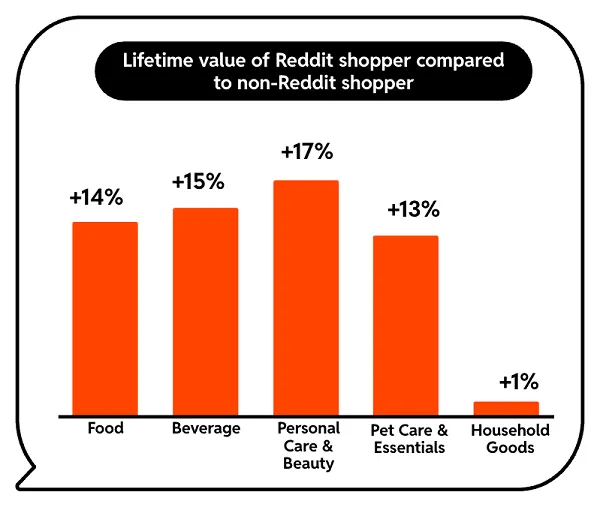
Reddit says there were more than 3.1bn grocery shopping conversations on the platform in six months. It also says 84% of Reddit shoppers feel more confident after researching products there.
That confidence is the important bit. It suggests people are not just browsing or being entertained. They are using social content, comments and communities to make ordinary purchases feel safer, easier or more justified.
For FMCG, that is commercially important. Confidence is often the layer between attention and action. Social can build it, weaken it, or reveal exactly where it is missing.
The planning gap that can be a chasm
A NetInfluencer write-up of Socially Powerful’s FMCG report says 41% of enterprise FMCG marketers say most campaign ideas come from annual or quarterly planning. Only 11% say cultural or social insights drive those ideas. Just 1% say testing and learning in social shapes campaign direction.
Now, I understand why this happens. Big FMCG brands have complex calendars, retail moments, internal stakeholders, and so on.
But if social is where shopper discovery and reassurance are happening, and campaign ideas are still mainly coming from annual planning cycles, there is a gap. And not a cute little gap. The kind you can lose a shopping occasion in.
This is why “social-first” cannot just mean moving more money into influencers or short-form video. Marketing Dive has written about legacy CPG brands trying to crack social-first marketing, including Unilever’s push to commit half of ad spend to social and work with far more creators. That is a big signal, but the harder bit is not the spend shift. It is the operating shift.
If approvals are too slow, creator briefs are too rigid, insights arrive too late, and social data is treated as a reporting appendix rather than a planning input, then the brand may have social-first media money but campaign-first behaviour.
And shoppers do not care about your workflow. Rude, but true.
Mission Foods is built around the shopping mission.
This is where our work with Mission Foods is a useful example, because it shows the difference between using social as a broadcast channel and using it as a behaviour system.
Mission Wraps had secured a new listing in selected Tesco stores. Lovely news, but not a guaranteed win. Shelf space had to be earned. They were up against a rival brand in wraps and flatbreads, own-label products were often cheaper and better placed, and the decision about future Tesco stock would be shaped by sales in those selected stores.
So the challenge was not simply “drive awareness”. It was more precise than that. We had to prime the right shoppers, in the right towns, to recognise Mission, remember the brand, understand the usage occasion, and feel confident enough to seek it out in-store.
That is behaviour, not algorithm.
We used paid social with hyper-local targeting around the selected stores, combining postcode and pin-drop targeting with audience interests around Tesco, food, parenting and relevant affinity brands.
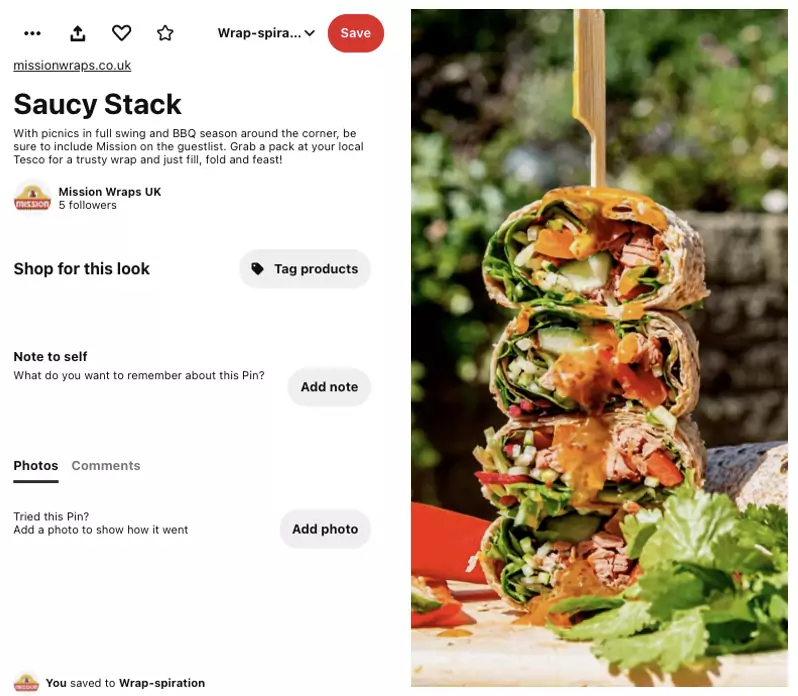
On Pinterest, the keyword work focused on practical shopper language around wraps, tortillas and lunches. The point was not to spray content at a broad food audience. It was to increase mental availability with people who were likely to have a real shopping mission.
The creative choices mattered too. We prioritised product quality, versatility, recipes, serves and UGC because those are the things that help a shopper picture use. Wraps are not just bought as a product. They are bought as an answer to “what can I make quickly?”, “what will the kids eat?”, “what feels a bit different?”, or “what can I add to the list without overthinking it?”
That same behavioural logic sat behind the wider Mission influencer and partnership work. Mission wanted to cut through rising food content and deepen trust with new and existing audiences at a time when consumer trust in UK food brands and retailers had dropped. So we started with shopper missions, used social listening to identify key themes and moments, then worked with micro-influencers and natural brand partners to create credible, useful content that felt rooted in real food occasions.
The role of social was not to make Mission look busy in-feed. It was to make the brand easier to recognise, easier to trust and easier to choose at the point of purchase. That showed up in the results: Mission increased brand advocacy, improved reputation with audiences and partner brands, drove greater product awareness, and exceeded the food-brand Instagram engagement benchmark.
The lesson for FMCG is simple, but easy to lose in the noise: behaviour-led social does not start with “what will get reach?” It starts with “what does the shopper need to believe, remember or feel confident about before they buy?”
Once you know that, the platform choices, creator briefs, targeting, content formats and measurement signals become much sharper. You are not gaming the algorithm. You are giving it better behavioural material to work with.
That is how social becomes commercially useful. It stops being a place where brands perform busyness and starts becoming a system for reducing uncertainty.
What FMCG brands should read in the feed
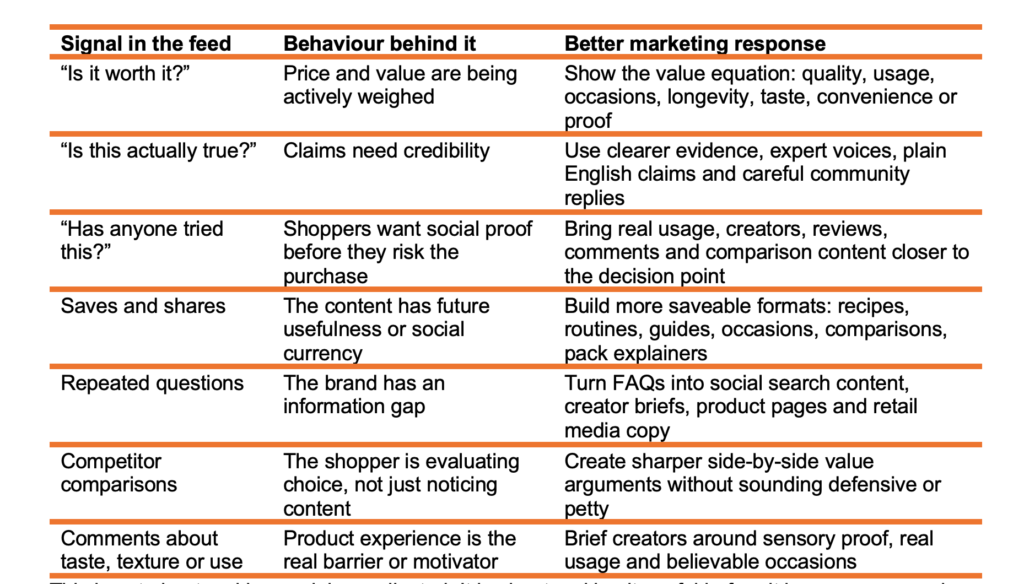
This is not about making social complicated. It is about making it useful before it becomes expensive.
The shelf still matters. Social just gets there first
NIQ’s CMO Outlook says consumers have become more selective as they seek to maximise budgets, placing pressure on brands to balance value, trust and quality. It also says 74% of CMOs are under more scrutiny to prove marketing ROI, while nearly three-quarters of FMCG sales still happen offline.
So no, the supermarket has not quietly disappeared because someone filmed a TikTok.
But the decision is no longer contained by the shelf. NIQ also points to shoppers moving among social platforms, search engines, messaging apps, retail media networks and stores. That is the real FMCG journey now. Messy, public, fragmented and full of little moments where people are either reassured or put off.
Social can shape the list before the shop. That is the commercial job.
Not to win the algorithm. To understand the behaviour it is showing you, then build a social system that makes shoppers more confident to choose.
That is doing better marketing.
If you’re an FMCG brand and you suspect social could be working harder before the shopper reaches the shelf, I’ll take a peek at what’s showing up in your category and give you three practical things you could be doing better.
Just a useful outside view on what shoppers are already telling you, and where social could do more to build confidence, proof and purchase intent.
Drop me a message and I’ll have a look.
FAQs on FMCG social
What does “stop gaming the algorithm” mean for FMCG brands?
It means moving away from short-term tricks around timing, formats and posting frequency, and focusing instead on what shopper behaviour is showing you. Social signals such as saves, comments, searches and product questions reveal what people need to understand before they buy.
Why is social important before the shopper reaches the shelf?
Social helps shape confidence before purchase. Shoppers use platforms, creators, comments and communities to compare products, check claims, find ideas, assess value and ask whether a brand is worth choosing over a familiar or cheaper option.
How can FMCG brands use social behaviour better?
They can track shopper questions, repeated objections, saves, shares, creator comments, comparison language and social search behaviour. These signals can improve content planning, product FAQs, retail media copy, creator briefs, claims clarity and paid social testing.
Are algorithm hacks useful?
Platform mechanics matter, but hacks are not a strategy. Algorithms respond to audience behaviour, so the better question is not “what does the algorithm want?” It is “what is the audience showing us through the algorithm?”
What should FMCG marketers measure beyond engagement?
They should look at confidence signals: saves, product questions, “where can I buy it?” comments, search increases, comparison language, repeat objections, creator credibility, social proof and retail action where measurable.
Sources
- https://www.marketingandpsychology.com
- https://support.tiktok.com/en/using-tiktok/exploring-videos/how-tiktok-recommends-content
- https://www.youtube.com/howyoutubeworks/recommendations
- https://support.google.com/youtube/answer/16533387?hl=en
- https://www.socialmediatoday.com/news/reddit-highlights-rising-opportunities-for-cpg-marketers/820321
- https://www.business.reddit.com/blog/valuable-cpg-shoppers-turn-to-reddit
- https://www.marketingdive.com/news/how-legacy-cpg-brands-can-crack-the-social-first-marketing-code/758651
- https://www.emarketer.com/content/uk-social-commerce-2026
- https://sproutsocial.com/insights/data/impact-of-social-media-marketing
- https://nielseniq.com/global/en/insights/report/2025/cmo-outlook-guide-to-2026